

Introduction
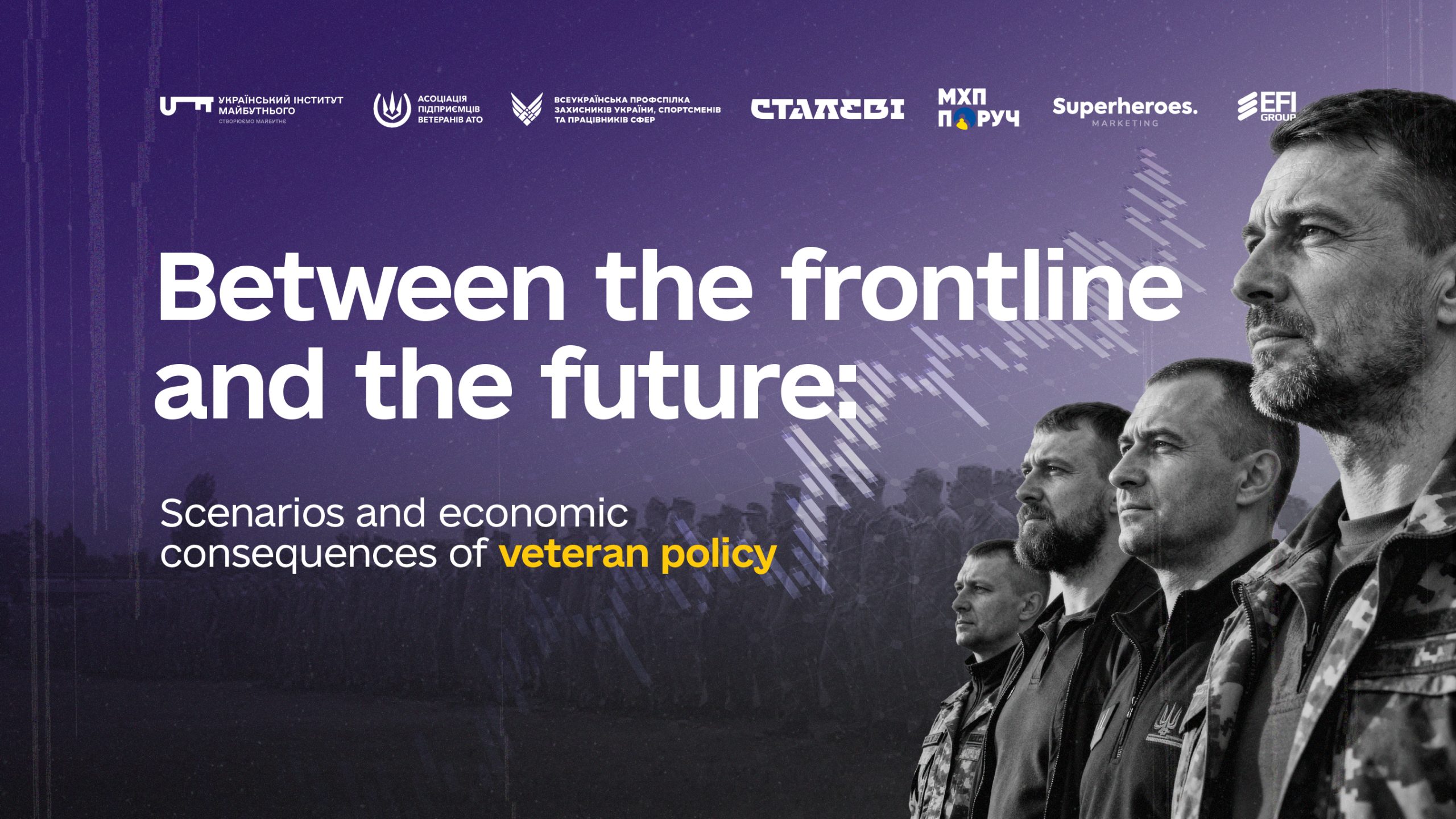
The Ukrainian Institute for the Future, in cooperation with the All-Ukrainian Trade Union of Defenders of Ukraine, Athletes and Workers of Various Sectors, the Association of Entrepreneurs – ATO Veterans, and the “Stalevi” Foundation, with the support of MHP, has completed an extensive study titled “Between the Frontline and the Future: Scenarios and Economic Implications of Veteran Policy.”
Structure of the study
Section I. Abbreviations, terminology, classification, and estimation of the number of veterans in Ukraine. Sociographic profile of a Ukrainian veteran
Section II. International experience in the field of veteran policy
Section III. Current veteran policy in Ukraine
Section IV. Problem statement: challenges and difficulties of reintegrating Ukrainian veterans into civilian life
Section V. Scenario analysis of possible developments in Ukraine
Section VI. Concept of veteran policy
Section VII. Assessment of socio-economic implications under two scenarios
This document presents an abridged version of the report, containing Sections VI and VII.
Objective of the study
To develop recommendations for the government on designing a new, comprehensive, and high-quality veteran reintegration program, and to assess the economic impact of implementing such a policy.
Object of the study
Veteran policy in Ukraine.
The process of reintegrating veterans into civilian life after completing military service in Ukraine, including the analysis of international experience and challenges related to reintegration.
Subject of the study
The conditions, factors, and mechanisms of successful social, economic, and psychological reintegration of veterans.
The socio-economic implications of effective veteran reintegration and the consequences of its absence.
Relevance
As a think tank, we believe that veteran reintegration must be a top priority of state policy for the next 3–5 years. Failure to achieve this will lead to serious socio-economic consequences, such as rising unemployment, social tension, the emergence of isolated veteran groups with their own sense of justice, the creation of conditions for growing criminal activity across the country and particularly in the regions, risks of political destabilization and threats to national security, deterioration in human capital quality, population outflow, demographic crisis, increased pressure on the state budget, and overall economic stagnation in Ukraine.
Activities conducted
- A series of focus groups was conducted with veterans.
- In-depth interviews and anonymous surveys were conducted (≈100 veterans, both men and women).
- Together with veteran community representatives, possible post-war development scenarios for Ukraine were modeled, along with key risks and opportunities identified.
- Interviews were recorded with experts working in the field of veteran support and reintegration.
- A study was conducted to examine the socio-demographic profile of veterans and analyze the primary challenges they face.
- The international experience of veteran reintegration into civilian life was examined.
- Ukraine’s current veteran policy was analyzed.
- Problems were identified across key stakeholders: the state (authorities), society, employers, and veterans themselves.
- A concept of Ukraine’s veteran policy was developed.
- The potential economic effect was assessed under two scenarios (with and without the implementation of the proposed veteran policy concept).
Methodologies
Statistical analysis — processing and analyzing official data from the Ministry of Veterans Affairs of Ukraine, the State Statistics Service, the Pension Fund of Ukraine, the National Bank of Ukraine, and other sources.
Monitoring and analysis of open sources — using public data from international organizations (IOM, UN, etc.), analytical centers, and other institutions.
Comparative analysis — comparing approaches to veteran policy formation and implementation in Ukraine and other countries with established veteran support systems (USA, Canada, the United Kingdom, Israel).
Scenario analysis — modeling possible developments in Ukraine depending on societal readiness for change and state policy towards veterans.
Content analysis — studying legislative acts, government programs, and strategic documents related to veteran policy.
Veteran surveys — an in-house study conducted among Ukrainian veterans to identify their current needs and challenges, and to assess their physical and mental health, as well as psychological, social, and economic adaptation after demobilization.
Focus group interviews — a series of in-depth qualitative discussions with veterans, representatives of veteran communities, and employers.
Main types of sources
- Official Ukrainian data sources (Ministry of Veterans Affairs of Ukraine, State Statistics Service, Pension Fund of Ukraine, National Bank of Ukraine, Cabinet of Ministers, etc.);
- International official sources (Department of Veterans Affairs (US), Office for Veterans’ Affairs (UK), Ministry of Defense of Israel, Government of Canada, etc.);
- Analytical and academic publications (reports by the Ukrainian Veterans Foundation, International Organization for Migration, Corioli Institute, etc.);
- Results of in-house research (surveys, focus groups, interviews);
- Other open sources and media.
Key findings of the study
As of July 2025, the number of Ukrainian veterans reached 1.56 million, of whom 82% are combatants. The number continues to grow, and, according to the Ministry of Veterans Affairs, it may reach 5–6 million, including family members, after the end of active hostilities — representing up to 20% of the national population. We assume that upon cessation or freezing of active combat, 800,000–1 million people could return from the front simultaneously. This will present a new challenge for the state, civil society, and the veterans themselves, necessitating the immediate implementation of an effective reintegration program and societal preparation, which should commence now.
Veteran policy in Ukraine effectively began forming only after 2014, and since 2022, its relevance has increased exponentially. The full-scale war has multiplied the number of service members and, consequently, veterans who need and will continue to need reintegration into civilian life after hostilities end. This requires timely and appropriate state measures. Veteran policy must become one of the government’s main priorities over the next 3–5 years.
Although two strategies in the field of veteran policy were adopted by the end of 2024, actual implementation remains weak. The system lacks coordination, qualified personnel, funding, and a modern vision of reintegration.
Currently, we primarily observe veterans’ dissatisfaction with state policy. Veterans face barriers and difficulties at all stages and in all dimensions of reintegration, from obtaining veteran status and exercising their civil rights to restoring their physical and mental health, achieving psychological adjustment, securing employment, and integrating into the community.
All this creates a risk of marginalization for a significant portion of veterans after the end of hostilities.
Without a systemic approach, the state risks facing social crises — rising unemployment among veterans, growing psychological disorders and physical illnesses, family and community conflicts, increasing crime, and social alienation.
Analysis of international veteran reintegration experience revealed that:
- Many veterans do not seek or use veteran programs or services. Efforts must be made to strengthen their motivation for change and reintegration.
- There should not be too many programs, but they must be simple and easy to understand.
- It is essential to raise awareness among veterans and their families about the available assistance programs, as they may not be aware of or understand the services that the state offers.
- A large number of programs and large-scale funding do not necessarily guarantee that veterans will receive the expected support or have their problems resolved.
Based on the identified challenges and international best practices, the Ukrainian Institute for the Future has developed a concept of veteran policy aimed primarily at:
- Transforming potential risks into opportunities for the economy (and, consequently, for citizens).
- Ensuring a comfortable and effective return of veterans to civilian life, their reintegration, and improved well-being.
- Supporting the adaptation of civilians to new realities — an evolving society where veterans and military personnel, on one side, and civilians without any military experience on the other, coexist and interact daily across various spheres.
The concept includes four areas of implementation:
I. Ensuring access to services, benefits, and veteran status.
II. Ensuring recovery and improvement of veterans’ physical and mental health.
III. Creating conditions for veterans’ economic reintegration.
IV. Creating conditions for veterans’ resocialization.
According to the proposed concept, veteran reintegration policy should focus on creating conditions for a full return to civilian life — through access to services, employment support, entrepreneurship development, institutional capacity building within government bodies, and preparing society itself to accept the new reality and engage daily with veterans. Ukraine has limited time to move from fragmented reactions to a strategic, forward-looking reintegration policy.
Investments in veteran policy are investments in human capital, demographic stability, and economic growth.
As part of the study, we assessed the costs of veteran policy under two scenarios: under the current policy and subject to the implementation of the proposed veteran policy concept.
According to our calculations, the total difference in expenditures on veterans between the two scenarios will amount to only USD 3.7 billion over the next five years. However, in the scenario with effective policy, the funds are transformed into investments in health, employment, and social integration.
Over the next 5 years, an additional USD 200 billion in GDP may be generated, and an additional USD 72 billion in tax revenues may be collected over the same period. Expenditures at the 2% of GDP level each year are capable of generating an additional 3–8% of GDP in revenues, due to the economic benefits of veteran reintegration.
The costs of veteran policy and its effect are incommensurate: relatively modest investments in veteran integration can deliver a multiple increase in economic returns. However, this requires resources that are much harder to secure than money — namely, strong organizational capacity, effective communication, political will, and consistency in working with veterans. Only under these conditions will veteran policy become a driver of development rather than a social burden.
Therefore, veteran policy must become one of the key state priorities in the years to come. Ukraine needs to transition from declarations to systemic action — creating conditions that enable veterans to fully reintegrate into civilian life, supporting employment, fostering entrepreneurship, and promoting an inclusive environment. Only with political will, organizational capacity, and societal readiness can veteran policy become a driving force for the country’s development rather than a social burden.


