Digests • 15 July 2025

15 July 2025
Published
Monthly Energy Digest – June 2025
The relatively cold weather in June resulted in a relatively low level of power demand. The power system remained balanced in June and operated in a relatively normal mode. There were no capacity shortages, and customers were not restricted in their power supply.
Three nuclear power units remained offline for maintenance, while hydropower production stayed low due to water shortages. The hydropower plants mainly supplied electricity to meet the daily peak demands of the power system. Instead, electricity generation from thermal power plants and combined heat and power plants remains high to compensate for this drop, along with renewable electricity generation, which has been increasing due to favorable weather.
Electricity imports continued to play a vital role in balancing power demand and ensuring the smooth operation of the power system during night peak hours. However, due to the factors mentioned above, the capacity shortage decreased, reducing the need for imported electricity. As a result, the volume of imported electricity remained almost unchanged, while exports increased during the month.
In June, power transmission system operator Ukrenergo reported a minimal risk of introducing power outage schedules during the summer, even on peak consumption days. At the beginning of the year, analysts expressed concern that in July and August, the power deficit would exceed electricity import capacities, necessitating demand restrictions. No large-scale attacks on the power system were reported in 2025, a contrast to last year. Renovations of power generation and transmission facilities, which were damaged earlier, and the installation of new power generation facilities, along with a scheduled maintenance plan, allowed for potentially avoiding power supply restrictions in the summer. This expectation is valid only in the absence of massive attacks on Ukraine’s power system.
Power supply restrictions have become a very sensitive issue because they have often been misused for misinformation in recent years. That is why the government tries to avoid scheduled power cuts. A likely scenario for the summer is that TSO may limit power supply to industrial and commercial customers to prevent cutting off supply to households. Undoubtedly, new attacks on energy facilities could change the situation.
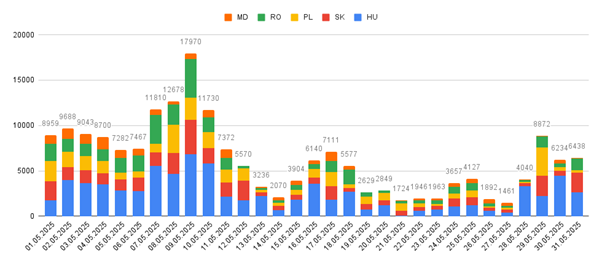
Daily volumes of electricity imports by countries of origin in April, MWh
(The chart is based on ENTSO-E data)
In June 2025, Ukraine increased electricity exports by 2.5 times compared to May, reaching over 237,000 MWh. Exports rose in all five neighboring European countries, with Hungary experiencing the largest increase from 34 to 122,000 MWh. Fifty-two percent of the exported electricity went to Hungary, while the remaining volume was nearly equally distributed among Romania, Slovakia, and Moldova.
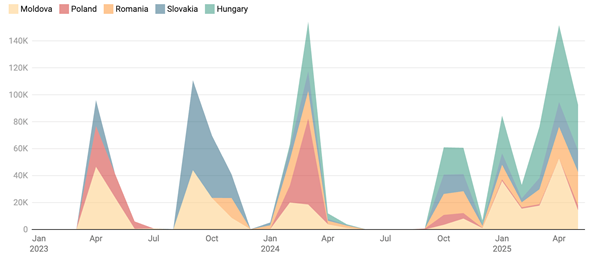
Electricity export, per month, 2023-2025, MWh
(ENTSO-E data, visualization by ExPro agency)
Imports increased by only 5% compared to May, reaching 203.8 thousand MWh. Deliveries from Hungary and Slovakia went up, while other destinations—Poland, Romania, Moldova—decreased. 43% of the imported electricity came from Hungary, 24% from Slovakia, 14.7% from Poland, 14.4% from Romania, and nearly 6% from Moldova.
Compared to June 2024, electricity imports decreased by more than four times. And there was no electricity export a year ago, as the Ukrainian power system suffered from massive Russian attacks with power supply restrictions for customers.
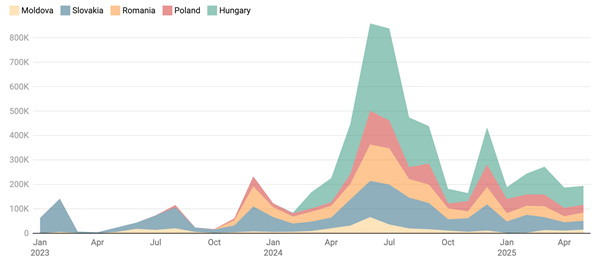
Electricity import, per month, 2023-2025, MWh
(ENTSO-E data, visualization by ExPro agency)
The transmission system operators of Ukraine, Slovakia, Hungary, and Romania have agreed to implement a medium-term (monthly) joint, coordinated allocation of cross-border power transmission capacity at the Ukrainian borders, using the electronic auction platform, Joint Allocation Office (JAO).
Ukrenergo has announced the start of public consultations on the project Harmonized Allocation Rules (HAR) for long-term transmission rights, as well as draft applications for the UA-SK, UA-HU, and UA-RO borders. Legislation requires drafts to be published on Ukrenergo’s website to receive comments and suggestions.
The long-term auctions will offer an opportunity to utilize the relevant cross-border transmission capacities more effectively, minimize or optimize electricity costs, and provide more supply guarantees and predictability.
Currently, yearly auctions are held only for bilateral trade with Moldova and for exports to Poland. Monthly auctions occur for bilateral trade with Moldova and Romania, as well as for exports to Poland.
Besides, the energy regulator approved agreements between Ukrainian and Moldovan power transmission system operators. The allocation of Ukraine-Moldova cross-border power transmission capacity for each direction is determined by Ukrenergo, in coordination with Moldova’s TSO, and is agreed upon as follows: 35% for annual auctions, 35% for monthly auctions, 35% for daily auctions, and 30% for intraday auctions. The distribution of interzonal capacity at intraday auctions is conducted using Ukrenergo’s auction platform.
In 2025, the trend toward settlements with renewable energy (RES) electricity producers continued to improve. Now the Guaranteed Buyer pays for the electricity produced in 2025 to a full extent. The highest debt was recorded in September 2024 with UAH 35.7 billion. In early June, the amount was UAH 23.3 billion. The settlement rates for electricity produced are as follows: 99.8% for 2021, 63.2% for 2022, 98.5% for 2023, 89% for 2024, and 86% for 2025.
The debt of Ukrenergo to the participants of the balancing market has decreased to UAH 15 billion. At the same time, market participants owe Ukrenergo UAH 38 billion. In early February, these debts were UAH 17,5 billion and UAH 35 billion, respectively. “Protected customers”, who are prohibited from being disconnected from the power supply in case of non-payment, are a key reason for the growing debt to Ukrenergo. These mainly include state-owned companies and utilities, such as water supply companies.
Debts are the key obstacle for building new capacities when the Ukrainian power system suffers from capacity shortages and faces the risk of damaging capacities with new Russian strikes. According to the transmission system operator Ukrenergo, during the upcoming ten years, the Ukrainian power system will need to commission 2.2 GW of shunting generation and 1.5 GW of energy storage systems.
The charter of the transmission system operator Ukrenergo was updated. The Energy Ministry stated that the amendments were made to strengthen the state’s control over the state-owned transmission system operator. According to the changes, the strategic plans of Ukrenergo, investment programs, and the chairman of the board must be coordinated with state representatives. This will occur through the mandatory participation of a state representative in approving the development plans of the transmission system for the next 10 years, endorsing the investment programs of the electricity transmission licensee, and appointing the chairman of the company’s board. Now, to pass decisions of approving a ten-year development plan, at least five members of the supervisory board should participate in the vote, with at least three representing the state (the board consists of 4 independent members and three state representatives).
The updated charter defines the supervisory board’s obligation to conduct a competitive selection for the chairman of the board within 90 days of the previous chairman’s date of dismissal.
The changes also specify a revised approach for the supervisory board’s vote to appoint the chair and members of the executive board. The vote to appoint the chair of the board needs five members of the board to participate in the voting, including three representatives of the state. The minimum number of votes for the candidate is five. If the vote is unsuccessful within 10 days, another vote is held under the same rules. If the second vote is unsuccessful, a third vote should be held within 5 days. At the third vote, five votes for the candidates are necessary for a successful outcome, regardless of how many state representatives vote for the candidate. If the third vote is unsuccessful, a new competition for the chair of the board should be announced.
Initially, the energy ministry intended to change the rules for appointing the CEO to make it dependent on the positions of the supervisory board members representing the state. However, in fact, the new rule contradicts this intention. Earlier, the European Bank for Reconstruction and Development sent a letter to the energy ministry, emphasizing its right to halt the selection of loan funds and demand early repayment of the already granted loan, in case of the government’s tripartite selection of a new CEO through amending the charter. However, the updated voting procedure is a compromise. And the conflict is settled.
On June 23, Ukrenergo’s supervisory board appointed the company’s chief dispatcher as the new CEO. All seven members of the supervisory board voted in favor of Zaychenko. Zaychenko is experienced, and his candidacy suited both donors and the energy ministry.
In June, daily natural gas consumption ranged from 20 to 27 million cubic meters. Imports ranged from 15 to 19.5 million cubic meters. This enabled the daily injection of 38 to 50 million cubic meters into storage facilities. Gas was imported from Hungary, Poland, and Slovakia.
In June, Ukrainian companies added 1.35 bcm of natural gas to storage. This injection was 1.8 times higher than in June last year (0.74 billion cubic meters) and 23% more than in May 2025 (1.1 billion cubic meters).
Most of the injected gas, 810 million cubic meters or 60%, is produced domestically. Meanwhile, 540 million cubic meters or 40%, comes from imports and is stored. In June, Ukraine’s gas imports rose by 8% from May, marking the highest monthly import volume in nearly two years, since September 2023.
By the end of June, total gas storage in facilities exceeded 8 billion cubic meters. This is 19.6% or 1.95 bcm less than last year, marking the lowest level in at least 11 years. However, the gap compared to last year is decreasing, and for the first time since this year’s pumping season began in mid-April, the backlog from last year has fallen below 20%.
On June 18, natural gas prices in the Ukrainian commercial market segment (excluding gas
supplies under PSO mode) rose sharply to over 26,000 – 26,583 UAH per thousand cubic meters (excluding VAT), or $626-640 per thousand cubic meters, or €51.1-52.3 per MWh. So gas price in Ukraine hit a record high in 2,5 years.
On one hand, this was driven by rising gas prices in Europe, and the Ukrainian market depends on imports. On the other hand, prices were pressured when the government extended the Public Service Obligation in late March, requiring UkrNafta to sell its gas to specific groups of customers at a lower price. As a result, decreased supply of domestically produced gas put pressure on the market and prices.
On June 20, 2025, Naftogaz received the Final Decision of the International Arbitration in Zurich regarding Gazprom’s termination of payments for the transit of Russian gas through Ukraine from May 2022. The Swiss arbitration court issued a final decision, siding fully with Naftogaz and ordering Gazprom to pay $1.37 billion in favor of Naftogaz. The transit contract was concluded on the principles of take or pay. This amount includes the principal debt for gas transit services in accordance with the 2019 agreement, fines and compensation for all legal costs incurred.
Naftogaz immediately sent a payment demand to Gazprom. However, most likely this will be done through seizing the company’s assets and additional trials.
On June 18, the parliament postponed fines for the absence of 5% bioethanol in fuel until 2026. The primary reason was the shortage of this type of fuel in Europe during a period of high demand, which made it impossible to meet Ukraine’s import needs. Most EU member states have a standard of 10% biocomponent in gasoline (E10), so Europe’s capacity to produce E5 is limited. Additionally, earlier Russian attacks destroyed Ukrainian facilities that produce bioethanol. The government was informed about the situation, and, along with the market, they reached a compromise: the fines were lifted, but the biogasoline law remains in effect.
The Supreme Court of Ukraine confirmed the legality of the forced alienation of PJSC TFPNK UkrTatNafta shares under martial law. On June 5, 2025, the Court rejected the cassation appeal from Relix Services Ltd. The decisions of the lower courts regarding the refusal to satisfy the claim remained unchanged.
The court confirmed that the forced withdrawal of UkrTatNafta shares occurred on legal grounds, in accordance with the decision of the military command dated November 6, 2022, and the provisions of the Law of Ukraine on the Transfer, Compulsory Alienation, or Seizure of Property in the Context of the Legal Regime of Martial Law or State of Emergency. The court recognized that the alienation of the corporate rights of PJSC Ukrnafta and PJSC TFPNK UkrTatNafta was a necessary measure to ensure the defense capabilities, stability of Ukraine’s fuel market, and the safety of citizens amid a full-scale war.
The Ministry of Justice noted that this case is among many where companies connected to the former owners of strategically important enterprises are appealing the state’s actions to expropriate shares: as of June 2025, there are 15 similar cases in Ukrainian courts. In all these cases, the claims have been rejected. Additionally, the Supreme Court has issued final judgments in 14 court cases.
Since the memorandum on financing the restoration of energy infrastructure damaged by Russian attacks was signed in June 2024, the National Bank of Ukraine reports that banks have financed nearly UAH 25 billion to fund these projects.
Throughout the year, banks issued 1,879 business loans totaling UAH 23.7 billion and approved 8,622 household loans worth UAH 1.3 billion. In June, the energy loan volume reached a peak of UAH 5.5 billion. Consequently, the gross portfolio of such loans to legal entities, after repayments on June 25, was UAH 14.9 billion, while loans to individuals stood at UAH 1 billion. By June 25, the total financed generation capacity through business loans exceeded 705 MW, including 320 MW of storage. These projects are spread across 21 regions of the country.
Most likely, these loans were issued for small projects, such as rooftop solar power plants.


Together we can change the future! Your support allows us to continue our research and provide objective analysis of key social issues. Join us today to build the future of our generations together.
Support