

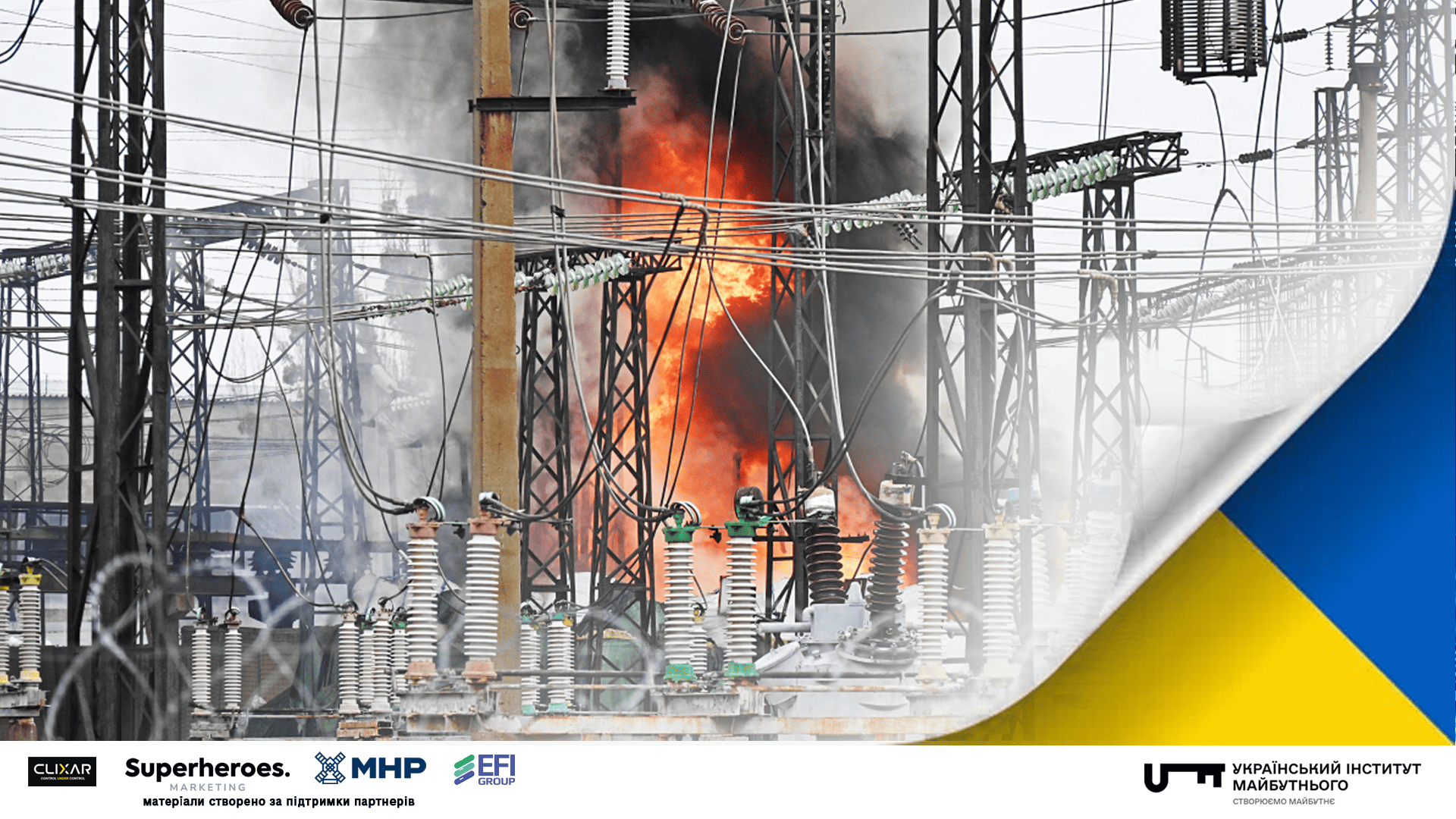
Since the beginning of the full-scale war, Ukraine’s energy sector has undergone profound transformations. Despite major shocks, including disconnection from the Russian energy system and immense damage caused by massive enemy attacks, Ukraine’s energy infrastructure has endured. The issue of its restoration is particularly urgent, as the uninterrupted operation of various industries depends on the stable functioning of the energy system.
Living in a “country of generators” is not only inconvenient but also expensive, prompting experts to consider different scenarios for launching the recovery process of Ukraine’s energy infrastructure. Special attention has been given to green energy as a way to offset domestic shortages and establish partnerships with European countries.
Doctor of Technical Sciences, Professor, and Chairman of the Board of the Ukrainian Association of Renewable Energy, Stanislav Ihnatyev, shared how the resilience of Ukraine’s power grid to attacks by the Russian Federation can be improved and how to minimize risks for consumers.
Current State of Ukraine’s Energy Sector
Ukraine’s energy sector is based on the principles of centralized electricity generation and includes nuclear, thermal, and hydroelectric power plants. Unfortunately, since October 2022, more than 50% of Ukraine’s energy facilities have suffered massive damage due to Russian attacks, which highlighted the vulnerabilities of our energy system.
This knowledge can become an invaluable foundation for its restoration and adaptation to current challenges. We have already begun building a distributed generation system, with renewable energy being one of its key components.
The year 2023 proved to be a turning point: 42.8% of generation capacity was destroyed, which encouraged domestic businesses to take responsibility for their own operations and begin constructing distributed generation systems to meet their own needs.
Already in 2024, we reached nearly 1 GW of installed distributed generation capacity, of which 587.22 MW are solar power plants built exclusively on shopping centers, industrial facilities, and logistics terminals.
Four Future Scenarios
The evolution of Ukraine’s energy system is complicated by war, political risks, technical limitations, and a lack of investment, leading to the emergence of different scenarios for its recovery.
- Optimistic scenario: If the Russian Federation ceases attacks on Ukraine’s energy system and gas distribution infrastructure, and if Ukraine manages to regain control of the Zaporizhzhia Nuclear Power Plant, the city of Enerhodar, and the surrounding infrastructure, then the focus will only need to be on repairing the damage.
- Environmental scenario: Ukraine moves toward decarbonization, i.e., transitioning to more environmentally friendly energy sources. According to Stanislav Ihnatyev, we will be able to create an energy mix with a gradual replacement of thermal generation capacities with distributed, localized green generation.
- Pessimistic scenario: Over the next 3–5 years, we will have to periodically operate in “generator country” mode until new capacities are built.
- Fatal scenario: If Russian attacks on key elements of the national energy infrastructure are successful, Ukraine will fragment into “energy islands.” Currently, this is the situation in the Kharkiv, Chernivtsi, and Ivano-Frankivsk regions, and Odesa and the Odesa region could potentially become an “energy island” as well.
Reality manifests in the form of constraints and challenges that can undermine even the most carefully devised plan. To ensure the reliability of Ukraine’s energy system, it is crucial to consider current challenges and seek the best solutions.
The Role of Green Energy
According to Stanislav Ihnatyev, green energy appeared in Ukraine even before the implementation of the green tariff. Before the Verkhovna Rada adopted the Law on Stimulating Green Energy Generation on September 25, 2008, we had localized projects related to solar generation and two wind farms operating with wind turbines in Crimea.
“The green tariff gave a significant push, but when it was adopted, it became a closed club for two major players,” the expert noted in an interview on the “KSPA Media” channel, referring to an economic-political group and DTEK.
In 2017, when active business participants slightly reformed this law, a true boom in green energy began. Two years later, Ukraine entered the top 10 countries in the world regarding green energy generation growth rates.
The expert noted that initially when issuing technical conditions for large volumes, a serious mistake was made: “Whoever wanted it paid for the connection.” Fortunately, Ukrenergo corrected this error in 2020, ultimately allowing Ukraine to secure an honorable place among the top five European countries in solar generation growth.
What is the current state of green energy in Ukraine?
- In 2024, compared to 2023, the volume of energy generated from alternative sources increased by 11%, which is a reasonably high indicator.
- Zakarpattia and Chernivtsi regions produce more electricity during the summer hours than they physically consume.
- Kherson, Donetsk, and Zaporizhzhia regions are the leaders in wind generation. All wind farms are located in temporarily occupied territories.
Significant volumes of natural energy generation may pose technical challenges due to massive overproduction. It becomes profitable for all electricity producers from alternative sources to operate on the market, meaning our market prices gradually align with those in Europe.
Stanislav Ihnatiev shared that due to the war, the implementation of a project allowing private producers or their associations with a capacity of over 100 MW to build private interconnectors at a 110 kV voltage level has been postponed.
Energy Storage Systems (Storages)
Given that a sufficient amount of energy is generated from alternative sources, which guarantees its origin and the absence of destruction of the energy system, we can export part of the energy to neighboring countries during summer. This is a good opportunity to build partnerships with Europeans, whose development of alternative energy generation is not progressing as rapidly (for example, the Poles, Hungarians, and Romanians).
How can we manage the surplus of green energy? “We have the option of storage — energy storage systems,” notes Stanislav Ihnatiev. According to various statements from “Ukrenergo,” our energy system currently needs about 2 GW of storage capacity.
The implementation of storage systems is progressing very slowly: they are very expensive, raise questions about safety and insurance, and have a long payback period. Over the past 4 years, storage costs have decreased by four times: from 1 million euros per MW to 250 thousand euros per MW.
For example, Stanislav Ihnatiev cited the company “OKKO” in the Lviv region, which commissioned the first 20 MW storage facility to provide system balancing services.
Owners of solar power plants benefit from storage systems, as they offer an opportunity to increase profits and reduce responsibility for imbalances. Experts advise them to find a trader who can profitably sell the electricity generated at the plant.
Conclusions
The model of the Ukrainian energy system was built back in the Soviet Union, so the transition to a new direction requires radical changes and significant investments in the grid. Despite existing problems and shelling from the Russian Federation, we should turn to renewable energy.
Experts estimate the cost of restoring all of our energy generation and replacing destroyed capacities at nearly 44 billion US dollars, which is twice the revenue part of the pre-war budget. Stanislav Ihnatiev emphasized that in times when the lion’s share of the budget is allocated to defense and military expenditures, the budget may not withstand additional financing for green generation projects.
So, how can we stimulate foreign investors? Considering that all European financial institutions support decarbonization processes (reducing CO₂ emissions), the focus should be on green energy generation. Its advantages are clear: it is cheaper, builds quickly, can be more distributed, and Ukraine has many qualified specialists and companies to implement this type of project.
Green generation is our “lucky” ticket to the European Union, as in this way, Ukraine will demonstrate that it shares Western values and can benefit from partnership collaboration. A gradual transition to this energy system model will ensure full coverage of our own needs and, under favorable conditions, establish the export of part of the energy to neighboring countries.
Sources:
- Ihnatiev S.V. “Restoration of Ukrainian Energy: Options and Scenarios.” SQ, 28.02.2025.
- Interview with Stanislav Ihnatiev on the YouTube channel “KSPA Media.”


