

Stanislav Ihnatiev,
Doctor of Technical Sciences, Professor at the National University “Poltava Polytechnic named after Yuri Kondratyuk”, Head of the Department of Scientific and Technical Supervision of Operation and Development of UGS of the “Gas Transportation Institute” branch of JSC “Ukrtransgaz”, Honorary Professor of the European University of Continuing Education (Slovak Republic), Associate Expert of the Ukrainian Institute for the Future.
On February 3, U.S. President Donald Trump stated that he wants to conclude an agreement with Ukraine to provide assistance in exchange for guarantees of access to rare earth metals. Currently, active discussions are ongoing regarding the demand from the United States for the transfer of Ukrainian mineral resources worth $300 billion. I believe that the proposal from the United States presents a unique opportunity for Ukraine to effectively develop its mineral resources, create new jobs, replenish the state budget, and develop related businesses that add value to raw materials. However, I strongly hope that we will allocate most of our deposits under an adequate production sharing agreement and negotiate the localization of a large percentage of related extraction enterprises and technologies within Ukraine. What are production sharing agreements in the context of subsoil use, what successful cases exist, and what prospects the country has? These questions will be addressed in this publication.
What is a Production Sharing Agreement?
A production sharing agreement (PSA) is a special type of contract for establishing a joint venture. Typically, a PSA is a contract for the distribution of natural resources concluded between a foreign extraction company (contractor) and a state enterprise (public party), authorizing the contractor to carry out exploration and extraction operations within a specified area (contractual territory) in accordance with the terms of the agreement.
The essence of a PSA lies in the fact that one party (the state) entrusts the other party (the investor) with conducting exploration, prospecting, and extraction of minerals within a specified area (or areas) of subsoil over an agreed period and carrying out related work under the agreement, while the investor is obligated to perform the assigned work at its own expense and risk, with subsequent cost reimbursement and remuneration in the form of a share of profitable production. The parties to the agreement are the investor and the government or local self-government body within whose territory the respective subsoil area is located. The agreement may involve several investors, provided they bear joint responsibility for the obligations stipulated by the agreement. By its legal nature, a PSA is a complex investment contract that safeguards both civil-law (private) and administrative (public-law) relations.
Although the concept of production sharing was first applied in Bolivia in the early 1950s, the first PSA in its modern sense was signed in August 1966 in Indonesia.
Successful Case of Production Sharing Agreement: Tengizchevroil
A relevant example of PSA utilization is the Republic of Kazakhstan, specifically the Tengiz field and the joint venture “Tengizchevroil”, which has been a budget-forming enterprise of Kazakhstan for almost 30 years, evolving into a world-class petrochemical cluster and generating the development of related Kazakh businesses worth billions of dollars.
The oil reserves of the Tengiz and Korolev fields, developed under a PSA, amount to 1.4 billion tons (11.5 billion barrels). Tengiz is the world’s deepest supergiant oil field, with the top oil-bearing reservoir located at a depth of approximately 4,000 meters. The Tengiz reservoir stretches 21 kilometers (13 miles) in length and 20 kilometers (12 miles) in width, with an oil-bearing layer height of 1.6 kilometers.
In the PSA of Tengizchevroil LLC, the following entities participate with their respective shares:
- State company “KazMunayGas” — 20%
- Transnational company “Chevron” — 50%
- Subsidiary of ExxonMobil Corporation “ExxonMobil Kazakhstan” — 25%
- Russian private oil company “Lukoil” — 5%
Direct payments to the state budget of the Republic of Kazakhstan in 2024 amounted to $11 billion per year, and since the start of the PSA (signed in 1993), they have totaled $201 billion.
Production Sharing Agreement – the Case of Ukraine
The text of the Production Sharing Agreement between Ukraine and Shell Corporation was actively discussed at the highest expert platforms. Experts agreed that the Production Sharing Agreement (PSA) has several advantages compared to special permits for subsoil use.
Firstly, PSAs have a longer duration – 50 years compared to five to seven years for special permits.
Secondly, within the framework of a PSA, it is possible to obtain the right to conduct exploration and production over significantly larger areas than a regular special permit. The law even prescribes an algorithm that combines several special permits into one site.
Thirdly, a so-called legal freeze applies to investors participating in a PSA. This means that the investor can rely solely on the regulatory framework that was in force when concluding the agreement. Therefore, if the parliament suddenly revises the corporate income tax or VAT upward, these changes will not affect the agreement participants. However, if legislative changes beneficial to the investor are adopted, they will be applicable.
Fourthly, hydrocarbons extracted within the framework of a PSA are not subject to price regulation like domestically produced oil or gas. This means that neither the operating company to be established – “Shell Exploration and Production Ukraine Investments (IV) B.V.” – nor the participants of LLC “Nadra Yuzivska” will face price restrictions. In other words, all hydrocarbons extracted within the PSA will be sold at a free market price rather than at the price of domestically produced gas.
Another pleasant bonus is that the potential export of hydrocarbons will not fall under existing restrictions. As is known, according to Cabinet of Ministers Resolution No. 1201 dated December 19, 2012, “On Approving the Lists of Goods Whose Export and Import Are Subject to Licensing,” a zero quota for the export of Ukrainian oil was established. The gas quota is determined according to the forecasted annual balance of resource inflows and distribution, approved by the government. All companies have the right to export gas or oil extracted within the PSA if it proves commercially viable.
Fifthly, none of the parties to the agreement are subject to restrictions on foreign currency proceeds obtained within the framework of the agreement. Since November 15, 2012, the Law of Ukraine, “On Amending Certain Legislative Acts Regarding the Expansion of Instruments of Influence on the Monetary and Credit Market” has been in force. This document required external economic activity entities to sell half of their foreign currency proceeds within 90 days.
The PSA stipulates equal shares of the participants: “Shell Exploration and Production Ukraine Investments (IV) B.V.” – 50%, LLC “Nadra Yuzivska” – 50%.
Fundamental concepts include compensatory and profit production. For instance, if hydrocarbon extraction starts at the Yuzivska site, the first stage involves compensating the parties’ expenses through production. This is called compensatory production. The maximum amount of compensatory production specified in the agreement is 65%. This means that from the first million cubic meters of gas, distribution will not follow the principle of 50/50. From the million cubic meters, 650 thousand cubic meters will be deducted and given to the investor as compensation. The remaining 350 thousand cubic meters will be divided between the parties based on the so-called R-factor calculation.
The formula itself looks as follows:
R = (X + Y) / Z, where:
X is the value of compensatory hydrocarbon production accumulated from the first reporting period until December 31 of the contract year preceding the R-factor calculation date. In other words, the value of all hydrocarbons is intended to compensate the investors’ exploration and development costs from the beginning of the agreement.
Y is the value of the investor’s share in profit hydrocarbon production after taxation, accumulated from the first reporting period to December 31 of the contract year. Simply put, it is the value of all hydrocarbons the investor received as profit after paying all taxes since the start of the agreement.
Z is the total cost of conducting oil and gas activities from the beginning of the agreement.
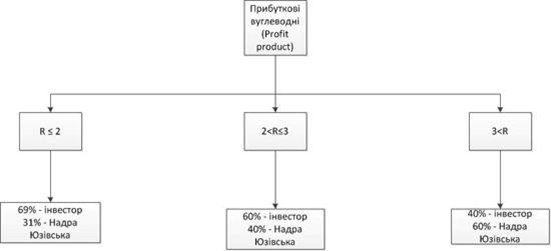
The agreement specifies three key R-factor values that affect the distribution of profit production (Figure 1).
Figure 1 – R-Factor Values Affecting Profit Production Distribution
Calculating the R-factor using this formula means that until the investors fully recoup their exploration and production costs and receive an equivalent amount as profit (excluding taxes), the state’s share will remain minimal at 31%.
Assuming that the hypothetical value of one thousand cubic meters of gas is 100 USD, the distribution of these funds would look as follows (Figure 2). Since production will start after January 1, 2014, VAT and income tax rates are set at 17% and 16%, respectively.
Figure 2 – Profit Distribution Under the Production Sharing Agreement
Thus, after dividing these thousand cubic meters into compensatory and profit portions, the latter will amount to 35 USD. Of this amount, the state will receive 10 USD in product and 9 USD through taxes. The actual state share in profit production will be around 53%, although the calculated R-factor share is only 39%.
After fully compensating investors’ expenses from the start of the agreement, changes will occur when they receive an equivalent amount as profit (excluding taxes). At this stage, the formal share of “Nadra Yuzivska” will increase to 40%.
In reality, considering withheld taxes, the state’s share will be slightly less than 60%. According to calculations, at a gas price of 100 USD per thousand cubic meters, the state will receive approximately 58 USD, while the investor will receive less than 40 USD. When the investor’s profit exceeds 200%, the formal share of “Nadra Yuzivska” will rise to 60% (Figure 3).
Figure 3 – Formation of the Investor’s Share in the Production Sharing Agreement
There may also be concerns regarding unconventional hydrocarbons expected to be produced under the PSA. The balance of expenses and profits in developing conventional hydrocarbons from the beginning of exploration looks approximately like this. In the case of unconventional gas deposits, production is associated with the need to drill more wells, which is not cheap at high depths. Although unconventional wells can be drilled using cluster methods, they are depleted faster.
Therefore, there is a risk that the expenses marked in red will be higher and more evenly spread over time, while the black profit columns will be lower, with a steeper decline.
In other words, drilling expenses may be higher compared to conventional methods and more evenly distributed throughout the entire period of site operation. The profits from wells will be lower due to a shorter lifespan and productivity.
This is where two identified disadvantages of the Ukrainian model may converge: the inflexibility of the R-factor and the increased need for drilling new wells. As a result, the R-factor may remain in the lower range (below 2) for several decades, prolonging the time needed to compensate the investor’s expenses.
Challenges and Opportunities for Ukraine from the Production Sharing Agreement with the USA
The rare earth elements (REE) mentioned in the agreement proposed by the USA include 17 elements from the periodic table: Sc (scandium), Y (yttrium), La (lanthanum), Ce (cerium), Pr (praseodymium), Nd (neodymium), Pm (promethium), Sm (samarium), Eu (europium), Gd (gadolinium), Tb (terbium), Dy (dysprosium), Ho (holmium), Er (erbium), Tm (thulium), Yb (ytterbium), and Lu (lutetium).
People encounter these rare earth elements daily, as they are found in phones, electric vehicles, and solar panels. REEs are used to create coatings inside fluorescent lamps that are responsible for the light color emitted. These elements are essential for optics, lasers, the aviation industry, nuclear reactors, and even chemical catalysts for oil refining. They are also crucial for the military industry.
Currently, China is the world’s monopoly supplier of rare earth elements, having long dumped prices to hinder competitors, including Ukraine. Following the trade war with the USA, China announced it would stop selling rare earth elements, prompting countries, including the USA, to seek independent sources. Apart from China, rare earth element deposits are located in Australia, Russia, Brazil, Greenland, Canada, Vietnam, and recently discovered large reserves in Norway (10% of global reserves). The localization of Ukraine’s rare earth metal license areas is shown in Figure 4.
Geologically, Ukraine possesses a mineral treasure in the form of the Ukrainian crystalline shield, which is rich in valuable minerals, and the Donetsk-Dnieper depression with hydrocarbon deposits.
Structurally, Ukraine can be divided into the Ukrainian crystalline shield, the Donetsk folded area, and the Black Sea depression. The crystalline shield contains minerals, both metals and metalloids, while the depressions are rich in hydrocarbons such as coal, gas, and oil. The folded area holds both hydrocarbons and metals.
Ukraine’s controlled territory has relatively few rare earth metals, while the Russian-occupied Azov region is rich in rare and rare earth metals (Figure 5). Industrial extraction prospects are significant there, such as the Mazurivske deposit of rare and rare earth metals: zirconium, hafnium, niobium, and tantalum. The Mazurivske nepheline syenite deposit, consisting of subparallel veins with high rare mineral content, used to serve as the industrial base for the Donetsk Chemical-Metallurgical Plant. Geologists regarded it as a benchmark deposit. In general, the entire Azov region is a valuable resource for rare and rare earth metals since the Azov platform is situated in the southeastern megablock of the Ukrainian shield. However, Mazurivka (Volnovakha) is currently under Russian occupation.
Figure 4 – Location of rare earth metal license areas in Ukraine
Figure 5 – Occurrence of rare earth metal deposits in Ukraine
In the past, these resources were not in demand due to outdated technology, and their development remains unrealistic due to the occupation. However, there is a possibility that Russia will exploit these natural resources using Donbas’s controlled industrial assets. Additionally, Ukraine possesses vast reserves of tight sandstone gas, colloquially known as shale gas.
What else makes Ukraine resource-attractive to the USA? Experts highlight several directions:
- Uranium mining.
- Titanium mining.
- Graphite and germanium – metalloids.
- Lithium – alkali metal.
- Zirconium – transition metal.
Nevertheless, combined resources are unlikely to offset the USA’s aid costs to Ukraine, as their extraction is expensive and technologically challenging. Additionally, coal accounts for nearly half of the estimated $10 trillion worth of Ukrainian natural resources, which the USA does not need due to the destruction of most thermal power plants (92% of installed capacity). Geographically, nearly half of the natural resource deposits are occupied. Only through a highly ambitious project of “recycling the Ukrainian shield” into its mineral components could revenues reach several hundred billion dollars, although the cost of such “recycling” would likely exceed the revenue.
Currently, what Ukraine has quick access to are iron and manganese ore reserves. These resources are controlled by Ukrainian oligarchs and transcontinental companies. About 5-7% of the Poltava Mining and Processing Plant (known for the highest quality iron ore) already belongs to the American company Blake Rock.


