Digests • 15 August 2025
Monthly Energy Digest – July 2025
On July 17, as part of forming a new government, Parliament voted for Svitlana Grynchuk to become Ukraine’s new Minister of Energy. She replaced Herman Galushchenko in this role, who became Minister of Justice. Before her appointment, starting from September 2024, Grynchuk served as Minister for Environment Protection. Before that, she was Galushchenko’s deputy for a year in the energy ministry.
The priorities highlighted by the new minister include preparing for the heating season, restoring energy infrastructure based on sustainability principles, pursuing a “green” transition and decarbonization, creating a strategic equipment reserve, developing a new decentralized energy system, and integrating it with the EU.
Ministerial reshuffles may signal changes in priorities and the willingness to implement them. Grynchuk dismissed two deputies who served in Galushchenko’s cabinet and appointed new personnel. Artem Nekrasov, acting director of the SE Guaranteed Buyer, has been appointed as the first deputy Minister of Energy of Ukraine. Nekrasov has made notable efforts to reduce debts to renewable power producers. He advocated for the development of small wind power, which can be deployed relatively quickly to address the capacity gap.
Additionally, some associations of renewable energy producers, who strongly supported Nekrasov, lobbied for his appointment as deputy. The appointment of Nekrasov highlights Grynchuk’s priorities as a minister, specifically emphasizing the development of renewables and distributed generation. Olga Yukhymchuk, Grynchuk’s deputy responsible for European integration at the Ministry of Ecology, has transitioned to the same role at the Ministry of Energy.
At the same time, the minister supported completing the power units at Khmelnytsky NPP. She confirmed an upcoming meeting with the Bulgarian Minister of Energy, where they will discuss further bilateral steps to finish the power units.
On July 8, an official review of Ukrainian laws for compliance with European Union energy regulations started in Brussels. This represents a key step in Ukraine’s EU accession process and will influence upcoming actions to align with the EU acquis under Chapters 15 Energy and 21 Trans-European Networks. Government officials and representatives from energy companies discussed progress in implementing EU rules in areas such as energy efficiency, the gas market, energy security, renewable energy, and trans-European energy grids. European Commission representatives highlighted Ukraine’s significant progress in gas, electricity, market design, and strengthening institutional capacity, thanks to long-term support from the EU.
The power system operated in a relatively normal mode. Some nuclear power units were still under maintenance, and hydro power production remained low due to water shortages. Renewable energy generation was high. Power demand increased compared to June because of higher air temperatures. Thermal power plants and electricity imports played a key role in balancing demand, and customers were not restricted. In June, Ukraine became a net electricity exporter for the first time in many months. In July, net electricity exports slightly decreased.
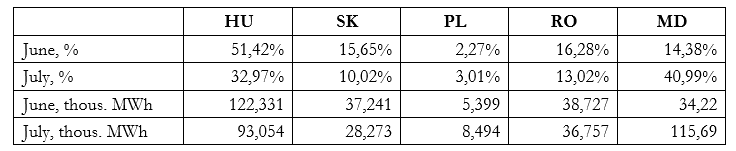
In July 2025, Ukraine increased electricity exports by 16%, compared to June 2025, to 282.2 thousand MWh. Supplies to Moldova increased sharply – exports in this direction took place almost at all hours of the day. In general, more than 115,000 MWh were exported to Moldova in July, which accounts for 41% of the total export volume. However, in all other directions, exports decreased.
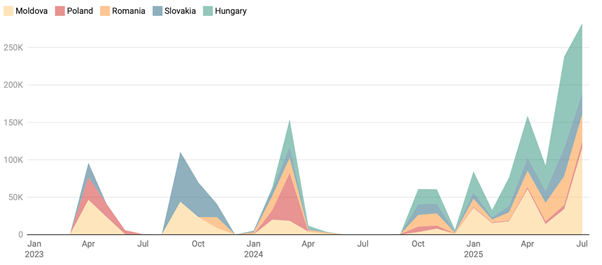
Electricity export, per month, 2023-2025, MWh
(ENTSO-E data, visualization by ExPro agency)
June and July export comparison (Calculation based on ENTSO-E data)
In terms of volume, Ukraine remains a net exporter; however, according to independent assessments, total import costs are much higher than export revenues.
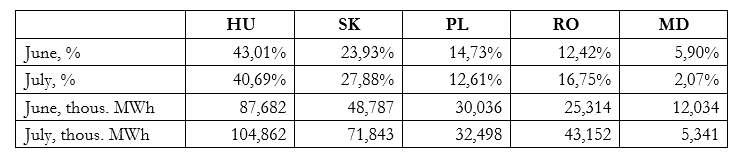
Electricity imports in July 2025 increased by 24.7% from the previous month, reaching 257.7 thousand MWh. Supplies from Moldova dropped by 55%. Imports from other sources went up. Compared to July 2024, this year’s imports are three times lower. Last year, the power system was recovered after Russian strikes and imports were not enough to cover shortages, so widespread cutoffs were applied.
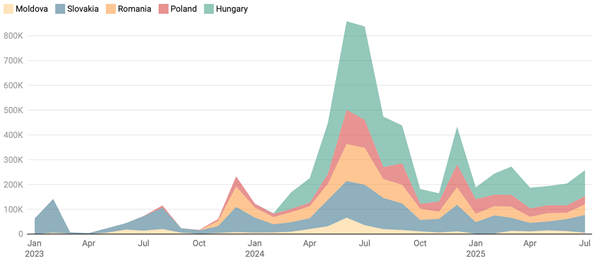
Electricity import, per month, 2023-2025, MWh
(ENTSO-E data, visualization by ExPro agency)
June and July import comparison (Calculation based on ENTSO-E data)
ENTSO-E has increased the maximum capacity of electricity export from Ukraine and Moldova to EU countries to 900 MW. The increase is valid until August 1 and will be reviewed monthly thereafter. The previous time the permitted export capacity was increased was on May 1, 2025, from 550 to 650 MW. However, even with the allowed capacity of 650 MW, TSO restricted the operation of renewable power plants to balance the power system.
On July 29, 2025, the National Energy and Utilities Regulatory Commission (NEURC) approved the rules for the long-term distribution of cross-border power transmission capacities of Ukraine with Slovakia, Hungary, and Romania.
Transmission system operators of Ukraine, Slovakia, Hungary, and Romania have agreed to implement medium-term (monthly) joint coordinated capacity allocation for cross-border power transmission on the Ukrainian section through the Joint Allocation Office (JAO) electronic auction platform. Auctions will offer an opportunity to utilize the relevant cross-border transmission capacities more effectively, minimize or optimize electricity costs, and provide guarantees and predictability.
Currently, yearly auctions are held only for bilateral trade with Moldova and for exports to Poland. Monthly auctions occur for bilateral trade with Moldova and Romania, as well as for exports to Poland.
These auctions are expected to start in early December. However, Russian strikes and capacity shortages may cause delays in auctions.
As of the end of the 2Q2025, the debt of NPC Ukrenergo to SE Guaranteed Buyer for the RES support service decreased to UAH 15.3 billion. By the end of the first quarter of 2025, Ukrenergo’s debt for RES services totaled UAH 15.5 billion. The settlement rates for electricity produced are as follows: 65.5% for 2022, 99.2% for 2023, 89.2% for 2024, and 90.1% for 2025.
In the first half of 2025, the debt of participants in the balancing market to Ukrenergo rose by 10%, reaching UAH 38.3 billion. Meanwhile, Ukrenergo’s debt to the balancing market participants decreased by 11% over the six months, totaling UAH 14.9 million.
Some state-owned utility companies generate a large share of those debts. These entities, like water supply companies, are prohibited from disconnecting customers due to unpaid bills. However, water supply tariffs do not cover all costs.
On July 25, the NEURC voted to raise the maximum prices on the electricity market from 5:00 p.m. to 11:00 p.m. starting from July 31, 2025. The limit prices for the day-ahead and intraday markets were raised from UAH 9,000/MWh to UAH 15,000.00/MWh and from UAH 10,000/MWh to UAH 16,000/MWh on the balancing market.
Most likely, this step was taken to prevent cutoffs in August in case electricity prices in Europe reach record highs and price caps make commercial electricity imports unviable.
Currently, there is no reason to believe that the reviewed caps will immediately and significantly affect prices. In July, hourly market prices only hit the cap a few times. Since the moment price caps were increased, in the following days, the hourly price seldom exceeded the previous cap slightly.
The energy regulator has introduced a monitoring system for services related to connecting to electric networks. This new system is designed to automatically gather, track, and summarize information on how system operators provide connection services; quickly identify, respond to, and prevent potential violations; ensure compliance with deadlines; and prevent data manipulation. The system’s implementation is set to begin on August 1, 2025. This move is expected to improve the quality of grid connections, which is among the indicators of investment attractiveness.
In July, daily natural gas consumption ranged from 22 to 26 million cubic meters. Imports averaged 27 million cubic meters per day. This enabled the daily injection of 51,3t to 58,7 million cubic meters into storage facilities.. Such daily volumes of storing gas will allow us to reach a target of about 13 bcm stored by November.
Natural gas imports to Ukraine in July reached the highest level in nearly two years since September 2023, totaling 833 million cubic meters. Compared to 539 million cubic meters imported in June, import volumes increased by nearly 1.5 times, and compared to July 2024’s 52 million cubic meters, they increased 16 times. Almost all of the imported gas—774 million cubic meters—was stored in the customs warehouse mode. Additionally, about 59 million cubic meters (7% of all imported gas) were imported directly into the gas system.
In July, Naftogaz accounted for over 90% of all imports, while privately owned companies imported the remaining gas. The largest volume of gas imported in July came from Hungary—300 million cubic meters (36% of all imports); 268 million cubic meters (32.2%) from Slovakia; 260 million cubic meters (31.2%) from Poland; and 5.1 million cubic meters (0.6%) from the Trans-Balkan routes. Most of the gas from the Trans-Balkan route originated from Greece. Private companies imported gas using this route.
Naftogaz has agreed to obtain two loans of UAH 4.7 billion each from PrivatBank and UkrGazBank, both of which are state-owned. At current European natural gas prices of around $400 per thousand cubic meters, the loan can purchase roughly 0.560 billion cubic meters. This amount allows Naftogaz to import gas at July’s rates for about 20-25 days in August.
Previously, Naftogaz secured 800 million euros in loans from EBRD and EIB during the recovery conference in Rome. Naftogaz has not yet received this money and has taken loans from Ukrainian banks to maintain uninterrupted gas imports. However, Naftogaz discussed loans with these banks before.
Naftogaz and Polish ORLEN signed another agreement to supply an additional 140 million cubic meters of natural gas from the USA, which will be delivered to Ukraine. This is the fourth contract between the companies in 2025. In total, in preparation for the heating season, Naftogaz contracted 440 million cubic meters of gas through ORLEN. The gas will be supplied from the USA, regasified at the terminal in Świnoujście (Poland) or Klaipeda (Lithuania), and transported to Ukraine via the Polish gas transportation system.
On July 24, Naftogaz and SOCAR Energy Ukraine, the Ukrainian subsidiary of Azerbaijani SOCAR, signed their first agreement to purchase Azerbaijani gas. Natural gas will be supplied through the Trans-Balkan Corridor along the route Bulgaria-Romania-Ukraine. The gas supply volumes are small because this is mainly a test supply and will not play a major role in gas supply diversification. Currently, it seems unlikely that Azerbaijan will be able to significantly boost supplies to Ukraine in the near future, as all the gas produced in the country is already contracted by buyers, especially from EU countries.
On July 10-11, in Rome, the fourth Ukraine Recovery Conference was held. Energy proved to be a key sector at the conference. The Energy Ministry announced that financial agreements in the energy sector exceeding 1.2 billion euros have been secured. Donor countries will contribute an additional 240 million euros to the Energy Support Fund, which will be used to buy equipment and restore critical infrastructure after enemy strikes.
The Ministry of Energy of Ukraine, along with Ukrainian state and private energy companies, has signed over 30 agreements, memoranda, and joint statements with international partners that bolster the country’s energy security and speed up post-war reconstruction.
The European Commission will allocate a new package of 2.3 billion euros to support Ukraine’s recovery and reconstruction efforts. This amount includes € 600 million in large-scale private sector projects in key sectors such as energy, transport and manufacturing.
Ukraine and the Secretariat of the Energy Community will develop a risk reduction mechanism for participants in long-term special auctions for the provision of auxiliary services. The objectives of this risk reduction mechanism include supporting the timely implementation of projects that win Ukrenergo’s special auctions for ancillary services, reducing specific project risks such as infrastructure damage due to hostilities, and providing financial support or capital release for investors participating in Ukrenergo’s special auctions. The investment risk reduction mechanism is expected to be implemented as part of the activities of the Energy Support Fund of Ukraine, managed by the Energy Community Secretariat.
Ukrainian energy companies signed MoUs and agreements.
In early summer, households’ debt for heat and hot water reached UAH 33.9 billion, which is UAH 2.2 billion (or 6.9%) higher than a year earlier. Kharkiv Oblast, Kyiv, and Dnipropetrovsk Oblast account for the largest share—60.6% of the total debt for heat and hot water.
The shareholders of Ukrnafta – Naftogaz of Ukraine and the Ministry of Defense of Ukraine changed the company’s type and name, and approved a new version of the Charter. Now, the official name of the company is JSC Ukrnafta, whereas it was PJSC Ukrnafta before.
Charter amendments, in particular, stipulate management changes.


Together we can change the future! Your support allows us to continue our research and provide objective analysis of key social issues. Join us today to build the future of our generations together.
Support