Digests • 13 May 2025

13 May 2025
Published

Monthly Energy Digest – April 2025
In April, the power system operated in a relatively normal mode. The warm weather decreased power demand, which reduced the need for electricity imports. Simultaneously, due to a surplus during the day, the system operator restricted solar power production.
The combination of these factors contributes to decreased imports and rising electricity exports. Electricity is primarily exported during daytime hours, when solar power production is high. Two additional nuclear power units were gradually taken offline for maintenance, leaving five operational and connected to the grid by the end of the month. Power generation was low due to the lack of water flows: more than twice as low compared to April 2024. By turn, thermal power plants increased production to cover shortages. These factors ultimately defined higher volumes of imports during peak hours at the month’s end, although imports remained relatively low.
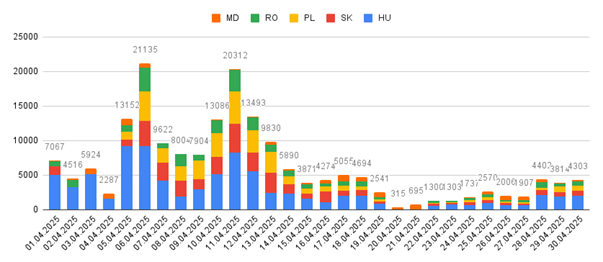
Daily volumes of electricity imports by countries of origin in April
(The chart is based on ENTSO-E data)
In April 2025, Ukraine’s electricity imports dropped by 31% from March, totaling 187 thousand MWh. Hungary was the primary supplier, providing 44%, while both Slovakia and Poland contributed 18% each. The highest import level was recorded on April 11, exceeding
20,000 MWh, but after April 20, the volume of electricity received from abroad sharply declined.
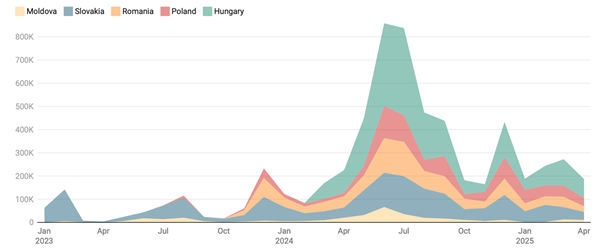
Electricity import, per month, 2023-2025, MWh
(ENTSO-E data, visualization by ExPro agency)
In April 2025, electricity exports nearly doubled compared to March, surpassing 150,000 MWh. The peak export period occurred from April 22 to 25, with a total of over 11,000 MWh exported. Hungary received the largest share (38%), followed closely by Moldova (35%).
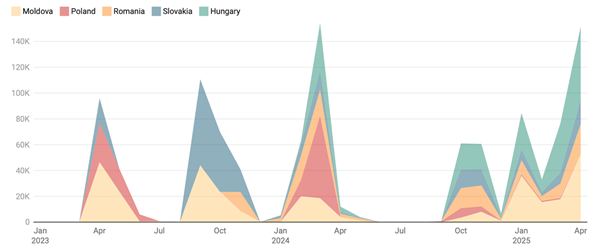
Electricity export, per month, 2023-2025, MWh
(ENTSO-E data, visualization by ExPro agency)
The European Network of Transmission System Operators for Electricity increased the maximum allowed capacity for electricity exports from Ukraine and Moldova to EU countries by 100 MW to 650 MW. The increase is in force starting on May 1, 2025.
At the same time, the Ukrainian power system has much greater potential to export electricity during daylight hours, as the limitation of renewable energy source (RES) production exceeds this increase. Therefore, this will not have a significant impact on the economy of Ukrainian
power companies and the energy sector in general.
NPC Ukrenergo reached an agreement on the terms of the debt management operation for green bonds of sustainable development, guaranteed by the state, in the amount of $ 825 million at a rate of 6.875% per annum and due in 2028 with an ad hoc group of bondholders representing approximately 40% of the total nominal value of not repaid bonds and bondholders outside the Ad Hoc group representing more than 45% of the total nominal value of not repaid bonds.
The debt management operation, which is expected to be completed in early July 2025, will include an offer to bondholders to participate in the redemption offer and/or exchange offer for new debt securities of Ukrenergo.
Buy-out offers
Exchange Offers
The transmission system operator Ukrenergo reduced its debt to balancing market participants to UAH 13.7 billion. Overall, Ukrenergo’s debt to these participants decreased by 25% since the start of 2025.
At the same time, the debt owed by market participants to Ukrenergo continues to grow. By the end of March, the total reached nearly UAH 37.5 billion, setting a record level. Since the beginning of the year, the debt has risen by 6.6%.
Debts in the balancing market continue to be one of the primary obstacles to attracting investment in new electricity generation facilities, despite the capacity shortage in the power system.
Bulgarian Deputy Prime Minister and leader of the Bulgarian Socialist Party, Atanas Zafirov, informed that the country would not sell two nuclear reactors from the Bulgarian Belene NPP to Ukraine. He emphasized that this is a collective decision, calling the reactors key for Bulgaria’s energy security and economic independence. Zafirov stated that nuclear energy is a reliable, cost-effective and predictable source of energy. He argued that Bulgaria possesses both the infrastructure and the expertise to develop the sector domestically, and that selling the reactors would be a mistake. The Deputy Prime Minister emphasized that all coalition partners supported the decision not to sell. This change, among other factors, stems from shifts in the country’s political landscape. A vote in Parliament is yet to occur.
The European Commission opposed installing these reactors. Some Bulgarian politicians probably expect to have warm relations with Russia and amend the Commission’s position to have these reactors launched. Besides, it may also be an attempt to increase the price, which is now 600 million euros.
Bulgaria’s refusal to sell Ukraine equipment for 2 GW of nuclear capacity highlights the need for the country to enhance its power-generating capabilities with technologies that can be developed swiftly and economically. A separate priority today should be electricity storage systems, including power-to-gas/gas-to-power technologies. This will at least help smooth out price drops in the market during daytime hours in summer caused by the boom in solar generation. It is also necessary to develop wind generation projects, which are less stochastic in seasonal terms compared to solar. In the current conditions, it is essential to maximize the potential of coal-fired power by reconstructing thermal power plants. If coal-fired generation is lost today, another problem will arise: what to do with the mines and everyone employed in coal mining?
Naftogaz reported that it has already recovered half of the production volumes lost due to Russian attacks in February. The real extent of the drop in gas production has not been disclosed.
Recovery in gas production will not help to avoid gas imports. At least 4.5 bcm of gas should be imported by early November.
Ukraine has officially started the season of pumping natural gas into underground storage facilities on April 17, 2025.
On April 17, 2.1 million cubic meters of natural gas were pumped into underground storage facilities, while gas extraction amounted to only 0.5 million cubic meters, indicating the start of the gas pumping season. In the following days, the volume of gas injection rose to 5.3 million cubic meters on April 19. By the end of the month, injection rose to 35 mcm daily.
In April 2025, Ukraine pumped 258 million cubic meters of natural gas into underground gas storage facilities.
This year’s gas extraction season from underground storages lasted 167 days – from November 1, 2024. to April 16, 2025, and became 22 days longer than last year. Almost 7.56 billion cubic meters of gas were withdrawn from storage facilities, 13% less than during last year’s withdrawal season – 8.65 billion cubic meters (this number includes re-export of gas from the warehouse).
Naftogaz has contracted 1.5 billion cubic meters of gas since the beginning of the year: 800 million cubic meters were urgently imported at the start of the year, 400 million cubic meters will arrive in Ukraine in preparation for next winter, and another 300 million cubic meters of LNG were purchased by Naftogaz from the Polish ORLEN. (The gas will be supplied from the USA, regasified at the terminal in Świnoujście (Poland), and transported to Ukraine through the Polish gas transportation system).
During the first quarter, Naftogaz secured approximately EUR 430 million from various institutions. This includes EUR 270 million from EBRD (the loan is guaranteed by the state) and a EUR 140 million grant from the government of the Kingdom of Norway, provided through the NORAD foundation. Naftogaz plans to spend the funding to purchase 1 bcm of imported natural gas.
The company is also negotiating with the government and international financial institutions to secure financing of EUR 1 billion for the acquisition of over 2 billion cubic meters of gas.
However, Naftogaz still needs to collect funds to purchase additional gas, as it plans to import at least 4.6 bcm by November.
As reported by foreign media, a Russian court has raised the financial penalty against Ukraine’s Naftogaz from about $ 150 million to $ 1.3 billion in connection with its international arbitration claim to resolve a gas transit dispute with Gazprom. A St. Petersburg regional court had stripped Naftogaz last year.
This relates to the May 2022 situation when Ukraine halted gas transit through the Sokhranivka measuring station, citing “force majeure.” At that time, Gazprom ceased payments for transit via Sokhranivka, as Naftogaz had started international arbitration.
The Paris court recognized and granted permission for the enforcement (exequatur) of the Hague Arbitration’s decision concerning compensation for damages resulting from the illegal expropriation of Naftogaz Group’s assets in Crimea, amounting to $5 billion. As part of this process, Naftogaz has already registered encumbrances on several assets belonging to the Russian state and located in France, with a total value exceeding €120 million.
Naftogaz will continue to supply natural gas to Ukrainian household consumers at the unchanged price of UAH 7.96 per cubic meter.
Considering the significant need for imported gas after Russia struck Ukrainian gas production facilities, Naftogaz will have to spend money to import expensive gas and sell it at lower prices, which will result in additional losses. This justifies a review of gas prices for households, as they have not changed since the widescale invasion and were not altered drastically for years before that. However, the government probably tries not to change the price, considering it a socially sensitive issue.
Fuel prices in Ukraine increased by an average of 9.9% in March 2025 compared to March 2024. The growth rate of fuel prices accelerated to 9.9% year-on-year in March, up from 4.8% year-on-year in December 2024, according to calculations by the National Bank of Ukraine.
This increase was driven by another stage of excise tax increases and the high volatility of prices in global commodity markets. The weakening of the UAH against the EUR exchange rate in March added further pressure for higher fuel prices.
Ukraine increased bioethanol exports in January-March 2025 by 180.6% compared to the same period of the previous year- to 39,000 tons. According to the results from March, the export of bioethanol from Ukraine decreased by 9.1% compared to February, totaling 14.4 thousand tons. The entire volume consisted of undenatured bioethanol. In February, Ukrainian companies sold record-high volumes of ethanol abroad, which stemmed from a lack of supplies in January.
On April 25, Prime Minister Denys Shmyhal and World Bank Managing Director Anna Bjerde signed an agreement to provide financial support for Ukraine’s energy system. The World Bank will allocate $70 million to energy storage systems for UkrHydroEnergo.
The Supervisory Board of NJSC Naftogaz of Ukraine elected Serhiy Koretskyy as the new chairman of the NJSC Naftogaz of Ukraine board. The decision was made during the supervisory board meeting on April 28. He will assume office starting May 14.
The National Bank of Ukraine (NBU) has revised its estimate of the electricity deficit in Ukraine from 4% to 3% this year and from 2% to 1% next year, thanks to rapid repairs and the development of distributed generation.
Rapid repairs in shunting generation and energy infrastructure, along with the development of distributed electric power generation and RES capacities, amidst maintaining stable electric power imports, enable a more accurate estimation of the electric power deficit over the forecast
horizon. According to the NBU, the deficit will nearly disappear (1%) by 2027. Consequently, the report indicates that the impact of energy supply restrictions on changes in real GDP will lessen, and annual electricity imports will reach approximately $0.5 billion from 2025 to 2027.
At the same time, this assessment is deeply relevant as the situation may change if new strikes on energy facilities happen.
Starting July 1, 2025, European approaches to determining power supply quality parameters will be implemented in Ukraine, particularly the transition to a nominal voltage of 230/400 V.
This represents another important step in the European integration of Ukraine’s electricity market.
According to the company’s consolidated statements for 2024, which an independent auditor, KPMG, confirmed, the Naftogaz Group’s net consolidated profit for 2024 amounted to UAH 37.9 billion. Compared to last year, Naftogaz’s profit increased by 64%, or UAH 14.8 billion, from UAH 23.1 billion in 2023 to UAH 37.9 billion in 2024.
The parent company Naftogaz of Ukraine concluded the year with a profit of UAH 23.9 billion. However, according to the results for 2023, a loss of UAH 0.8 billion was recorded.
The largest contribution to the profit came from UGV, which increased the financial result to UAH 20.9 billion.
The net profit of JSC Energoatom for 2024 was UAH 1.3 billion. All of the profit will be used to cover previous years’ losses, and dividends will not be paid. The government also confirmed the independent auditor’s conclusion.
Energoatom produced 53 billion kWh of electricity in 2024, which is 2% more than the amount generated in 2023 and 12% more than in 2022. In 2024, Energoatom directed UAH 116.3 billion (excluding VAT) of its own funds, or 58% of its net income, to pay for PSO, that is, to support fixed electricity tariffs for the population.


Together we can change the future! Your support allows us to continue our research and provide objective analysis of key social issues. Join us today to build the future of our generations together.
Support