Digests • 11 September 2025

11 September 2025
Published
Despite all fears and expectations, Ukraine passed the summer without rolling blackouts and any consumption restrictions for customers.
In August, the output of hydropower plants stayed low due to water shortages. During the first week of the month, the power system mainly relied on electricity imports to remain balanced, especially in the evenings when demand increased and solar power production decreased.
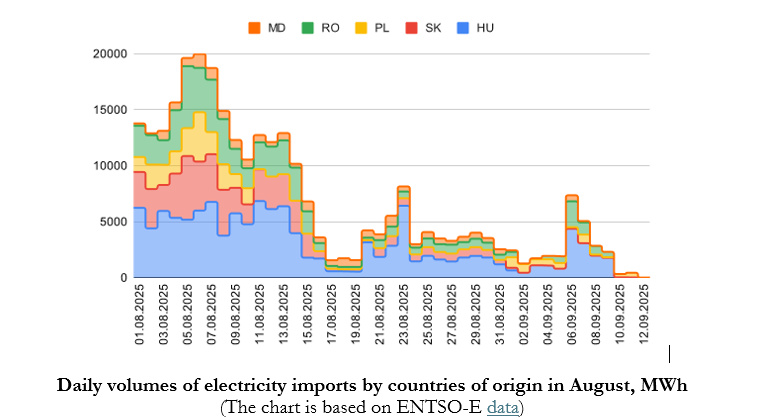
However, the situation changed in the second half of the month, when some nuclear units were connected to the power system, thereby increasing the system’s available capacity. Together with the high productivity of renewable power plants and the typical August weather, which has not led to extra power demand, this has resulted in decreased imports and increased exports of electricity.
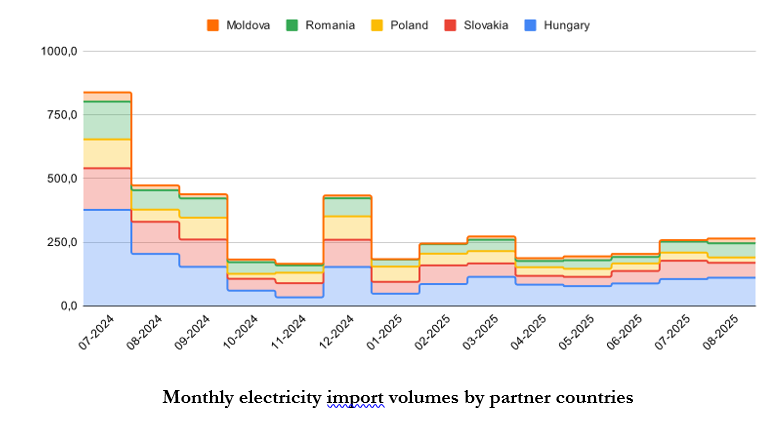
In August, Ukraine exported 450,1 thousand MWh, which is 60% more than in July. This export volume is a record since the Ukrainian power system integrated into the European system in 2022. At the same time, imports increased by only 2.5 percent compared to July (264.2 thousand MWh).
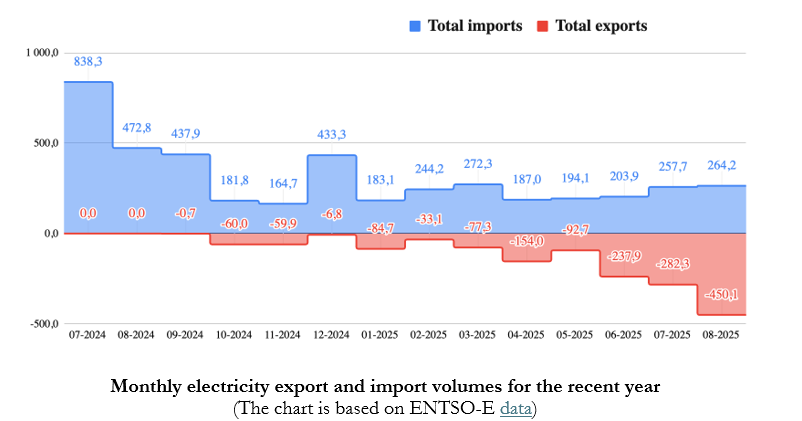
Monthly electricity export and import volumes for the recent year
(The chart is based on ENTSO-E data)
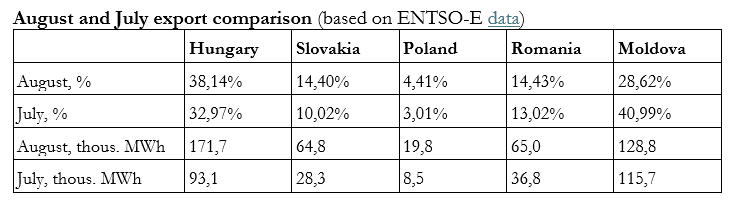
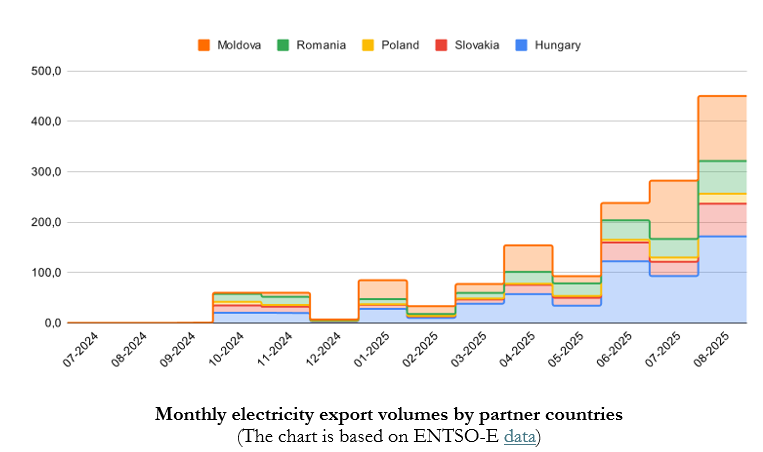
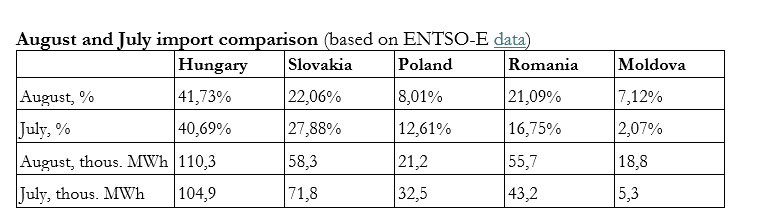
The distribution of exports and imports among partner countries remained almost unchanged compared to July. However, more electricity was exported to Hungary and Slovakia, while exports to Moldova decreased. And traditionally, most imports came from, and most exports went to, Hungary.
On August 21, the Supervisory Board of Energoatom replaced Petro Kotin as acting chairman of the board. Pavlo Kovtonyuk, the CEO of Rivne NPP, was named the new acting chairman. He has the experience and skills needed for this position. Later, Kotin left the company altogether.
On August 15, 2025, the Cabinet of Ministers of Ukraine made amendments to the Charter of JSC NNPC Energoatom. The Supervisory Board now consists of seven members. Its composition includes four independent members, who hold the majority, and three members representing the state, as outlined in the updated Charter.
Additionally, the supervisory board proposed establishing three new key roles: Chief Operating Officer (COO), Vice President of Governance and Ethics, and Vice President of Finance and Strategy.
Winners of Ukrenergo’s special auctions to supply ancillary services can delay starting to provide these services for several months if they cannot get new generation facilities operational within the contract period. The NEURC has approved changes to the Market Rules that support this. The main challenge energy companies faced was connecting new power generation and storage facilities to the grids and delivering equipment.
However, only two of the 37 companies (gas-fired power plants), totaling 2 MW, have so far exercised their right to delay providing energy system balancing services, which were supposed to begin on October 1. According to Ukrenergo officials, perhaps two more companies will also request a postponement.
The first two long-term special auctions of Ukrenergo took place in August 2024. Winners should start providing the services on October 1.
As Minister of Energy, Svitlana Grynchuk reported, in 2025, Ukraine had already commissioned 600 MW of distributed generation facilities utilizing natural gas and renewable energy sources. An additional 300 MW is projected in the public sector and 500 MW in the private sector. At least 350 MW of these 800 MW are expected to be gas-fired power generation.
In August, daily natural gas consumption ranged from 23.3 to 26 million cubic meters, while the average domestic gas production was 53 million cubic meters. Combined with imports, this allowed for the daily injection of 42.5 to 51.7 million cubic meters into gas storage facilities. By the end of the month, storage contained 11.2 billion cubic meters of gas. This pace of storing makes it feasible to reach a target of about 13 billion cubic meters stored by November.
Naftogaz of Ukraine and the European Bank for Reconstruction and Development (EBRD) have signed a new agreement for a revolving credit of €500 million. Naftogaz will purchase gas on competitive terms from over 30 pre-qualified suppliers through contracts that follow the standards of the European Federation of Energy Traders (EFET). This amount can cover about 1.5 billion cubic meters of natural gas at current European gas prices (around €32.6/MWh).
For the first time, the loan is issued with the European Union’s guarantee through the UIF Hi-Bar (Ukraine Investment Framework) program, eliminating the need for a state guarantee from Ukraine. The total financing from the EBRD Naftogaz since the start of the full-scale war in 2022 has reached EUR 1.6 billion.
This loan was secured at the Ukraine Recovery Conference in Rome in July. The €300 million loan from the European Investment Bank, which was also secured in Rome, is still expected to be finalized.
Norway’s government allocated a $98 million (NOK 1 billion) grant to Naftogaz of Ukraine for the same purposes. The aid will be provided through the Nansen Support Program, which aims to assist Ukraine across various sectors. The program was launched in February 2023.
The independent natural gas transmission operator ICGB (Interconnector Greece-Bulgaria), in cooperation with the transmission system operators of Greece, Bulgaria, Romania, Moldova, and Ukraine, is ready to launch two new cross-border capacity products: Route 2 and Route 3 (in addition to Route 1, launched at the end of May). The new routes aim to boost the amount of natural gas transported via the Trans-Balkan route to Ukraine.
All operators agreed to a 25% discount on the standard monthly tariff, with ICGB and the Ukrainian GTS Operator offering a 46% discount, the highest in the region. The offer is only available as monthly products and will be sold through a single fixed-price auction. Similar to Route 1, nominations are only possible for exit to Ukraine, with no access to internal points in other countries along the route.
Importing gas from the Trans-Balkan region is essential for diversification; however, it is significantly less significant than the booked capacities from Hungary, Slovakia, and Poland. The daily combined volume of booked capacities from these three countries is 63 million. Meanwhile, the guaranteed booked capacity via Route 1 is only 7 million. Additionally, importing from this route makes it easier to supply gas to southern Ukraine, avoiding the need to transport gas from the western border.
Following Russian attacks on the gas metering station in Orlivka in August, which is part of the route for importing gas from the Trans-Balkan region, importers did not bid to book capacities for importing gas through this route in September.
The Cabinet of Ministers of Ukraine has announced a new competition for investors to sign PSAs, which will take place at two oil and gas fields in western Ukraine – Svichanska and Mezhihirska. Both are situated within the Lviv, Ivano-Frankivsk, and Chernivtsi regions.
To remind, according to the agreement between the governments of Ukraine and the United States on establishing an investment fund, the partner from the United States has the right of first refusal to purchase the extracted products (such as oil or gas) under the conditions specified in the agreement. The previous two resolutions of the Cabinet of Ministers dated April 8, 2025, regarding tenders for the Svichanskaya and Mezhyhirskaya oil and gas fields will become invalid. In 2023, the state-owned UkrGazVydobuvannya applied for the conclusion of production sharing agreements within the Svichanska and Mezhyhirska sections.
The Vienna court approved Naftogaz’s request to enforce the 2023 arbitration award in Austria. This involves the forced sale of more than 20 real estate properties owned by the Russian Federation located in Austria. The estimated value of these assets is over €120 million.
This decision is part of efforts to recover over $5 billion in compensation from Russia for illegally seized Naftogaz assets in Crimea, which is currently under occupation. Similar actions are ongoing in other jurisdictions.
JSC Ukrnafta and the company Shell Overseas Investments BV have completed the agreement on the acquisition by the Ukrainian state-owned company of a 51% stake in LLC Alliance Holding, which owns a network of 118 fueling stations under the Shell brand in Ukraine. The remaining 49% of the enterprise belongs to the State Property Fund of Ukraine, i.e., the state is currently the ultimate owner of 100% of Alliance Holding. Along with Shell gas stations, 663 gas stations will operate under the Ukrnafta brand this year.
In August, Ukraine’s Armed Forces (UAF) began attacking Russian oil infrastructure. Most likely, this was a response to Russian strikes on Ukrainian energy facilities earlier in the summer. During the month, UAF targeted about ten Russian oil refineries. These attacks reduced Russia’s refining capacity by roughly 17 %, or 1.2 million barrels per day, this month. According to Reuters calculations, Russia’s total offline primary oil refining capacity hit a record high of 6.4 million tons in August, rising 65% from previous estimates based on maintenance plans.
Naturally, this created a surplus of crude oil that Russia tried to sell abroad, even offering discounts to China. Russia has increased its planned crude oil exports from Western ports by 200,000 barrels per day (bpd) in August, exceeding the original schedule.
This situation was followed by several UAF’s strikes on the infrastructure of the Druzhba pipeline, which carries Russian oil to Slovakia, Hungary, and the Ust-Luga Sea terminal in the Baltic Sea, responsible for 20% of Russian seaborne crude exports. Very probable that those attacks were planned to affect crude oil export when Russia found itself in a situation of an oil surplus to be exported. Attacks resulted in suspensions of oil flows. Besides, Ukrainian drones hit Novatek’s LNG processing plant in Ust-Luga.
In August, Russia intensified attacks on Ukrainian energy facilities. However, those attacks still were not so massive as some in the past.
The State Geology and Subsoil Service of Ukraine has launched the State Register of Oil and Gas Wells. This information is now accessible on the State Geodesy website. The purpose of creating the register is to document wells consistently and provide enterprises, institutions, and the public with accurate data about these wells. The register is a crucial part of the Unified State Electronic Geoinformation System for Subsoil Use. It includes details on over 12,500 wells, covering active, preserved, monitoring, and other types.
From now on, subsoil users will no longer need to submit paper documents to register a well passport. All information generated during their activities will be processed online.
Additionally, the Ministry of Economy and the State Geodesy will conduct an audit of all subsoil users who have received permits for strategically important deposits. Among other objectives, it will aim to identify permit owners and licenses that were issued but no production work was carried out in the fields.


Together we can change the future! Your support allows us to continue our research and provide objective analysis of key social issues. Join us today to build the future of our generations together.
Support