Digests • 14 June 2025

14 June 2025
Published
Monthly Energy Digest – May 2025
On April 30, Ukraine and the United States signed the Agreement on the Creation of the US-Ukraine Reconstruction Investment Fund, which is part of a so-called minerals deal. On May 8, 338 members of parliament (a so-called constitutional majority) voted for Bill No. 0309 to ratify the agreement between the governments of Ukraine and the United States of America regarding the establishment of the US-Ukrainian Reconstruction Investment Fund during the plenary session of the Verkhovna Rada. No MP voted against. A few days later, President Zelensky signed the law.
As reported by First Deputy Prime Minister and Minister of Economy Yulia Svyrydenko, as part of the agreement, Ukraine would transfer 50% of the funds from new oil and gas licenses to the Reconstruction Investment Fund. Revenues from already initiated projects or anticipated budget revenues should not be included in the fund.
However, as Minister for Environmental Protection and Natural Resources Svitlana Hrynchuk stated, Ukraine will review existing mining licenses after signing the deal. Hrynchuk estimated that approximately 10% of these may be inactive and suggested adopting “appropriate management decisions”regarding them.
The Ministry of Energy of Ukraine and the Ministry of Economy and Employment of Finland have signed a Memorandum of Understanding in the energy sector. The document was signed by Ukraine’s Minister of Energy, Herman Galushchenko, and Tarya Fernandes, the Ambassador of Finland to Ukraine, during a meeting in Kyiv. The MoU aims to promote public and private investments, joint research and development, and the exchange of experts, technicians, and scientists, along with the sharing of technologies, experiences, information, and best practices. Additionally, it seeks to encourage business cooperation and collaboration among innovation agencies, research organizations, associations, and companies.
Since March 2022, over 60 aid shipments, totaling more than 600 tons, have been sent from Finland. These shipments included transformers, generators, gas boilers, cables, and other essential equipment and materials needed for restoration work at facilities damaged by Russian attacks.
Naftogaz and Polish energy corporation Orlen signed a memorandum on strategic cooperation. It envisions the development of cooperation, particularly in the fields of mining and deposit development, infrastructure restoration, and the implementation of potential joint projects. Earlier this year, Naftogaz and ORLEN signed agreements for the supply of liquefied natural gas to Ukraine, amounting to 300 million cubic meters.
The power system operated in a relatively normal mode in May and remained balanced. Existing capacities, together with import, were sufficient to cover power demand without restrictions to customers.
As some nuclear units were offline for maintenance to get prepared for the next winter, and the productivity of hydropower plants was low due to a lack of water resources, the capacity shortage was covered by thermal power generation and imports. Since the beginning of May, Ukraine has increased its electricity imports while exports have dropped. Another factor contributing to high imports and low exports on some days was that electricity prices have exceeded those in neighboring European countries. At the same time, low prices in Europe were caused by decreased demand, driven by higher volumes of power production from renewables and reduced demand due to warmer temperatures.
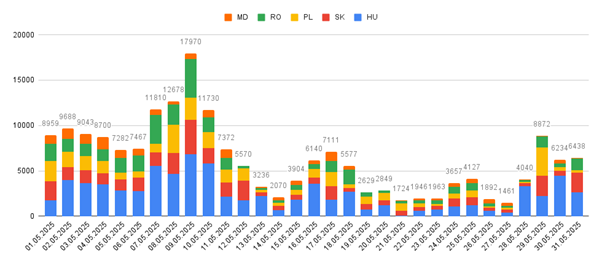
Daily volumes of electricity imports by countries of origin in May
(The chart is based on ENTSO-E data)
In May 2025, Ukraine reduced its electricity exports by more than 40% compared to the previous month, totaling 92.5 thousand MWh. Most of the electricity was exported to Hungary, which accounted for 37% of the total volume. Compared to May 2024, electricity exports increased twenty-twofold, as the year before, Ukrainian power system lost a significant share of capacity due to Russian attacks.
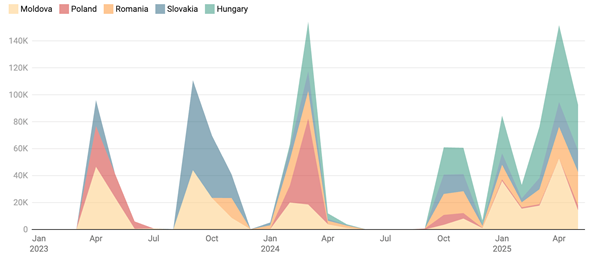
Electricity export, per month, 2023-2025, MWh
(ENTSO-E data, visualization by ExPro agency)
Electricity imports in May 2025 increased by 3.6% compared to April 2025. Import volumes from Moldova and Slovakia saw the largest growth, but Hungary still held the biggest share, accounting for 40%.
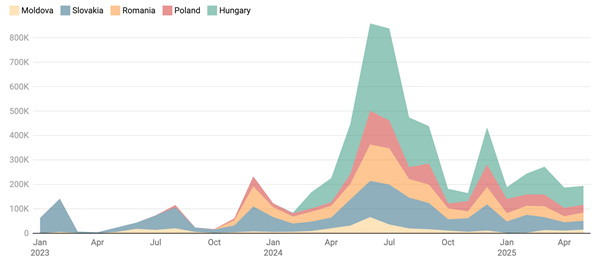
Electricity import, per month, 2023-2025, MWh
(ENTSO-E data, visualization by ExPro agency)
Export growth in Spring was temporary. In the following month, power demand in Ukraine is expected to rise, and some existing capacities, primarily nuclear, will be taken offline for maintenance to prepare for the upcoming winter. At the same time, this export would be impossible without renovation work Ukrainian energy companies do to recover the power system after past Russian strikes on the energy facilities.
On May 27, the National Energy and Utilities Regulation Commission extended the current limit prices on the day-ahead, intraday, and balancing markets for another six months from May 31, 2025.
Still, there is a risk that price caps will limit the feasibility of electricity imports during the night peak hours in summer if prices in Europe rise. Ukraine will need to import more electricity in the summer during peak hours, as some nuclear power units will be undergoing maintenance, while power demand is expected to be high due to the hot weather. Hot weather is expected to impact electricity prices in Europe, potentially driving them up. Sure, the regulator may review its decision, but the concern lies in the delay between the shortages and the new decision.
Daily gas consumption varied from 25 to 33 million m³/day. Net gas imports ranged from 13.5 to 19 million m³ per day. This allowed for the storage of 25 to 40 million m³ of gas daily. Gas was imported from Hungary and Poland, and later, from Slovakia as well. The country’s gas production is still recovering after Russian attacks that occurred at the beginning of the year.
On May 13, the Cabinet of Ministers of Ukraine approved the Regulation on the information database of natural gas consumption in accordance with the Law of Ukraine On Ensuring Commercial Accounting of Natural Gas. The natural gas consumption database is created to ensure control over the use of imported natural gas resources and natural gas of own production and provides automated accounting of natural gas consumers (consumption objects), the volumes of natural gas consumed by them, as well as natural gas market entities related to them.
The primary functions of the information base are the centralized collection of data on natural gas consumption objects and associated market entities. Today, the absence of a natural gas consumption database makes it difficult to comprehend the market’s operation, production volume, technological costs, and associated imbalances.
In May 2025, the volume of natural gas injected into Ukrainian underground gas storage facilities reached about 1.1 billion cubic meters. Compared to May of last year, gas injection increased nearly 1.5 times, rising from 750 million cubic meters in May 2024. This substantial increase was mainly driven by imported gas, which made up around 45% of the total volume injected into storage in May 2025 (roughly 500 million cubic meters). The rest of the gas pumped into the storage facilities came from Ukrainian sources, accounting for 55% of the total volume.
Ukraine’s Foreign Minister Andrii Sybiga, following a visit to Baku, stated that Ukraine is ready to become a key energy hub for Azerbaijan in Europe. To reiterate, as mentioned earlier, Energy Minister Halushchenko stated that Ukraine is open to transiting Azeri gas to Europe.
The energy regulator approved the provision of a joint product of transportation services to the gas TSO of Ukraine (OGTSU) in collaboration with the TSOs of the Republic of Bulgaria (Bulgartransgaz), the Republic of Greece (DESFA SA), the Republic of Moldova (VestMoldTransgaz SRL), and Romania (Transgaz SA). Gas will be transported through the so-called Vertical Corridor – an initiative of the operators of certain European gas TSOs, aimed at increasing the volume of gas transportation from the South to the North, particularly from Greece to Ukraine.
The parties agreed to a single tariff for gas transit, offering a 25% discount to enhance the route’s attractiveness. Meanwhile, the discount for the Ukrainian operator will be 46%. Gas will flow from Greece to Ukraine via the Trans-Balkan route at the following connection points: Sidirokastro/Kulata, Kardam/Negro-Vode, Isakcha/Orlovka, and Kaushany/Grebenyki.
This decision envisions holding a single auction for the allocation of capacity at all points along the Trans-Balkan Corridor, which is the natural gas transportation route from Greece to Ukraine, totaling approximately 3 million cubic meters per day. The auction will take place on the Regional Booking Platform (RBP) according to the following schedule: for July – October 2025, on the fourth Monday of the month before the capacity usage month.
On May 29, an auction was announced to reserve monthly capacity for June for the transportation of natural gas from Greece to Ukraine, involving a daily supply of 2.9 million cubic meters. However, no participants applied, resulting in the auction ending with no bids. The lack of participants was most likely caused by insufficient information about the product, as it was approved shortly before the auction. Earlier, Naftogaz reported that it would start importing American LNG from June via a new gas transportation route to Ukraine.
Gas TSO of Ukraine agreed with its Polish counterpart Gaz-System to extend the guaranteed capacity at the point of entry into Ukraine until October 1, 2026. The volume of the guaranteed capacity at the entrance to Ukraine will remain 6.0 mcm at 0°C (6.4 mcm at +20°C) per day until October 1, 2026. Capacities not contracted under previously offered products will be provided on the GCP GAZ-SYSTEM/UA TSO in accordance with the current transportation situation as guaranteed capacity for annual, quarterly, monthly, daily, and intraday products until the end of the 2025/2026 gas year.
Besides, later, Ukraine has nearly doubled its firm gas import capacity booked from Poland. The gas transmission system operators (TSOs) of Ukraine and Poland have agreed to nearly double the guaranteed capacity for importing natural gas from Poland to Ukraine. Starting July 1, 2025, the volume of guaranteed capacity will increase from 6.4 to 12.4 million cubic meters per day. As a result, the guaranteed capacity for importing gas to Ukraine from the western countries (Poland, Hungary, Slovakia) has increased to 63 million cubic meters per day. Additionally, there are up to 3 million cubic meters of guaranteed import capacity available from the Trans-Balkan route, which runs from Greece to Ukraine.
The Polish route, along with the Hungarian route, remains the most attractive option for importing natural gas to Ukraine due to transportation costs. Additionally, through the Polish GTS, Ukraine can access LNG terminals in Swinoujscie, Poland, and Klaipeda, Lithuania, as well as Norwegian gas via the Baltic Pipe.
UGV achieved a new drilling record of 107,136 meters in the first quarter of 2025. This drilling speed is nearly twice as high as in the same period last year and exceeds the previous quarterly maximum recorded in the third quarter of 2024 (102,866 m). March was the most productive month, achieving 41,229 meters, which is 6,929 m above the planned indicator of 34,300 m. Consequently, the monthly record set in April 2024 at 40,059 m has been surpassed.
PJSC Ukrnafta has become a party to the production sharing agreement (PSA) for the Olesk site in the Lviv and Ivano-Frankivsk regions, replacing Nadra Olesk LLC, which is owned by Nadra National Oil Company of Ukraine and a subsidiary of the American oil giant Chevron.
So now, Ukrnafta instead of Chevron Ukraine B.V., is the owner of the special permit for subsoil use in this area. and LLC Nadra Oleska. Earlier, at the beginning of April, the government transferred 100% of the rights and obligations of Nadra Oleska LLC regarding this site to Ukrnafta PJSC.
Previously, the American company Chevron planned to develop the Olesk field. Now, Ukrnafta will start geological exploration at the Olesk field. In addition to traditional oil and gas deposits, unconventional ones (shale gas, gas from tight reservoirs) are expected to be discovered there. Ukrnafta already has all the necessary technological facilities near the Olesk field.
In April 2025, the transit of Russian oil through Ukraine amounted to 900,000 tons. This is 2% less than the previous month but 28% more than in April 2024 (due to the impact of a low base for comparison). However, the transit volume in April 2025 is the lowest since August 2024.
The reduction in transit volumes is linked to the cessation of Russian oil deliveries to the Czech Republic starting March 4. According to the head of the Russian company Transneft, the Czech Republic is not receiving oil due to unpaid invoices for the resource. The Czech Republic has stated that it does not plan to resume purchases of Russian oil.
Most of the oil was transported to Slovakia in April, totaling 500,000 tons, which is 2% less than in March. The supply of oil to Hungary increased by 0.7% to 400,000 tons in April.
As of May 1, gasoline in Ukraine must contain at least 5% liquid biocomponents. This requirement is set forth in the Law on Amendments to Certain Laws of Ukraine Regarding the Mandatory Use of Liquid Biofuel (Biocomponents) in the Transport Industry, voted last year.
It concerns the use of biobutanol, biogas, biodiesel, bioethanol, biohydrogen, and others. The exception is gasoline with an octane rating of 98 and higher, fuel for the Ministry of Defense, and for maintaining minimum reserves of oil and oil products. The mixing of gasoline with bio-components can only occur at fuel production sites or wholesale trade locations, where the total capacity of fuel storage tanks is at least 1500 cubic meters.
Later in June, the parliament also postponed fines for violating the rule until 2026. The main reason was the shortage of this type of fuel in Europe, which is where Ukraine sources its fuel imports. Additionally, earlier Russian attacks destroyed Ukrainian facilities that produce bioethanol.
The Ministry of Economy of Ukraine considers it reasonable to resume the gas production operations of the Smart Holding group in the Poltava and Kharkiv regions, which were halted due to sanctions against the company’s shareholder, Vadym Novinskyi. This was stated by Yaroslava Maksimenko, the director of the Department of Property Policy and Sanctions at the Ministry of Economy. The main argument was that Ukrainian enterprises should work for the economy of Ukraine without creating any benefits for Russia, which unleashed the war against Ukraine.
The decision to resume operations for these enterprises relies on legislative amendments. Maksimenko noted that the Ministry of Economy, along with other governmental agencies, has already prepared the necessary legal changes.
Smart Energy Group companies—UkrGazVydobutok and Prom-Energo Product—are not operating due to the state’s forced suspension of special permits for hydrocarbon extraction. The licenses were revoked as a result of the sanctions imposed on Ukrainian oligarch Vadym Novinsky, the company’s chief beneficiary.
PrJSC UkrNaftoBurinnya (UNB), managed by PJSC Ukrnafta, reported a net profit of UAH 1.19 billion in 2024. Of this amount, UAH 1.074 billion was allocated to the state budget. In July 2024, the state budget of Ukraine received a tranche of 747.7 million UAH from Ukrnafta, derived from the management of UNB.
The Verkhovna Rada approved the project of the law on amendments to the law on sanctions regarding the application of sanctions to ships and aircraft in its first reading. The bill has to pass another reading to become a law. The draft law aims to impose sanctions on ships and aircraft involved in the Russian shadow transportation of oil and oil products, weapons, and the military. Ukrainian legislation has not stipulated mechanisms to impose sanctions against separate vessels but only companies and individuals. In particular, it is proposed to establish the fact of the use of ships and aircraft in activities that create real and/or potential threats to national interests, national security, territorial integrity, sovereignty and independence of Ukraine as a basis for applying the sanction.
Greenpeace Ukraine, based on a satellite analysis, reported construction of a new high-voltage power line for the Zaporizhzhia NPP in the temporarily occupied territories of the Zaporizhzhia and Donetsk regions. The visual identification of these objects confirms Rosatom’s intentions to restart the nuclear reactors at the ZNPP.
The Permanent Mission of Ukraine to international organizations in Vienna sent a verbal note to the IAEA Secretariat, condemning the clear intentions of the Russian Federation to connect the occupied Zaporizhzhia nuclear power plant to the Russian energy system and to restart the NPP independently. Any operation of the nuclear power plant without the explicit permission of the Ukrainian nuclear regulator is illegal and poses an immediate and unacceptable threat to nuclear safety.
IAEA spokesman Fredrik Dahl stated that the IAEA is aware of reports regarding Russia’s construction of a power transmission line toward the ZNPP, but the agency has no additional information or comments on this matter. Earlier, IAEA’s Director General Rafael Grossi stated that the agency assumes that none of the reactors will be restarted as long as the nuclear safety and security situation at the ZNPP remains at risk due to the ongoing conflict
The Permanent Representation of Ukraine to international organizations in Vienna also points out that Russia continues to use the captured Zaporizhzhia NPP as a military base and a tool of political blackmail, and systematically obstructs the work of the IAEA mission. Ukraine calls for the development of a transparent mechanism based on international law that will allow IAEA personnel to be rotated exclusively through the territory under the control of the Government of Ukraine until the ZNPP is fully returned to its rightful owner – Ukraine.
Ihor Syrota has stepped down as the general director of UkrHydroEnergo PJSC. The Supervisory Board of UkrHydroEnergo approved Syrota’s resignation in a decision made on May 28, 2025. He has been running the company for 15 years, having joined during Yanukovych’s cabinet. Bohdan Suhetskyi, a board member, will temporarily fulfill the company’s leadership duties until the Supervisory Board elects a new CEO in accordance with legal requirements.


Together we can change the future! Your support allows us to continue our research and provide objective analysis of key social issues. Join us today to build the future of our generations together.
Support