Digests • 17 November 2025
On October 23, the NBU kept the key policy rate at 15.5%.
On October 30, the NBU published the new Inflation Report for Q4 2025. The forecast for GDP growth in 2025 was revised down from 2.1% to 1.9%. The inflation forecast for 2025 was revised down from 9.7% to 9.2%. The NBU’s forecasts can be found discussed in more detail in this digest.
The trade deficit continues to worsen. In September it reached USD 5.56 billion. The NBU revised its full-year 2025 forecast from USD -52.5 to -55.8 billion.
International reserves in October 2025 increased from USD 46.5 to 49.5 billion. This is a new all-time record for Ukraine.
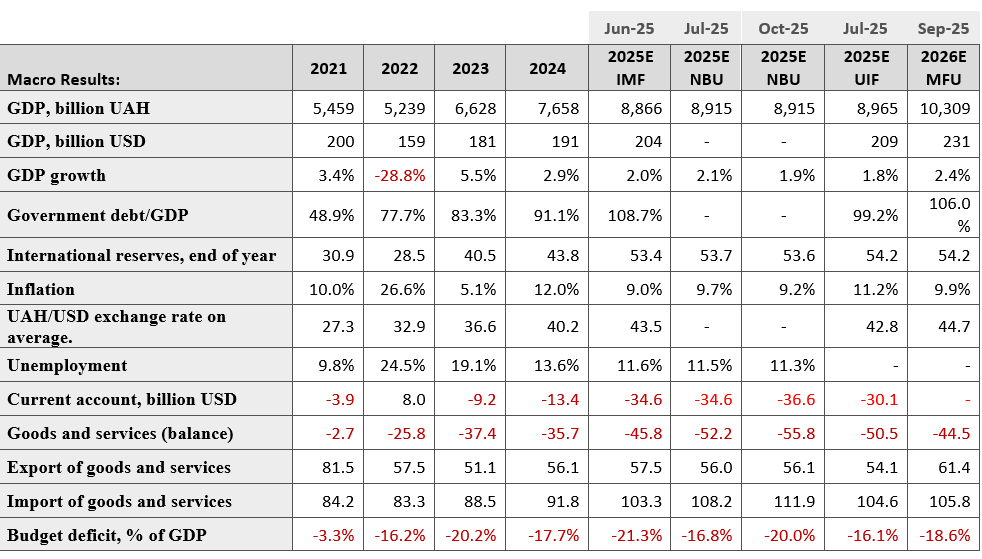
The NBU has downgraded its forecast for the growth of the Ukrainian economy in both 2025 and 2026. The GDP growth forecast for 2025 was revised down from 2.1% to 1.9% of GDP. For 2026, the NBU now forecasts GDP growth of 2.0% (down from 2.3%).
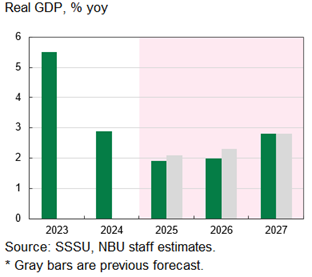
Source: NBU Inflation Report, Q4 2025.
Consumer prices in October 2025, rose by 0.9% compared with September, and by 10.9% compared with October 2024.
Core inflation in October 2025 amounted to 0.6% compared with September, and 10.2% compared with October 2024..
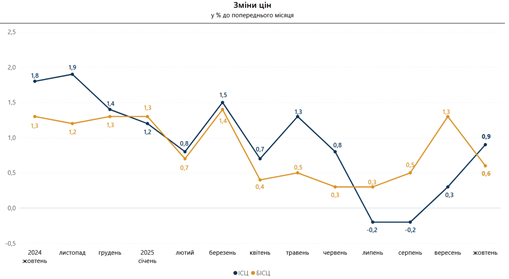
Changes in prices over the past 12 months. Source: Ukrstat.
Figure translation
Change in prices
(in % to the previous month)
2024 October November December 2025 January February March April May June July August September October
In the consumer market in October, prices for food and non-alcoholic beverages rose by 1.6%. The largest increases (by 11% and 10.4%) were recorded for eggs and vegetables. Prices for lard, grain processing products, milk, fish and fish products, sunflower oil, non-alcoholic beverages, bread, butter, meat and meat products, and cheese rose by 7.1–1.0%. At the same time, prices for fruit, sugar, rice, and pasta decreased by 2.6–0.2%.
Prices for alcoholic beverages and tobacco products increased by 1.5%, mainly due to a 2.2% rise in tobacco product prices.
Transport prices rose by 0.1%, primarily due to a 0.6% increase in road passenger transport fares. At the same time, rail passenger transport fares fell by 5%.
Against the backdrop of declining inflation over the past few months, the NBU has improved its inflation forecast for 2025. Inflation is projected at 9.2%.
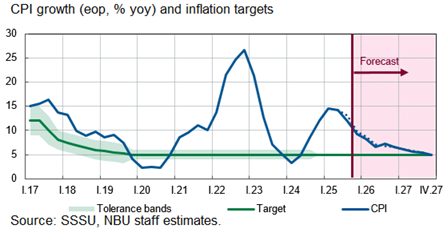
Source: NBU, Inflation Report, Q4 2025.
On 23 October the Board of the National Bank decided to keep the key policy rate at 15.5%. Despite the decline in inflation in recent months, inflation expectations remain high, and pro-inflationary risks – in particular those related to increasing energy shortages and budgetary needs – have intensified. Under these conditions, in order to maintain the attractiveness of hryvnia-denominated assets, the stability of the foreign exchange market, and the steady downward trend of inflation toward the 5% target over the policy horizon, the NBU will maintain relatively tight monetary conditions.
The NBU has also changed its forecast for the future path of the key rate. Whereas previously the forecast envisaged that rate cuts would begin in Q4 2025, the NBU now plans to keep the rate at 15.5% until Q1 2026.
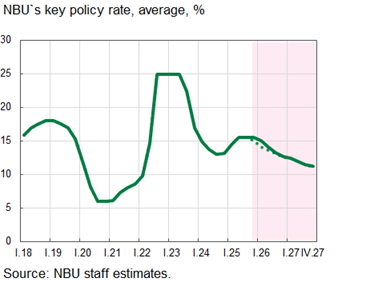
Source: NBU, Inflation Report, Q4 2025.
BUDGET
The consolidated budget for the first 9 months of 2025 posted a deficit of UAH 870.5 billion, compared with UAH 733 billion in January-September 2024.
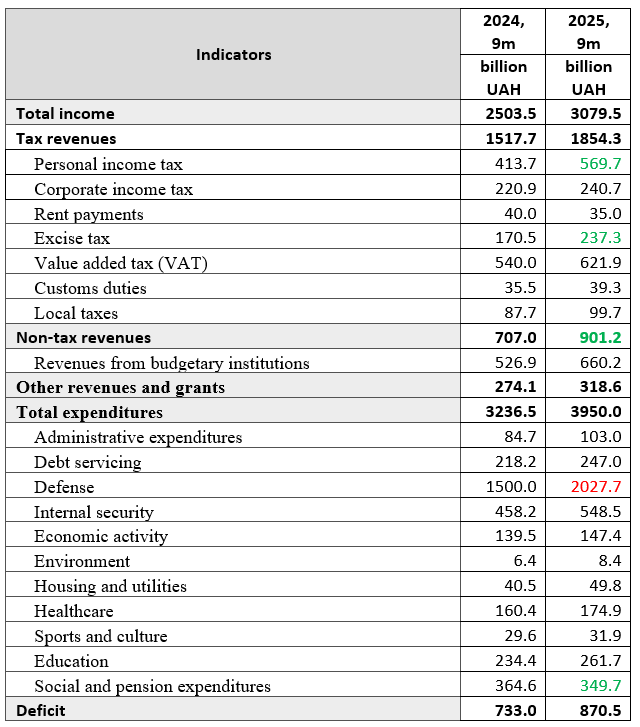
Tax revenues in 2025 are already UAH 336.6 billion higher than in 2024. Revenues from the SSC (Single social contribution) are also above plan (they are not part of the budget). This reduces the need for social transfers from the state budget to the Pension Fund. As a result, social spending of the consolidated budget in 2025 over the first 9 months is lower than in 2024. At the same time, UAH 527 billion in additional defense spending and UAH 100 billion for domestic security over 9 months have generated UAH 630 billion in additional security-related expenditure in the first 9 months of 2025.
Of this, according to our estimates, approximately UAH 130 billion exceeds Western military assistance, and there is about + UAH 500 billion in domestic defense spending. However, around UAH 200 billion more has been spent on wages and procurement than in 2024. This indicates that the main growing item of security expenditure is payments related to the death of servicemen. These may reach UAH 300 billion more than in 2024.
At the same time, the state budget deficit for January-September 2025 amounted to UAH 926.5 billion, while local budgets recorded a surplus of UAH 54.0 billion.
In October 2025 Ukraine received external financing from the following sources:
Ukraine also received USD 177 million from the World Bank.
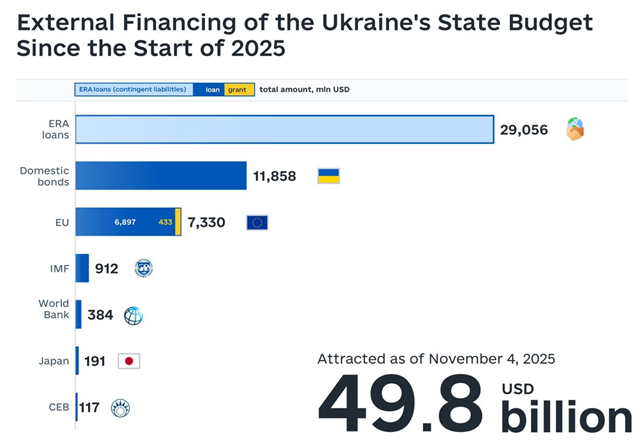
Source: Ministry of Finance.
As of 1 October 2025, the balances on the accounts of the state budget and local budgets amounted to UAH 380 billion. This is sufficient to finance state budget expenditures for 2-3 months without external assistance.
As of 1 October 2025, Ukraine’s public and publicly guaranteed debt totaled USD 194.21 billion (+ USD 1.5 billion in September 2025).
The debt increased due to EU financing received by Ukraine in September 2025.
In the first 9 months of 2025 the current account deteriorated significantly, which was offset by an increase in credit resources flowing into Ukraine. Thus, imports of goods increased by USD 11.1 billion, while exports of goods in 2025 fell by USD 1.1 billion compared with the first 9 months of 2024.
It should also be noted that, despite the fact that remittances from migrant workers to Ukraine almost fell by USD 900 million in 2025, they have stabilised at around USD 550 million per month.
As a result, the current account balance for the first 9 months of 2025 deteriorated by USD 13 billion.
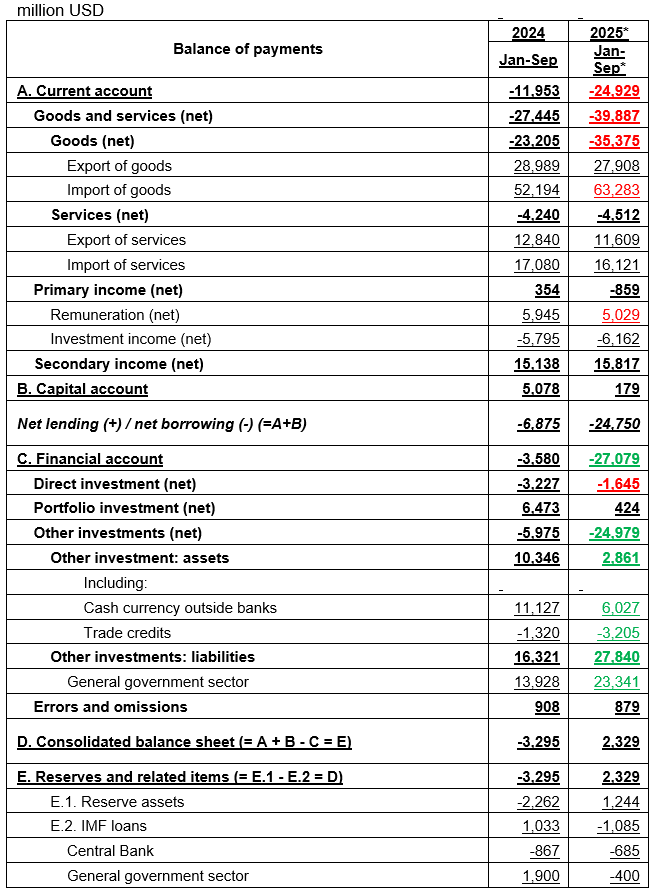
Balance of payments for the first 9 months of 2024-2025. Source: NBU.
On the financial account, it is worth noting a sharp decline in foreign direct investment (FDI) in Ukraine. In the first 9 months of 2025 FDI halved. At the same time, with the exchange rate of the hryvnia against the dollar remaining stable since the beginning of the year, household purchases of foreign currency fell from USD 11.1 billion to USD 6 billion.
Credit financing for Ukraine in 2025 is USD 9.5 billion higher than it was in 2024.
We see that inflation is falling faster than we expected, and this allows the NBU to shift its exchange rate policy from containing inflation through a fixed hryvnia/dollar rate to a policy of slight managed depreciation of the hryvnia against the US dollar.
In addition, we see that the euro has weakened against the US dollar, which will bring the hryvnia/dollar rate closer to the hryvnia/euro rate.
We believe that the hryvnia/dollar rate in November may exceed UAH 42.5 per USD.
At the same time, the hryvnia/euro rate in November will remain at the October level.
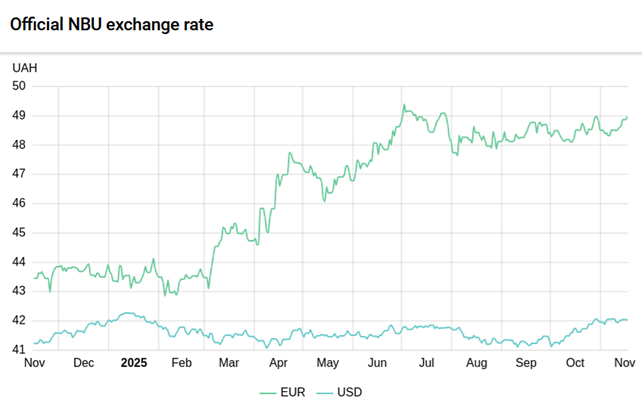
Hryvnia exchange rate to the US dollar and the euro over the past 12 months. Source: NBU.
International reserves in October 2025 increased from USD 46.5 to 49.5 billion. This is a new all-time record for Ukraine.
According to its balance sheet data, the National Bank sold USD 2,834.9 million on the foreign exchange market and purchased USD 0.8 million into reserves. Thus, net foreign currency sales by the NBU in October amounted to USD 2,834.1 million.
In October, USD 6,398.4 million were credited to the government’s foreign currency accounts with the National Bank, including:
A total of USD 611.6 million was paid to service and repay public debt in foreign currency, including:
In addition, Ukraine paid USD 83.9 million to the International Monetary Fund.
The current level of international reserves covers 5.1 months of future imports.
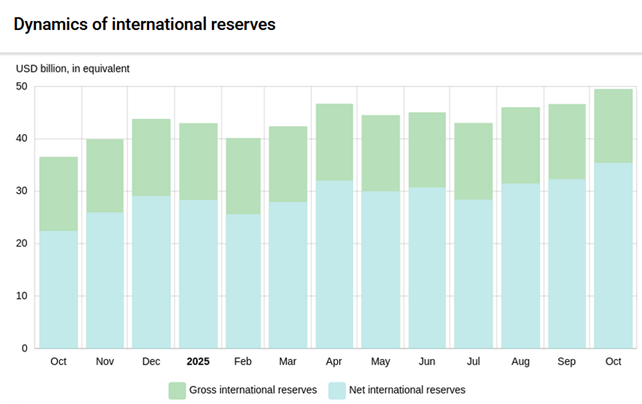
Changes in international reserves over the past 12 months. Source: NBU.
Second half of November – Verkhovna Rada. Adoption of the 2026 Budget.
10 December – UIF. Update of the UIF forecast on the state of Ukraine’s economic macro-indicators, the budget, and the balance of payments in 2025.
11 December – NBU. Meeting on the NBU key policy rate.


Together we can change the future! Your support allows us to continue our research and provide objective analysis of key social issues. Join us today to build the future of our generations together.
Support