Digests • 17 March 2025
The Ukrainian Institute for the Future has presented an economic forecast for 2025. In a scenario where the war continues until the end of 2025, economic growth is projected at 1.8% of GDP, with inflation reaching 9.9%. The budget deficit is expected to be 8.5% of the GDP, with USD 22 billion in grant support. In the scenario where the war ends in mid-2025, economic growth is projected at 2.8% of GDP, with inflation at 9.5%. The budget deficit is expected to be 7.4% of the GDP, with USD 15 billion in grant support. A more detailed forecast for 2025 can be accessed at:
Representatives of the Ukrainian government and experts from the International Monetary Fund (IMF) have reached a staff-level agreement on the seventh review of the Extended Fund Facility (EFF) program. However, at Ukraine’s request, the amount of the next tranche has been reduced from USD 900 million to USD400 million.
On March 6, the National Bank of Ukraine (NBU) decided to raise the interest rate from 14.5% to 15.5%.
As of February 2025, international reserves have decreased from USD 43.0 billion to USD 40.1 billion.
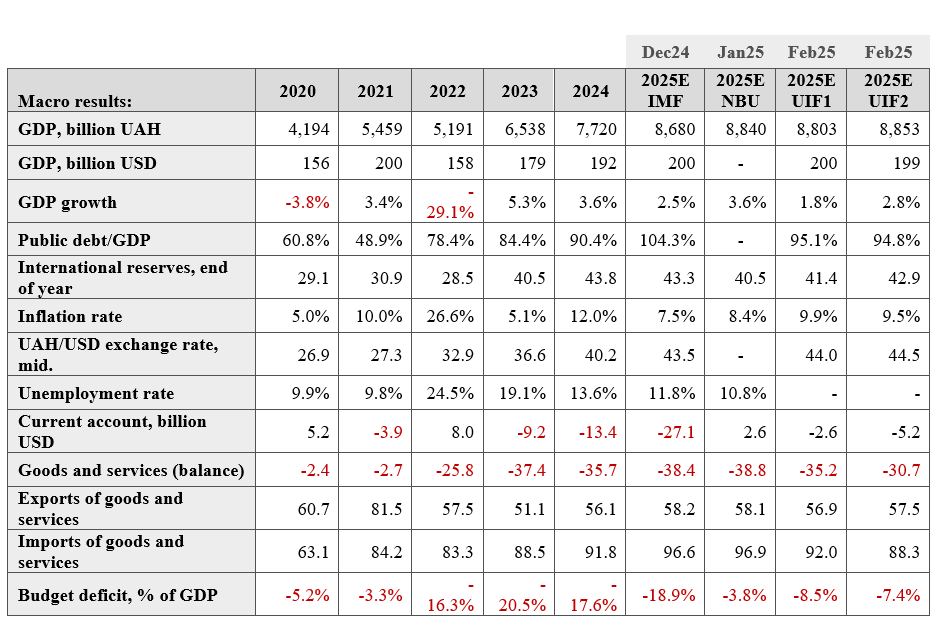
Nominal GDP Data for 2024 – from the Latest NBU Report (January 2025). GDP Growth Data – Estimates by the Ministry of Economy and UIF.
Seventh review of the IMF program.
Representatives of the International Monetary Fund (IMF) and the Ukrainian government have reached a Staff-Level Agreement (SLA). This agreement is subject to approval by the IMF Executive Board, which is expected to review it in the coming weeks. Once approved, Ukraine will gain access to financing amounting to 0.3 billion Special Drawing Rights (SDRs), equivalent to approximately USD0.4 billion.
In its official release, the IMF stated the following:
“The economy continues to demonstrate resilience despite the challenges associated with the three-year war in Ukraine. Real GDP growth is estimated at 3.5 percent in 2024, but it is expected to slow to 2-3 percent in 2025, reflecting headwinds due to labor shortages, damage to energy infrastructure, and the continued war in Ukraine. Inflation has continued to rise, reaching 12.9 percent year-on-year in January, mainly driven by increasing food and labor costs. In response, the National Bank of Ukraine (NBU) raised its key policy rate by 150 basis points since December. As of January 2025, gross international reserves stood at USD 43 billion, reflecting continued substantial external official support. Risks remain extremely high due to uncertainty surrounding the war, as well as prospects for peace and recovery.
The 2025 budget projects a deficit (excluding grants) of 19.6 percent of the GDP and remains a key pillar of fiscal policy for the year. It includes additional revenue generated from increased excise taxes on tobacco products, with the adoption of this tax policy change serving as a prerequisite for completing the review. Financing this significant budget deficit will require substantial and timely external support, particularly through the G7 Economic Resilience Assistance for Ukraine (ERA) initiative, to maintain macroeconomic stability. Addressing high fiscal risks will require readiness to implement compensatory measures, including large-scale, long-term, and effective revenue-enhancing actions and an accelerated implementation of Ukraine’s National Revenue Strategy (NRS).
Restoring medium-term fiscal sustainability will require decisive reforms to mobilize domestic revenues, combat tax evasion, and improve the investment climate. Tax policy reforms must also be accompanied by improvements in tax administration, with continued reform of the State Customs Service (SCS) and the State Tax Service (STS). Restoring debt sustainability will depend on this revenue-based fiscal adjustment and further implementation of the government’s debt restructuring strategy, with the resolution of GDP-linked warrants remaining a key priority. The forthcoming budget declaration for 2026-2028, expected to be submitted to Parliament in June, will provide an important opportunity to outline both the context and strategic objectives of the medium-term fiscal strategy.”
On March 6, the Board of the National Bank of Ukraine (NBU) decided to raise the key policy rate from 14.5% to 15.5% per annum. This decision aims to maintain the attractiveness of savings in hryvnia, ensure the stability of the foreign exchange market, and control inflation expectations, ultimately returning inflation to a sustainable downward trajectory toward the 5% target. The NBU remains ready to implement additional monetary measures if inflationary risks intensify further.
In January, inflation accelerated to 12.9% year-on-year and, according to NBU estimates, continued to rise in February. The acceleration in consumer inflation was primarily driven by temporary factors. These trends were anticipated and generally aligned with the NBU’s forecast.
Inflation is expected to increase in the coming months due to the lingering impact of last year’s poor harvests and rising production costs for businesses. However, the NBU’s monetary policy tightening will help contain fundamental price pressures, while the arrival of new harvests in the summer will slow food price growth.
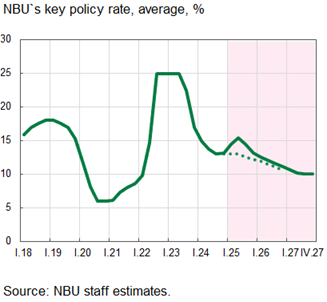
key rate forecast (January 2025)
According to UIF’s assessment, the interest rate hike has only a minor impact on curbing inflation, as Ukraine’s inflation is primarily non-monetary.
Consumer inflation in February 2025 increased by 0.8% compared to January 2025 and by 2.0% since the beginning of the year.
Core inflation in February 2025 was 0.7% compared to January 2025, reaching 2.0% year-to-date.
In February, food and non-alcoholic beverage prices rose by 1.2%. The most significant increases were recorded in egg prices (+3.5%) and sunflower oil (+3.4%). Prices for pasta, fruits, butter, processed grain products, fish and seafood, non-alcoholic beverages, milk and dairy products, vegetables, bread, and meat products increased by 0.6% to 1.9%. Meanwhile, sugar prices declined by 0.4%. Prices for alcoholic beverages and tobacco products increased by 1.3%, mainly due to a 2.0% rise in tobacco prices.
Clothing and footwear prices fell by 3.1%, with clothing decreasing by 3.4% and footwear by 2.7%.
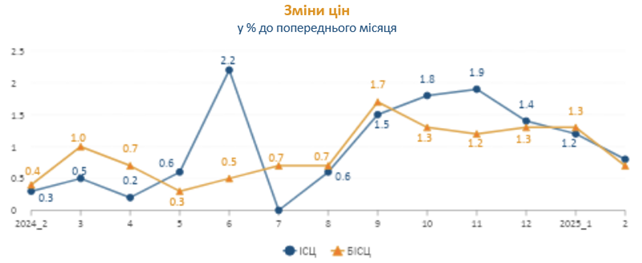
Price changes over the last 12 months.
CPI, CCPI
Source: Ukrstat.
Over the past 12 months, inflation has risen from 12.9% to 13.4%.
The consolidated budget for January 2025 closed with a deficit of UAH 50.2 billion, compared to UAH 4 billion in January 2024. Defense expenditures were exceptionally high, reaching UAH 233 billion in January 2025, up from UAH 65 billion in 2024. Our assessment indicates that the high defense expenditures are linked to a large transfer of military products to Ukraine’s budget, estimated at approximately UAH 130 billion (over USD 3 billion).
Including the military product transfers in December 2024, which we estimate to be USD 4 billion, the total amounting to over USD 7 billion. This suggests that Ukraine has reserves even in the event of a suspension of U.S. military aid.
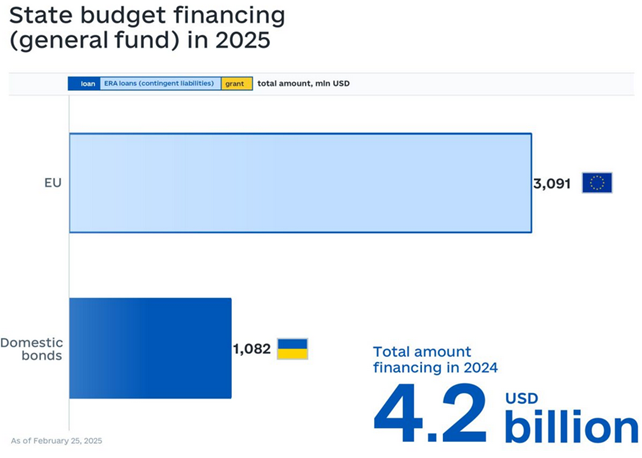
No external financing was received in February 2025.
On March 7, 2025, the UK provided a USD 1 billion tranche under the ERA program.
Source: Ministry of Finance of Ukraine
As of January 2025, cash balances in the state and local budgets increased from UAH 264 billion to UAH 308 billion, sufficient to finance expenditures through February and March 2025.
As of February 1, 2025, Ukraine’s total public and guaranteed debt amounted to USD 168.99 billion (+USD 3 billion in January 2025).
Notably, the Ministry of Finance recorded the USD 3 billion in financing received from the EU under the ERA mechanism in January as a loan rather than a grant.
If the ERA program financing, sourced from frozen Russian assets, continues to be recorded as debt rather than grants, public debt is expected to exceed 100% of the GDP by the end of 2025.
Balance of payments
The balance of payments for January 2025 was negative, even with USD 3 billion in Western financing. The trade deficit in January 2025 was USD -2.99 billion, which is USD 1 billion higher than in January 2024 (USD -2.015 billion).
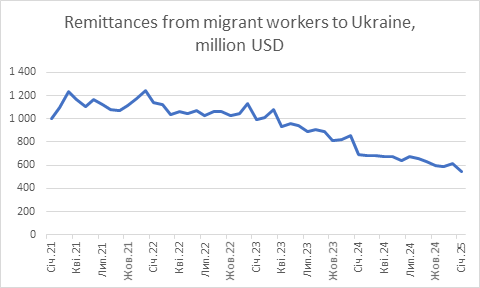
Additionally, remittances from Ukrainian workers abroad continue to decline. In January 2025, remittances fell to USD 546 million, whereas two years ago, they exceeded USD 1 billion per month. If the war persists, remittances are projected to drop to USD 200-300 million per month by the end of 2026.
Source: NBU balance of payments.
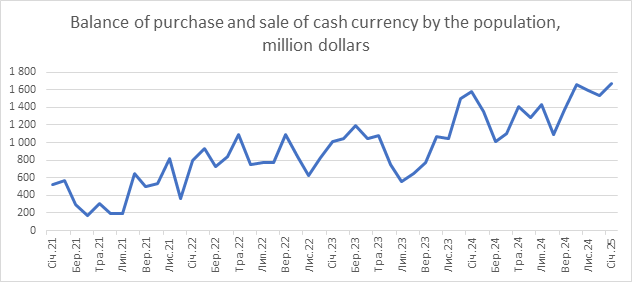
An unfavorable development in January 2025 was the population’s increase in net foreign currency purchases, reaching a record USD 1.674 billion for the month.
Source: NBU balance of payments.
The hryvnia exchange rate in February exceeded our expectations. We had projected a rate of around 42 UAH/USD, but despite the absence of external financing in February, the National Bank managed to maintain the hryvnia at approximately 41.5 UAH/USD.
We believe that the NBU has now shifted to actively containing inflation by stabilizing the national currency exchange rate. Additionally, we assess that the exchange rate is influenced by a currency basket of the U.S. dollar and the euro. The strengthening of the euro from 1.03 to 1.08 against the dollar has contributed to the hryvnia’s appreciation against the dollar.
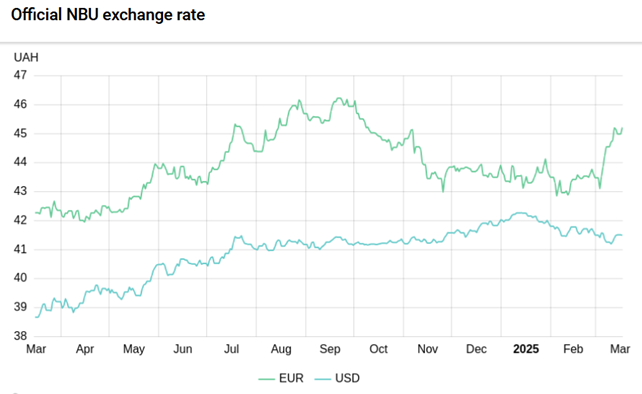
Dynamics of the official exchange rate of the UAH to the USD and EUR. Source: NBU
Despite the current appreciation of the hryvnia, we consider it a temporary phenomenon. Fundamental factors, such as the deteriorating balance of payments in 2024, are expected to drive devaluation, leading to an exchange rate of 46 UAH/USD by the end of 2025.
Ukraine’s international reserves decreased from USD 43 billion to USD 40.1 billion in February 2025.
In February 2025, compared to January, the National Bank’s net foreign currency sales decreased by 19.4%. According to NBU balance sheet data, the bank sold USD 3.0226 billion on the foreign exchange market.
In February, Ukraine’s government received USD 255.0 million from placing foreign currency-denominated government bonds.
The government made foreign currency debt service and repayment payments totaling USD 341.6 million, including:
Additionally, Ukraine paid USD 428.9 million to the International Monetary Fund.
The current level of international reserves covers 4.9 months of future imports.
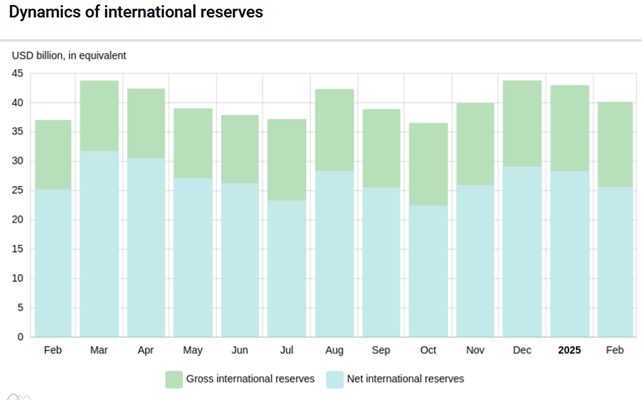
Changes in international reserves over the last 12 months. Source: NBU
End of March: Ukrstat will release GDP data for 2024.
End of March: The IMF will publish a new economic forecast for Ukraine as part of the seventh program review.


Together we can change the future! Your support allows us to continue our research and provide objective analysis of key social issues. Join us today to build the future of our generations together.
Support