Digests • 17 April 2025
On March 28, 2024, the Executive Board of the International Monetary Fund approved the seventh review of the Extended Fund Facility (EFF) program. The successful completion of this review grants immediate access to financing in the amount of SDR 0.3 billion (approximately USD 0.4 billion equivalent), which will be directed toward supporting the state budget.
According to IMF data, Ukraine is expected to receive USD 17 billion more in financial assistance under the ERA program in 2025 than previously anticipated.
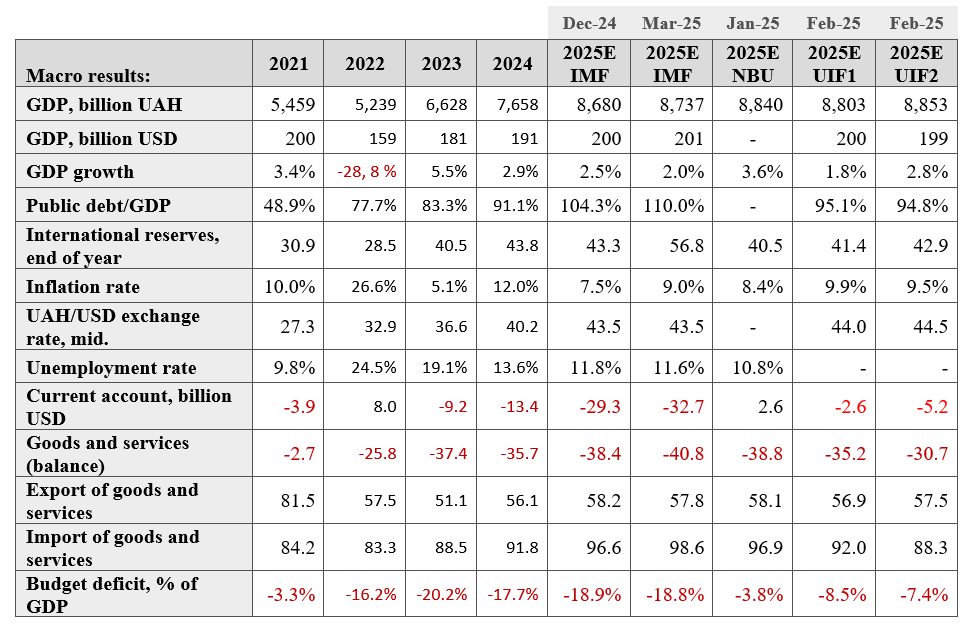
On March 31, the State Statistics Service of Ukraine published GDP figures for the fourth quarter of 2024 and the whole year. In Q4 2024, the economy experienced a 0.1% decline. Economic growth for 2024 was 2.9%, significantly lower than all forecasts.
International reserves increased in March 2025 from USD 40.1 billion to USD 42.4 billion.
Seventh Review of the Arrangement with Ukraine
On March 28, 2024, the Executive Board of the International Monetary Fund approved the seventh review of the Extended Fund Facility (EFF) program. The successful completion of this review provides for immediate access to financing in the amount of SDR 0.3 billion (approximately USD 0.4 billion equivalent), which will be directed toward supporting the state budget.
In its press release, the IMF stated the following:
“Ukraine’s performance under the program remains strong. All structural benchmarks set for December were met, as were the majority of structural indicative targets. Prior actions for the signing of the law increasing excise taxes on tobacco products were also fulfilled. The structural benchmark concerning the adoption of the law establishing the High Administrative Court was implemented with a delay. New benchmarks, including measures to enhance public investment management, have been established, while the timelines for other benchmarks have been adjusted accordingly. The authorities have also requested a modification of IMF disbursements to better align with Ukraine’s updated financing needs. The overall size of the program remains unchanged.
Economic growth in 2024 was resilient but slowed in the second half of the year. According to the Fund’s forecasts, the deceleration of economic recovery is expected to continue in 2025, driven by even tighter labor market conditions and the impact of Russian attacks on energy infrastructure. The tightening of monetary policy by the National Bank in response to the recent inflation spike, driven mainly by rising food prices, was appropriate. At the same time, inflation expectations remain anchored and reserves remain adequate due to continued external support. However, risks to the outlook are extremely high given the uncertainty surrounding the duration of the war.
The 2025 budget remains the fiscal anchor. The adoption of the law on excise tax on tobacco products is welcomed, as it supports the authorities’ commitment to implementing the National Revenue Strategy. Accelerated implementation of this strategy, including the modernization of tax and customs administrations, reduction of tax evasion, and harmonization of legislation with EU standards, is necessary to meet priority spending needs. This, combined with enhanced systems for managing public investment, preparing a medium-term budget, and mitigating fiscal risks, will contribute to growth, investment, and fiscal sustainability.
The authorities continue to work on finalizing the debt restructuring strategy. At present, they are focused on reaching agreements with the remaining holders of external commercial claims, including GDP warrants. Achieving an agreement consistent with the program’s debt sustainability objectives is essential to reduce fiscal risks and create room for critical expenditures.”
On March 31, the State Statistics Service of Ukraine published GDP data for the fourth quarter of 2024 and the whole year. In Q4 2024, the economy experienced a 0.1% decline. Economic growth for 2024 was 2.9%, which is significantly lower than all forecasts.
One of the reasons for this outcome is a 30% decline in agriculture in Q4 and a 7.3% decline for the full year 2024. However, other negative trends are also present in the economy. Most notably, a decline in trade by 6.8% in Q4 2024 and 4.1% for the year as a whole.
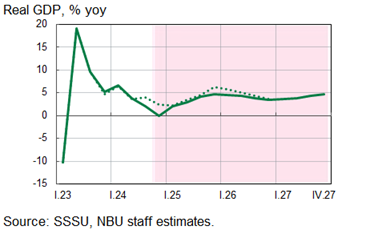
GDP Growth: Actual for 2023–2024 and NBU Forecast for 2025–2027. Source: State Statistics Service of Ukraine, National Bank of Ukraine (NBU).
The IMF has revised its GDP growth forecast for Ukraine in 2025 downward from 2.5% to 2.0%.
In the seventh review, the IMF provided its forecast regarding changes to the National Bank of Ukraine (NBU) key policy rate over the coming months. Based on this forecast, the NBU rate is expected to rise to 16–17% at the next meeting and remain at that level through the first quarter of 2026.
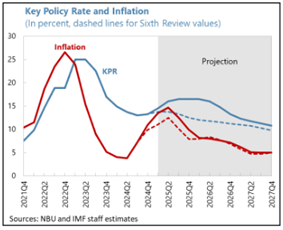
Rate Forecast. March 2025. Source: IMF, March 28, 2025.
Such a rate level would support an increase in the NBU’s certificate of deposit rate to 20% and generate profits for the banking system in 2025 of UAH 250–300 billion per year, due to reduced transfers of NBU profits to the state budget.
As of the end of February 2025, according to UN data, 6.91 million Ukrainians are abroad. Over the past year, net migration outflow totaled 450,000 people. Based on demographic composition, 31% of those abroad are children aged 0–17, which amounts to an estimated 2.14 million children. Meanwhile, between 2008 and 2024, 6.466 million children were born in Ukraine over 17 years. Therefore, the estimated number of children currently residing in Ukraine stands at approximately 4.3 million.
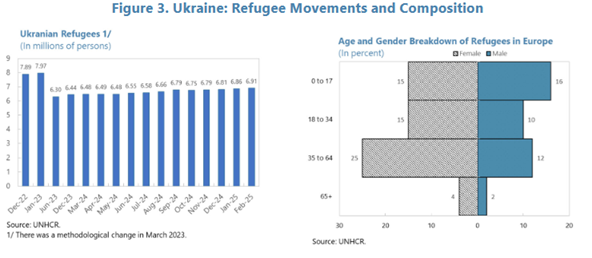
Source: IMF, March 28, 2025
Consumer market inflation in March 2025 compared to February 2025 amounted to 1.5%, and 3.5% since the beginning of the year.
Core inflation in March 2025 compared to February 2025 was 1.4%, and 3.4% since the beginning of the year.
In March, prices for food and non-alcoholic beverages on the consumer market rose by 1.7%. The most significant increase was in egg prices, which grew by 18.8%. Prices for fruits, non-alcoholic beverages, sunflower oil, vegetables, grain processing products, bread, meat and meat products, milk, and butter increased by 0.6% to 6.6%. At the same time, prices for rice and pork fat declined by 0.5%.
Prices for alcoholic beverages and tobacco products increased by 1.9%, driven by a 2.4% rise in tobacco product prices.
Clothing and footwear prices rose by 13.3%, with footwear increasing by 13.8% and clothing by 13.0%.
Transport prices rose by 0.2%, mainly due to a 4.4% increase in railway fares and a 1.5% increase in road passenger transport fares. Meanwhile, prices for fuel and lubricants declined by 0.9%.
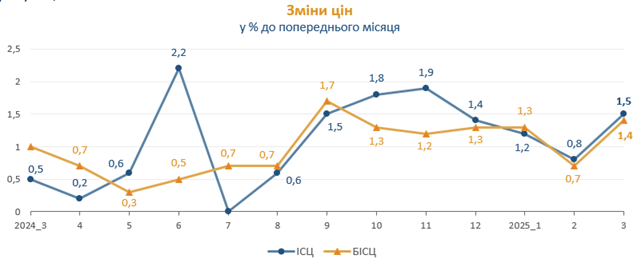
Price changes over the past 12 months. Source: State Statistics Service of Ukraine.
The IMF has raised its inflation forecast for Ukraine in 2025 from 7.5% to 9.0%.
The consolidated budget for January-February 2025 closed with a deficit of UAH 203.7 billion, compared to a deficit of UAH 66.8 billion in January-February 2024.
Notably, defense spending was extremely high. In January-February 2025, it reached UAH 475 billion compared to UAH 227 billion in January-February 2024. According to our estimates, the elevated defense expenditures are linked to the substantial transfer of military equipment to Ukraine via the budget, which we estimate at around UAH 220 billion, or more than USD 5 billion.
The budget deficit in 2025 will be much higher than in 2024 due to the lack of grants in financing.
In March, external sources provided UAH 264.6 billion (approximately USD 6.3 billion), including loans obtained under the ERA mechanism totaling UAH 248.0 billion (approximately USD 5.9 billion), specifically:
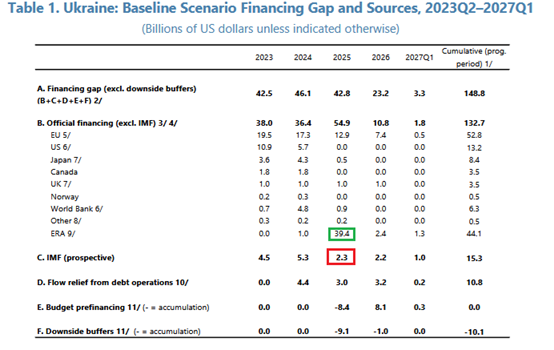
The IMF has revised its forecast for Ukraine’s financing in 2025. Under the ERA program, Ukraine is now expected to receive USD 39 billion in loans, up from the previously projected USD 22 billion. At the same time, the IMF has reduced its own lending to Ukraine in 2025 by USD 0.4 billion.
This level of financing enables Ukraine to build reserves for budget funding in 2026 in the amount of UAH 700 billion.
As of March 1, 2025, Ukraine’s public and publicly guaranteed debt totaled USD 169.09 billion (+ USD 0.1 billion compared to February 2025).
It is worth noting that, according to IMF forecasts, the financing provided under the ERA mechanism by the EU in 2025 will be allocated to Ukraine in the form of loans.
The IMF has revised its forecast for the level of public and publicly guaranteed debt by the end of 2025 to 110% of GDP, or UAH 9,611 billion. This is expected to exceed USD 210 billion by the end of 2025.
The balance of payments in February 2025 was negative. The trade deficit in February 2025 amounted to USD 3.179 billion. This is USD 1.27 billion higher than in February 2024 (–USD 1.907 billion), indicating a negative trend in 2025. Exports are declining, while imports are increasing.
Additionally, the primary income balance shows a weak performance for the first two months of 2025, with a deficit of USD 259 million compared to a surplus of USD 20 million in 2024.
On a positive note, in February 2025, the population’s balance of foreign currency purchases improved. Currency purchases fell from USD 1,676 million in January to USD 1,157 million in February.
The hryvnia exchange rate remained relatively stable in March, supported by the inflow of Western financial assistance. The National Bank of Ukraine has shifted its focus to actively curbing inflationary pressures by maintaining the stability of the national currency. Given the increase in annual inflation and the high level of international reserves at the end of the year, we believe the NBU will continue to restrain inflationary processes by maintaining a steady exchange rate in April 2025.
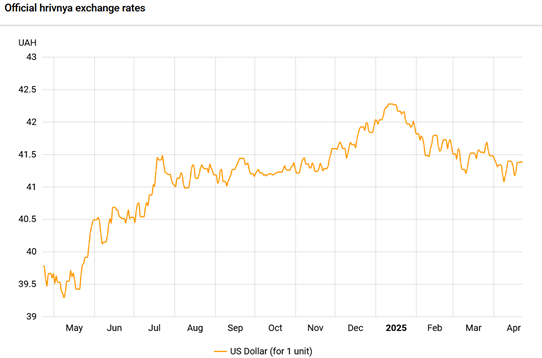
UAH to USD exchange rate over 12 months. Source: NBU.
In its forecasts, the IMF projects the average hryvnia-to-dollar exchange rate for 2025 at 43.5.
In March 2025, international reserves increased from USD 40.1 billion to USD 42.4 billion.
The NBU sold USD 2,653.7 million on the foreign exchange market and purchased USD 10.0 million into reserves.
USD 5,980.2 million was received into government foreign currency accounts at the National Bank, including:
In addition, Ukraine received a USD 970.0 million loan under the agreement with the United Kingdom as part of the ERA mechanism. These funds were not included in Ukraine’s international reserves due to their restricted (targeted) use.
A total of USD 786.7 million was spent on servicing and repaying public debt in foreign currency, including:
– USD 688.7 million for servicing and repaying foreign currency government bonds (OVDPs);
– USD 55.9 million for servicing and repaying debt to the World Bank;
– USD 42.1 million in payments to other international creditors.
Additionally, Ukraine paid USD 729.2 million to the International Monetary Fund.
The current level of international reserves covers 5.2 months of future imports.
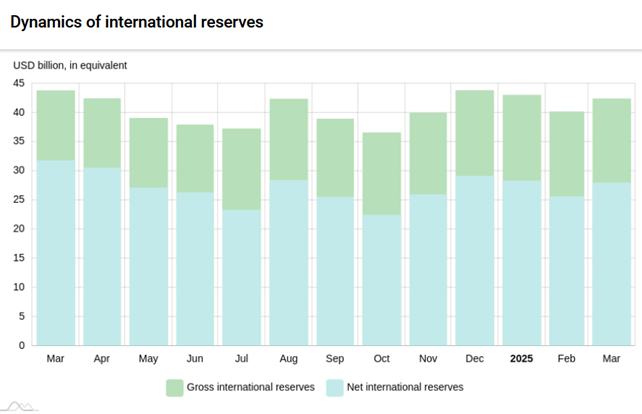
Change in international reserves over the past 12 months. Source: NBU.
April 17 – NBU board meeting on monetary policy
April 24 – NBU inflation report for Q2 2025


Together we can change the future! Your support allows us to continue our research and provide objective analysis of key social issues. Join us today to build the future of our generations together.
Support