Digests • 09 October 2025

9 October 2025
Published
The Ukrainian Minister of Energy, Svitlana Grynchuk, and Azerbaijan’s Minister of Energy, Parviz Shahbazov, held an online meeting. The parties outlined their shared priorities for the future and updated the cooperation roadmap between departments and countries. The discussion focused on diversifying sources and routes of gas supply, developing the Trans-Balkan gas corridor, and exploring potential export/import of oil products. Additionally, they discussed the current situation in Ukraine’s energy system and the effects of recent Russian shelling. Shahbazov confirmed continued support for Ukraine in response to the threats of increased Russian attacks. As reported, at the beginning of September, Azerbaijan donated energy equipment and materials to Ukraine for infrastructure restoration, in line with the agreement on energy aid.
Overall, capacity availability in the Ukrainian power system has remained relatively stable compared to the second half of August. Two nuclear power units remained offline for maintenance, while power generation from renewable energy sources, mainly solar, remained high due to favorable weather conditions. At the same time, cooler temperatures led to lower power demand. This influenced the supply-demand balance, as power generation remained high while demand decreased.
The existing supply-demand balance, on one hand, increased net electricity exports; on the other hand, supply that exceeded demand affected prices. In August, the average day-ahead price index was 5,188.79 UAH/MWh. For the first 10 days of September, it was 3,836.33 UAH/MWh, 3,903.65 for the first 20 days, and 4,196.92 for the entire month, which is 19% less than in August.
Many electricity traders did not anticipate such a sharp decline in prices and reported losses, with some even accusing some actors of market manipulation. However, record volumes of electricity exports in September are another indication of a sensitive excess of electricity surplus over demand during the month, which affected prices. The losses are tied to the fact that trading contracts utilize the Day Ahead Market index, which is not representative due to its relatively small share of electricity traded in this segment, and the inability to predict prcies accurately.
In September, Russia continued occasional strikes on Ukrainian power facilities. Some areas experienced short-lasting rolling blackouts. However, power supply remained broadly available nationwide. The situation deteriorated and became more serious in early October. This year, Russia may adopt a new tactic in attacking Ukrainian energy facilities.
Ukraine set a new electricity export record in September.
Electricity exports from Ukraine reached a new high in September at 635.1 thousand MWh, representing a 41% increase from August. As a reminder, August was also a record month for exports, with trade volume nearly 60% higher than in July.
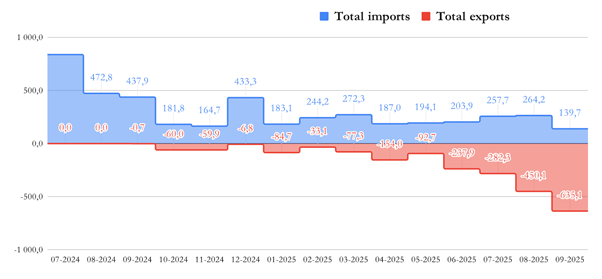
Monthly electricity export and import volumes for the recent year
(The chart is based on ENTSO-E data)
The primary reason for this trend is a decline in demand resulting from a gradual decrease in temperature and a high volume of available capacity in the power system, primarily due to repairs and the construction of new generation units, particularly solar. Solar power plants remained highly productive in September, increasing the supply.
August and September export comparison (based on ENTSO-E data)
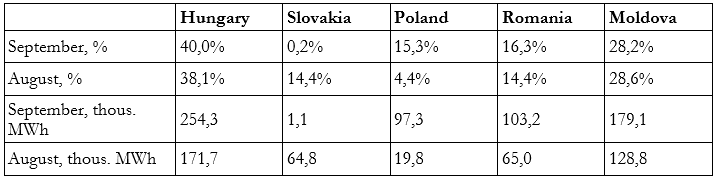
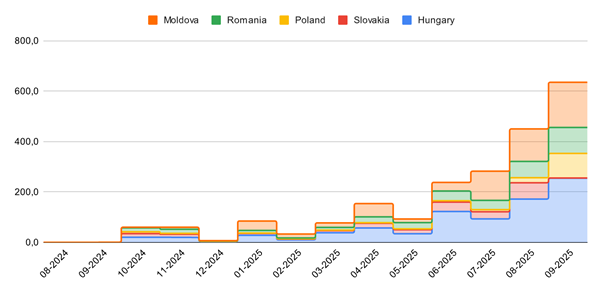
Monthly electricity export volumes by partner countries
(The chart is based on ENTSO-E data)
August and September import comparison (based on ENTSO-E data)
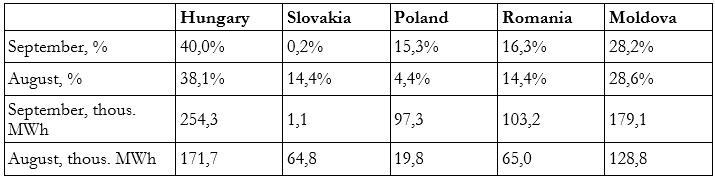
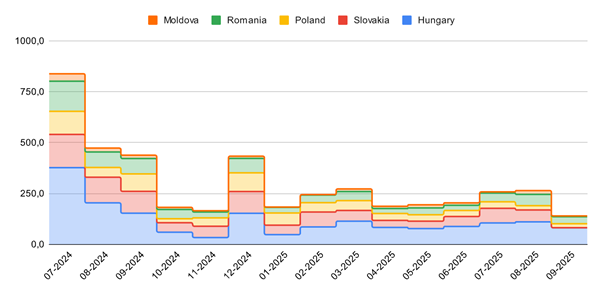
Monthly electricity import volumes by partner countries
At the beginning of September, the rise in exports was even more noticeable compared to August. In the last 14 days of August, exports totaled 289.5 thousand MWh, while in the first 14 days of September, they reached 307.3 thousand MWh. Conversely, imports showed the opposite trend: 52.7 thousand MWh entered the Ukrainian power system in the last 14 days of August, and nearly 44 thousand MWh in the first two weeks of September. This indicates that net exports in the first half of September are significantly higher than exports in the second half of August.
However, in the second part of the month, export volumes declined slightly, while import volumes increased as power demand grew due to colder weather and a decrease in solar power generation caused by cloudy skies.
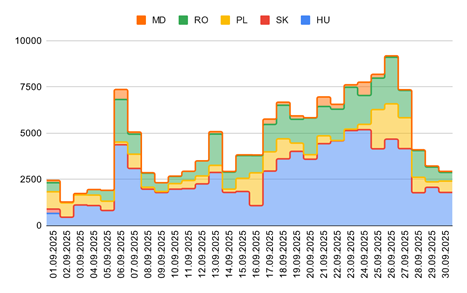
Daily volumes of electricity exports by countries of origin, MWh
(The chart is based on ENTSO-E data)
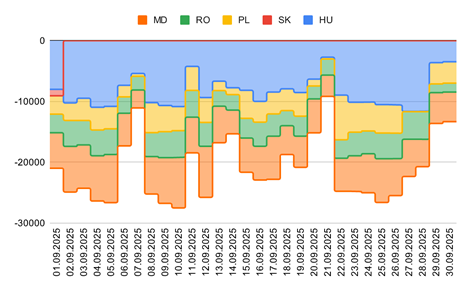
Daily volumes of electricity imports by countries of origin, MWh
(The chart is based on ENTSO-E data)
Maintenance on the interstate power transmission line “Vel’ke Kapusany – Mukachevo,” which connects Slovakia and Ukraine, began on September 1 and will last through the end of October 2025. During this period, capacity will be limited. There has been no bilateral trade since September 2. At the same time, this has not impacted Ukraine’s overall export capacities, as exports to Poland increased significantly after the maintenance of the power line to Slovakia.
Debt to Ukrenergo on the balancing market has already reached UAH 39.2 billion. Since the beginning of the year, the amount has increased by 13%, hitting a record high. Ukrenergo’s debt to balancing market participants as of September 2025 was UAH 16.7 billion, maintaining the same debt level as at the start of the year.
The debt issue arises from the privileges of a separate list of companies, which are designated by the government as protected, and therefore not required to pay for electricity. The increasing debts distort trade among segments of the electricity market, hinder the entry of new participants, and threaten the reliability of financing for the system operator Ukrenergo.
DTEK Group has commissioned 200 MW of energy storage facilities developed in partnership with the US company Fluence. The company connected six new facilities with capacities ranging from 20 to 50 MW in the Kyiv and Dnipropetrovsk regions. The total system capacity will be able to store 400 MWh of electricity, enough to supply power to approximately 600,000 Ukrainian homes for two hours.
The construction lasted six months, from March to August 2025, which is much faster than the usual timeline for such projects. DTEK’s total investment in construction reached $125 million. As of now, this is the largest group of energy storage facilities in Ukraine.
In September, a corporate conflict erupted at transmission system operator Ukrenergo. It had been ongoing since the end of July, but became publicly known by the end of September and reached its peak.
On September 26, it was announced that the Supervisory Board of NPC Ukrenergo had dismissed the company’s management board, including its head, Vitaliy Zaichenko. The Supervisory Board unanimously appointed Zaichenko as the company’s head in July 2025. Before that, Zaichenko served as the chief dispatcher of the power system for many years, is regarded as a highly skilled specialist, and is considered one of the key figures whose professionalism helped maintain the integrity of the Ukrainian power system during the period of Russian energy attacks that began in September 2022.
The publicly stated reason for the conflict was the disagreement between Zaichenko and the independent members of the supervisory board over the new composition of the management board. The independent members of the Supervisory Board decided that Zaichenko had lost his independence according to the standards of corporate governance and removed him from his position.
In response, state authorities launched an investigation into the appointment process of board members and the dismissal of Zaichenko, blocking them through relevant lawsuits. The official reason for the government’s suspension of the supervisory board’s decisions was the violation of the appointment procedure by the Supervisory Board.
Following private negotiations between Supervisory Board members and government officials, the Supervisory Board on October 2 overturned its previous decision and retained Zaichenko in his position.
In September, daily natural gas consumption ranged from 24 to 40 million cubic meters, exceeding the August levels of 23.3 to 26 million cubic meters due to colder weather at the end of the month. The average daily gas import volumes were 23.5 million cubic meters. Combined with domestic gas production, this enabled the daily injection of 38 to 59 million cubic meters into gas storage facilities.
By the end of the month, storage held 12.9 billion cubic meters of gas. As a reminder, the goal is to reach approximately 13 billion cubic meters by November. In October, gas consumption is expected to continue increasing, and domestic gas production may be at risk due to Russian attacks on gas infrastructure. Therefore, the rate of gas storage will slow down, and additional volumes might be needed.
As of the end of September, the Naftogaz group allocated $1 billion of its own funds to buy gas for winter needs, and an additional $1.5 billion was raised from the European Bank for Reconstruction and Development, the Norwegian government, and other international financial institutions. Additionally, in late September, Naftogaz signed a loan for 300 million euros from the European Investment Bank, as agreed upon during the Ukraine Recovery Conference held in July in Rome.
The head of Naftogaz stated that the company has already secured 95% of the gas needed for the start of the heating season. At the same time, if Russia keeps attacking Ukraine’s gas production facilities in fall and winter, more imported gas and funds will be required.
Gas import capacities from Poland will be unavailable from October 20 to 23 due to repairs.
From October 20 to 25, 2025, modernization work is scheduled to upgrade the Ukraine-Poland virtual connection point infrastructure used for importing natural gas into Ukraine. During this time, access to import capacities at the Polish-Ukrainian border will be limited.
Since the beginning of September, Ukraine has been importing approximately 10 to 10.4 million cubic meters of natural gas daily from Poland. Poland’s share in Ukraine’s total gas imports exceeds 42%, and in September, the Polish route became the main way that Ukraine imports gas, mainly because it is one of the lowest-cost options.
Naftogaz of Ukraine, working with Polish Orlen, has imported about 400 million cubic meters of US LNG to prepare for the heating season. The LNG is brought in via two terminals: Swinoujscie in Poland and Klaipeda in Lithuania. Once regasified, the natural gas is transported through Poland to Ukraine. Naftogaz reports that by mid-September, approximately 450 million cubic meters of American LNG had been contracted for delivery to Ukraine.
India maintained its leading position in diesel supply in July (15.5% of all supplies) and August (18.1%). The majority of diesel of Indian origin comes from Romania – 94.9% of supplies are from key regional traders, including Euronova Energies, Alkagesta, SOCAR Petroleum, and Oscar Downstream.
Some media and analysts spread information, as if Imports of diesel fuel from India to Ukraine will be restricted. According to those messages, the Security Service of Ukraine sent a request to the Energy Customs address on September 15, and the restrictions are set to take effect on October 1. All Indian shipments will require a selection process and laboratory analysis of samples.
At the same time, there were no official statements regarding any regulations or sanctions that would affect the import of diesel fuel from India. Meanwhile, some media outlets reported that the Ministry of Defense has unofficially informed suppliers that Indian diesel is not desired. JSC Ukrnafta announced a second round of tenders for fuel supply and expanded the list of prohibited countries of origin, adding India to the existing restrictions on the Russian Federation, Belarus, and Iran.
The only power transmission line supplying the Zaporizhzhia NPP from the Ukrainian power system was disconnected on September 23 at 16:56.
Russians are attempting once again to connect the NPP to the Russian power grid. These efforts have been attempted before, but the Russians failed each time, as Ukrainian armed forces destroyed Russian lines and later Ukrainian energy personnel reconnected ZNPP to the Ukrainian power grid.
Russia accused Ukraine of destroying the power line that connects the ZNPP to the Ukrainian grid. However, an investigation by Greenpeace found no evidence that military strikes damaged the line. Russia has officially announced plans to connect the ZNPP to its power system. The suspension of power from the Ukrainian line might just be part of a false campaign to justify their attempt to connect the NPP to their grid.
The General Conference of the International Atomic Energy Agency (IAEA), held from September 15-19, adopted a resolution on nuclear safety in Ukraine, calling on Russia to immediately remove all unauthorized military and other personnel from the Zaporizhzhia NPP. Sixty-two member states voted in favor. The resolution affirms that the ZNPP and all nuclear facilities in Ukraine must operate under the full sovereign control of Ukrainian authorities and adhere to the mandate and ongoing work of the Agency’s mission at the ZANP—despite Russia’s ongoing attempts to undermine its activities.
Naftogaz Group has secured UAH 2.445 billion ($59.3 million) in additional financing through a partnership with the state-owned Ukrainian Export-Import Bank (UkrExImBank). The funds will be used to finance the production needs of JSC UkrGazVydobuvannia.
According to the National Bank of Ukraine, from June 2024 to September 2025, Ukrainian banks financed projects to install 1.026 GW of electricity generation capacity and 402 GW of energy storage for heat. The total funding for energy restoration projects across 21 regions is UAH 27.1 billion. Specifically, more than 2,000 loans were issued to businesses for UAH 25.5 billion, and over 10,000 loans to individuals for UAH 1.6 billion.
On July 21, 2025, DTEK imposed an executive arrest on 50% of Gazprom’s shares in the Dutch gas production company Wintershall Noordzee. DTEK, which in 2023 won an international arbitration case in The Hague against Russia for seized assets in the illegally annexed Crimea, justified this by stating that Gazprom can be identified with the Russian Federation. The Russians tried to appeal the arrest, but on September 5, the court denied Gazprom’s request.
The Cabinet of Ministers of Ukraine has appointed new members to the National Energy and Utilities Regulatory Commission: Roman Shikerynets, Lyubomir Salovsky, and Serhiy Pushkar. Their terms will last six years. A selection committee chose the candidates. Maksym Nemchynov, one of the top winners of the competition, was excluded from the appointment because he was under investigation by NABU. Moving forward, NEURC will operate with a whole team of seven members.
The Supreme Anti-Corruption Court cleared former NEURC members Oleksandr Formagei and Dmytro Kovalenko of liability in the Rotterdam+ case because the statute of limitations had expired. The ex-members were charged with official negligence related to their vote on the regulator’s resolution, which became invalid on July 1, 2019. In August, Oksana Kryvenko, a former NEURC member and its head from 2018 to 2019, also announced that the case against her regarding Rotterdam+ was closed.


Together we can change the future! Your support allows us to continue our research and provide objective analysis of key social issues. Join us today to build the future of our generations together.
Support