Digests • 14 April 2025

14 April 2025
Published

Monthly Energy Digest – March 2025
Is the energy ceasefire in effect?
On March 12, after eight hours of negotiations with the US delegation in Saudi Arabia, Kyiv announced that it had accepted a proposal for a 30-day general ceasefire. During a subsequent phone conversation between President Donald Trump and his Russian counterpart, the kremlin suggested instead a suspension of strikes on energy infrastructure.
On March 25, the US and Ukraine presidents held a phone conversation, during which Volodymyr Zelensky announced that a ceasefire covering energy infrastructure was coming into force. At the same time, earlier, the Kremlin stated that the energy infrastructure ceasefire was in effect starting March 18.
However, according to Ukrainian officials, Russian drones have targeted Ukraine’s energy facilities at least eight times since March 18. As Kyiv states this, the Kremlin accused Ukraine of striking its energy infrastructure as well, but Kyiv denied the claims. Strikes took place after March 25 as well. Russia threatened to withdraw from the energy ceasefire, claiming that Ukraine attacked its energy infrastructure.
The general situation in the power system
In the first half of March, the weather in Ukraine was unusually warm for this time of year, decreasing power demand. Due to the excessive available capacity, two nuclear units were disconnected from the power system for maintenance. By the end of the month, seven nuclear power units were operational within the Ukrainian energy system.
Power production by hydropower plants remained low. The available water resources significantly constrain electricity generation by hydroelectric power plants. Due to insufficient spring irrigation, Ukraine is facing a hydrological drought. The situation may worsen further
in the summer. Water flow through hydropower plants in 2025 is expected to be among the lowest ever recorded, similar to the volumes documented in 2015 and 2020.
Due to all these factors, in March 2025, domestic power production was 11 percent lower compared to March 2024, even though domestic power production last year fell after massive Russian strikes on March 22 and March 28, 2024.
The maintenance of nuclear power units resulted in an increase in electricity imports throughout the month. At the same time, output from renewables was restricted to over one GW during certain hours this month due to an oversupply.
In March 2025, Ukraine raised its electricity imports by 11% compared to February 2025, reaching a total of 272 GWh. Hungary supplied the largest share of electricity at 42% of the total volume. Slovakia contributed 19%, Poland 18%, Romania 16%, with the remainder coming from Moldova.
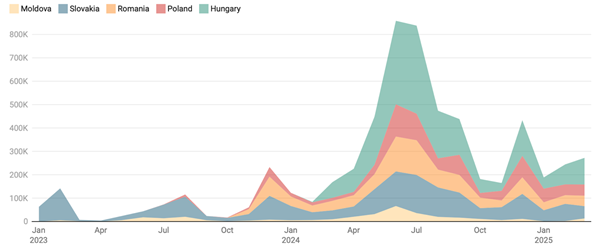
Monthly electricity imports, 2023-2025, in MWh (chart by ExPro agency)
Electricity imports increased in all directions except Slovakia. At the same time, compared to March 2024, the volume of electricity imports decreased by nearly 40%. The significant increase in imports in 2024 was driven by massive strikes that began on March 22, 2024, when Ukraine lacked capacities and transitioned from being a net electricity exporter to an importer. In the same way, Ukraine doubled its electricity exports in March, reaching 76.3 thousand MWh.
Over the past six months, the debt from previous years to RES power producers has decreased by 37.7%.
Over the past six months, the Guaranteed Buyer’s debt prior to RES generation has decreased by 37.7%, from 35.8 billion UAH to 22.3 billion UAH. The debt settlement for renewable electricity by the Guaranteed Buyer last year was 86% and has now increased to 93%. Ukrenergo’s settlement for the RES support service, compared to 2024, rose from 72.9% to 85.2%.
This was partly due to additional payments from Ukrenergo to the Guaranteed Buyer, as stipulated by the recently adopted law. The law mandated that around UAH 12 billion of the excess income from its dispatch operations in 2023-2024 would be allocated to cover market debts.
The first “green” auction in 2025 did not occur due to lack of participants.
The first green auction in 2025 for distributing the support quota for 33 MW of solar PV power plants did not take place due to a lack of applicants. The maximum bid for this auction was 8 euro cents per kWh. Likewise, the auction aimed at distributing the quota for SPP in 2024 also failed for the same reasons.
The legislation limits the total share of capacity that a single investor can obtain. The Law of Ukraine “On Alternative Energy Sources” specifies that the auction winner (along with related companies) cannot receive more than half of the annual support quota for the relevant year (a quota of 25 % was in effect last year). Based on the announced support volume, the auction winner can develop no more than 16.5 MW under this model for this year. Such a small volume diminishes investor interest. Furthermore, investors are not significantly interested due to their fear of inadequate payments of the feed-in premium, as the electricity market is affected by existing debts.
The auction schedule for the allocation of the support quota for 2025 is as follows: 33 MW of solar energy on March 13, 2025; 100 MW of wind energy on April 4, 2025; 47 MW from other sources on May 12, 2025; and 150 MW of wind energy in July 2025.
The first corporate purchase of Guarantees of Origin in Ukraine.
KNAUF GIPS KYIV, a gypsum producer and part of the German Knauf Group, purchased guarantees of electricity’s origin in the Ukrainian market. DTEK served as the electricity supplier for this operation. This marked the first sale of Guarantees of Origin to a corporate buyer in Ukraine.
The EU does not recognize guarantees of electricity’s origin in Ukraine, so this would not impact exports or mitigate CBAM. Similarly, this does not offer any tax discounts in Ukraine. Therefore, this step is merely reputational, demonstrating that some companies utilize renewable energy and strive to reduce their carbon footprint.
Regulations
The government expanded the Public Service Obligation in the gas market, assigning responsibilities and new prices for electricity generation to Ukrnafta.
On March 28, the Cabinet of Ministers of Ukraine updated the mechanism for imposing special obligations (PSO) on participants in the natural gas market to protect the public interest in its operation. The amendment also changed the validity period of the PSO for the supply
of natural gas to household consumers, operators of gas distribution systems, the last resort supplier (Gas Supplying Company Naftogaz), and electricity producers using natural gas until October 31, 2025, instead of the previous date of April 30, 2025.
Previously, natural gas supplied by Naftogaz for consumer use under the framework of the PSO was provided by UkrGazVydobuvannia, which had special responsibilities for selling natural gas to Naftogaz. Starting from April 1 until October 31, 2025, these responsibilities will also be assigned to Ukrnafta and UGV.
After Russia started attacking gas-producing facilities, which led to a drop in gas production, the government was concerned that UGV’s production would not be sufficient to meet all the needs of PSO customers. This meant that Naftogaz had to import expensive gas and trade it at a lower price under PSO rules. That’s why the government has extended PSO, which now covers UkrNafta. At the same time, expanding PSO will affect oil and gas companies, which will have fewer funds to invest in drilling and repairing campaigns.
The amended prices for electricity producers under the PSO rule are the following:
Gas piston and gas turbine plants were divided into two new categories:
Oil transit status and updates
Hungary announced the suspension of Russian oil supplies due to attacks by the Armed Forces.
Hungarian Foreign Minister Péter Szijártó stated that, due to attacks by Ukrainian drones, the supply of crude oil from Russia to Hungary via the Druzhba oil pipeline, which traverses Ukrainian territory, has been suspended.
The General Staff of the Armed Forces of Ukraine reported that explosions were recorded near the Stalnoi Kon’ line-production control station in the Oryol region of the Russian Federation. This station oversees the technological processes of the Druzhba oil pipeline and plays a crucial role in supplying oil to the Ust-Luga seaport terminal in the Leningrad region. Deliveries were renewed one day later.
The government has established requirements for equipment used in the production of bioethanol.
The Cabinet of Ministers adopted Resolution No. 350, which approves the procedure for determining the maximum productivity of equipment used in the production of ethyl alcohol and bioethanol. This resolution was enacted to implement the Law of October 9, 2024, No. 4014-IX, regarding amendments to the Tax Code of Ukraine and other legal statutes pertaining to the specifics of excise tax on ethyl alcohol and bioethanol. This law will enter into force on January 1, 2025, and will be implemented on April 1, 2025.
The share of the shadow market in fuel increased to 18% in 2024, up approximately 5 percentage points from the previous year. This data comes from a study by the Ukrainian Institute of Social and Economic Transformation. The calculations show that the shadow share of Ukraine’s fuel market fell from 30% in 2020 to 13% in 2023, before rising again to 18% in 2024. The study emphasizes that budget losses resulting from the shadow market total UAH 10-12 billion annually.
Zaporizhzhia NPP Developments
The IAEA carried out a rotation at the ZNPP without Ukraine’s agreement.
Ukrainian officials reported that the IAEA rotated its personnel at the Zaporizhzhia Nuclear Power Plant without the approval of Ukrainian authorities. The IAEA mission accessed the plant through occupied Ukrainian territories.
Previously, the IAEA, in its regular review, noted that it is still negotiating with both the Ukrainian and Russian parties regarding the next rotation of its teams at the ZNPP, which was postponed due to intense military activity in the area. Meanwhile, sources in Ukraine indicated that the rotation was delayed because of the Russian Federation’s demands for the IAEA team to visit the ZNPP from the side of the occupied territory. Kyiv did not agree on locations for missions involving trips from the occupied areas.
The EBRD will allocate 1 billion euros to Ukraine for energy recovery.
The European Bank for Reconstruction and Development intends to allocate around 1 billion
euros this year to support Ukraine in revitalizing its impaired energy sector and improving energy sustainability. So far, the EBRD has committed 2 billion euros for these efforts. Altogether, since Russia’s full-scale invasion began in February 2022, the EBRD has contributed 6.4 billion euros to Ukraine.
The EBRD approved a loan of up to €270 million for Naftogaz to facilitate gas purchases.
On March 26, the European Bank for Reconstruction and Development (EBRD) approved a new loan of up to € 270 million for Naftogaz of Ukraine to purchase natural gas for the upcoming two heating seasons. Additionally, around €140 million in grants from the Government of Norway will be allocated through the EBRD for the procurement of natural gas.
According to Naftogaz projections, Ukraine should import up to 4.6 billion cubic meters of natural gas before the start of the next winter season on November 1, 2025.
Russia attacked Naftogaz gas production facilities.
In March, the Russian armed forces continued their campaign against Ukraine’s gas production facilities, which began in late January. This led to a decline in Ukraine’s gas production and highlighted the need to import natural gas for the winter. On the morning of March 7, Russian forces attacked the gas infrastructure of UGV, UkrNafta, and DTEK once again. However, data concerning the decrease in gas production was not disclosed. On March 28, the Russian army targeted Naftogaz facilities. This marked the 18th combined assault on Naftogaz infrastructure since the onset of the full-scale war and the 8th since the start of this year, resulting in damage to the company’s gas production facilities.
The Sudzha gas metering station on the Russia-Ukraine border sustained damage from strikes.
The Sudzha gas metering station, located on the Russia-Ukraine border and one of the entry points for Russian gas into the Ukrainian gas transmission system (GTS), was damaged by an airstrike on March 20. Evidence from the site, including photos and videos, shows a large fire in the area that lasted for two days.
The station was shelled in August 2024 while transit was still ongoing. However, there was no fire because they apparently struck a dry pipe.
Currently, there is no transit. However, a fire broke out after the shelling, suggesting that the pipes contained process gas.
Since there was no transit and the station was near the state border, there was no need to maintain gas in the pipeline. Moreover, the Russian army had moved soldiers through the pipeline a few weeks earlier, resulting in no gas remaining in it.
This suggests that the Russians arranged a staged shelling. The primary aim is to negotiate the
transit of gas around Ukraine via Nord Stream 2. Even before the shelling, we believed Russia would seek ways to export additional volumes outside Ukraine. On March 28, there was another attack on the Sudzha gas measuring station.
PJSC Ukrnafta, reflecting on its activities in 2024, reported a net profit of UAH 16.38 billion. The international firm Crowe Erfolg conducted an independent audit of Ukrnafta and confirmed the profit. The increase in net profit was driven by the rise in oil and gas production, growth in petroleum product sales, and expansion of market share in the gas station sector. However, we expect that revenue and profit in 2025 will decline due to the government’s anticipated public service obligation in the natural gas market, which mandates Ukrnafta to sell gas at lower prices to certain customer groups.
“Ukrnafta” bypassed UGV in terms of revenues in 2024.
For the second consecutive year, Ukrnafta topped the index of leading mining companies compiled by Opendatabot, outpacing UkrGazvVydobuvannya (UGV) and other firms in terms of revenue. In 2024, Ukrnafta’s turnover reached UAH 105.2 billion, reflecting a 10.5% increase from 2023.
“Ukrnafta” passed ISO certification.
State-owned Ukrnafta has received ISO certificates confirming that the company’s processes comply with international standards. At the beginning of 2025, the company successfully achieved certification for its Integrated Management System in accordance with international standards: ISO 9001 for quality management, ISO 14001 for environmental management, and ISO 45001 for occupational health and safety.
In 2024, Ukrenergo received a loss of UAH 37.7 billion.
According to the 2024 results, the transmission system operator NPC Ukrenergo incurred a loss of UAH 37.7 billion. Net income from sales in 2024 reached UAH 101.1 billion, a 21% increase compared to 2023. According to the reporting data, Ukrenergo’s financial expenses have risen significantly to UAH 38 billion, while other operating expenses have climbed to UAH 26.9 billion. In 2023, the company reported a profit of UAH 0.4 billion.
In fact, the loss did not occur in 2024 but has been accumulating since 2019, as the energy regulator did not approve the tariffs that would cover all company expenses, including payments to the Guaranteed Buyer for financing renewable power producers. In 2024, Ukrenergo formed a reserve for doubtful debts for the amount of green bonds that have not been restructured, leading to a technical default for the company. This step contributed to a loss in 2024.
Ukraine has submitted its first report to the Energy Community.
Ukraine prepared and submitted its first integrated report on the implementation of the National Energy and Climate Plan (NECP) on March 15, 2025. This report is comparable to those of European Union countries and complies with all relevant European regulations andlegislation. The Ministry of Economy of Ukraine, in cooperation with other appropriateministries, facilitated the preparation of the report


Together we can change the future! Your support allows us to continue our research and provide objective analysis of key social issues. Join us today to build the future of our generations together.
Support