Digests • 08 November 2024

8 November 2024
Published
Monthly Energy Digest – October
The European Commission, in its report on enlargement, “Ukraine 2024 Report”, has confirmed additional Ukraine’s progress in implementing the European legislation. Among other, the report noted that the legislation on renewables and the National Energy and Climate Plan were adopted, the Decarbonization Fund was created to support energy efficiency and renewable energy programs, the legislation on nuclear safety and radiation protection was harmonized with Euratom norms, progress in implementing REMIT and small steps aimed to improve the independence of the National Energy and Utilities Regulatory Commission (NEURC), which still is an issue.
The Ukrainian power system continued recovering from Russian attacks in the previous months. However, Russian armed forces continued attacking Ukraine’s energy facilities. Despite the absence of massive attacks, Russian drones and missiles attacked power systems facilities in the Sumy, Poltava, Kharkiv, and Donetsk oblasts, leading to temporary cutoffs in some of those regions.
Power consumption corresponded to seasonal indicators. During the first two weeks, a capacity surplus occurred during some hours, mostly at night, contributing to electricity exports. In other hours and days, the capacity shortage was covered by imports.
On October 9, 2024, NEURC received a letter from the Director of the Secretariat of the Energy Community, Artur Lorkovsky, in which he emphasizes the need to maintain the compliance of the Ukrainian transmission system operator Ukrenergo with the unbundling requirements of Directive (EU) dated June 5, 2019 No. 2019/944 on common rules internal electricity market, adapted and adopted (Directive on Electricity).
Following this letter, some energy experts shared information that Ukrenergo may lose its European certification, which will suspend electricity imports in the winter. This was tied to the risk of losing the accreditation if the supervisory board of Ukrenergo is not elected by December 9. Later, NEURC and the Secretariat of the Energy Community denied the information about the potential suspension of imports in the winter.
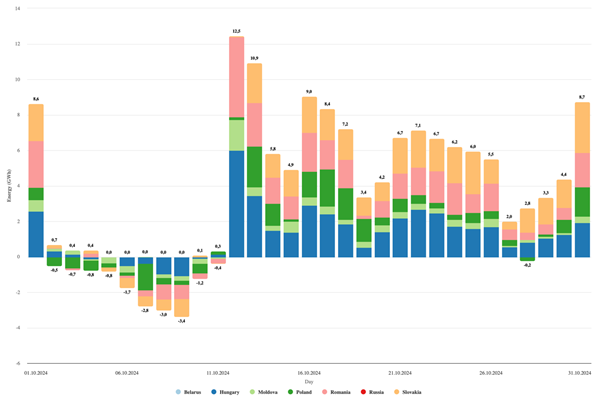
Electricity export (- minus) and import (+ plus) during the month
From December 1, the maximum capacity for importing electricity from EU countries will be increased from the current 1.7 to 2.1 GW. Ukraine will additionally have the opportunity for a guaranteed 250 MW of transfer capacity from the EU in emergency aid mode.
Transmission system operators jointly assessed the condition of the power system and looked for ways to maximize capacity this winter. The calculations allowed the operators to increase the capacity limit for supply to Ukraine and Moldova to 2,100 MW this winter. The new limit will be applied from December 1, 2024. From March 2025, every month operators will be able to review commercial capacity limits between the EU on the one side and Ukraine and Moldova on the other side.
In October 2024, electricity imports decreased by 58% – to 181,000 MWh. Most electricity was delivered from Hungary – 32.8%, 25.4% from Slovakia, and 24.8% from Romania. In general, the volume of electricity imports decreased in all directions – the most, from Poland, by 77%. Compared to October 2023, the import of electricity to Ukraine increased by 9.5 times.
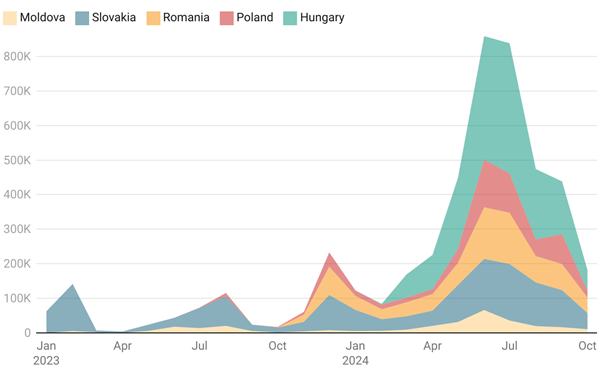
Electricity import, per month, 2023-2024, MWh. ExPro agency data
On October 31, the first pilot green auction for distributing the support quota for constructing new capacity from alternative energy sources was held, offering a quota for 11 MW of solar PV power plants. The maximum price offer was 9 euro cents for 1 kW. The location of objects is the territory on the left bank of the river Dnipro.
However, the auction did not take place, as no bidder applied. Three factors defied zero interest in auctions.
Two more auctions will be held in November to distribute an 88 MW wind power quota and 11 MW of other alternative energy sources (except solar PV, wind energy, blast furnaces, and coke gases, and hydropower produced only by micro-, mini-, and small hydroelectric power stations).
The first auction to trade guarantees of origin (GoO) of electricity produced from renewable sources took place in Ukraine. Market participants purchased 28,257 guarantees of origin, equivalent to 28,257 MWh, offered by UkrHydroEnergo on the site of the JSC Market Operator—12 Ukrainian companies bought GOs.
According to the auction results, the price of one guarantee of origin remained at the starting level of UAH 13/MWh. 56.5% of the proposed volume (50,000 MWh) was sold.
Note. The European Union does not recognize guarantees of origin issued in third countries. The NEURC is working with European bodies to agree to acknowledge the GoO issued in Ukraine. If not, there will probably not be much demand for GoO in Ukraine.
Another, the second one auction was hold later.
Gas consumption was 5% higher in October 2024 than a year earlier due to the increased gas usage for electricity production. Starting in mid-October, due to colder temperatures and the use of gas for heating, Ukraine’s daily gas consumption increased to 50 million cubic meters, and gas injection into underground gas storage decreased to 5 million cubic meters per day. From November 1, the season of gas extraction from underground storage began – gas consumption exceeded gas production.
The VITAGRO group of companies, with the participation of the Khmelnytskyi gas distribution systems operator, supplied biomethane to Ukraine’s gas transmission system for the first time. During its initial days of operation, the biomethane plant operated at 60-70% of the planned capacity, and the daily volume of gas entering DSO’s pipelines was approximately 6,000 cubic meters. The plant can reach 100% capacity by the end of October 2024.
Ukraine’s gas transmission system operator (OGTSU) and other national TSOs that are members of the Central and South Eastern Europe Energy Connectivity Initiative signed a Memorandum of Understanding on a joint approach and action plan for harmonizing gas quality requirements at connection points in the region. In addition to OGTSU, those are Bulgartransgaz (GTS operator of Bulgaria), DESFA (Greece), FGSZ (Hungary), ICGB (Greece-Bulgaria interconnector operator), Nomagas (North Macedonia), PLINACRO (Croatia), PLINOVODI (Slovenia), Transgaz (Romania) and Vestmoldtransgaz (Moldova).
As noted in the Memorandum, Central and Southeastern Europe historically depended on importing Russian natural gas, the physical and chemical characteristics of which determined the requirements for the quality of gas along the respective routes both at the national level and at the interstate connection points. The interoperability and market integration of gas systems in the CESEC zone require further efforts to consider supply diversification and the gradual abandonment of Russian gas. TSOs must adapt to the requirements, considering the different quality of natural gas sources.
At the Zaporizhzhia Nuclear Power Plant (ZNPP), a water leak was discovered from the impulse line – a small pipe that is connected to the first office of the unit and is part of the reactor’s coolant pump support systems, the IAEA press service writes.
IAEA experts visited power unit No. 1. According to them, reducing the pressure to atmospheric level was necessary to conduct repairs there. The welding work was completed on October 31, and radiographic inspections of the welds are now underway.
The Ministry of Energy reported that diesel generators provide backup power for the region’s most critical infrastructure. Since February 2022, international donors have donated almost 5,000 generators of various capacities to enterprises in Ukraine’s energy sector. Japan, South Korea, Belgium, the Netherlands, and Switzerland are the largest donors of such equipment.
The government adopted a resolution exempting imported energy equipment and materials from taxes and duties. The Ministry of Energy developed and approved the list. This equipment is necessary for restoring energy infrastructure facilities. The condition is that it be imported into Ukraine within the framework of the agreements financed by the Energy Support Fund of Ukraine.
The list includes oil and oil products, hydraulic turbines, various pumps, engines and generators, power generating sets, transformers, batteries, electrical equipment, vehicles, trucks, self-propelled machinery, tools, and other goods necessary to restore damaged energy infrastructure.
Seven Ukrainian substations have already been chosen to be covered by the International Atomic Energy Agency (IAEA) monitoring missions. These seven are crucial for the safe operation of nuclear power plants, power supply and avoiding blackouts.
The European Commission will provide 3 million euros—part of the necessary amount — for the IAEA’s monitoring missions at Ukrainian nuclear power plants. This money can also be used for missions at substations critical to ensuring the operation of nuclear power plants. The funds are allocated within the European Instrument for International Cooperation in Nuclear Safety framework.
Russian attacks on substations critical to the operation of Ukrainian nuclear power plants pose serious threats. According to IAEA Director General Rafael Grossi, unfunded needs for the further implementation of the comprehensive program of assistance to Ukraine by the International Atomic Energy Agency are estimated at 23 million euros.
The Cabinet of Ministers of Ukraine announced a competition for the positions of three independent members of Ukrenergo’s supervisory board. The fourth independent member will be, as well, under a similar transparent procedure. Simultaneously with the competitive selection of independent members, the Ministry of Energy will select candidates for state representatives in the Ukrenergo’s Supervisory Board.
UkrHydroEnergo canceled the previously announced tender for legal services in the arbitration case related to the destruction of the Kakhovka hydroelectric plant. The company stated that the decision was made to ensure consistency in its actions with Ukraine’s broad national strategy, which aims to hold Russia accountable for the damage caused to critical infrastructure and provide compensation.


Together we can change the future! Your support allows us to continue our research and provide objective analysis of key social issues. Join us today to build the future of our generations together.
Support