Digests • 09 January 2026
The Ministry of Economy, Environment, and Agriculture of Ukraine has approved an updated version of the model agreements regarding subsoil use terms. This document contains enforceable rules that clearly define the new responsibilities of subsoil users, aligning with the US-Ukrainian agreements. The updates to the model agreements bring them in line with the Agreement between the Government of Ukraine and the United States on establishing the US-Ukrainian Investment Fund for Reconstruction. Ukraine’s Law ratified this agreement on May 8, 2025, and it is being implemented in accordance with the Cabinet of Ministers of Ukraine’s Resolution No. 1411 dated November 5, 2025.
Updating the model agreements is another step in implementing the Ukrainian-US deal aimed at attracting investments, boosting the Ukrainian economy, strengthening economic ties between Ukraine and the United States, and reinforcing the strategic partnership during the country’s long-term reconstruction and modernization.
December 2025 was the most challenging month for Ukraine’s power system since the start of the autumn-winter season. The combination of extensive missile and drone attacks by Russia, severe damage to the main grids, and seasonal temperature drops caused a power shortage, leading to strict restrictions on electricity supply nationwide.
Strikes on key electricity transmission substations at the start of the month caused “grid constraints.” This forced the unloading of nuclear power plant units because the system couldn’t handle or transmit the full amount of electricity generated. These same grid constraints also prevented the full utilization of electricity imports, as bottlenecks in the system blocked their transmission deep into the country. Emergency generation sources, including thermal and hydro, were heavily damaged by Russian shelling, critically impairing the system’s ability to meet morning and evening consumption peaks. The cold snap in the second half of the month led to increased demand, which worsened the shortage.
In conditions of capacity shortage, limiting electricity supply to consumers remained a key tool for balancing the power system. During the month, hourly outage schedules were used in most regions, with the volume varying from 1-2 to 3-4 blocks at a time. Emergency outages were introduced at the end of the month during critical periods. Since mid-December, Ukrenergo has stopped publishing the exact number of outage shifts, switching to general information about restrictions in the regions.
In the first half of December, the most challenging situation was observed in the Odessa region, where after the attack on December 12 on DTEK and NPC Ukrenergo facilities, a large-scale blackout occurred (up to 60% of the region lost power, water, and heat). On December 17, a state of emergency was declared in the Odessa region due to extended power outages affecting over 50,000 residents—more than three days without electricity.
After the ninth mass attack on December 23, consumers in Rivne, Ternopil, and Khmelnytskyi regions were nearly completely cut off from electricity. The Kyiv power hub sustained significant damage by the end of the month. More than 1 million subscribers in the capital and surrounding areas lost power after the attack on December 27. In some locations, electricity and heat supplies were unavailable for three days. Power was restored by the beginning of January.
The Government of Ukraine, after reviewing critical infrastructure facility lists, has identified the potential to release 1 GW of electrical capacity to other customers. Prime Minister Yulia Svyrydenko demanded using this capacity to increase household supply by December 24 and to reduce rolling blackouts.
The review of critical infrastructure lists was conducted following the government’s decision to exclude waivers for two categories of consumers: a) facilities with a contractual capacity under 100 kW; b) facilities connected to other consumers that should be included in the general scheduling of restrictions to ensure fair electricity distribution. The review does not include hospitals, life support facilities, or enterprises of the defense-industrial complex.
In December, Ukraine imported 639.5 MWh, which is a record volume since August 2024. There were no electricity exports in December. Exports were halted on November 11 due to power system capacity shortages.
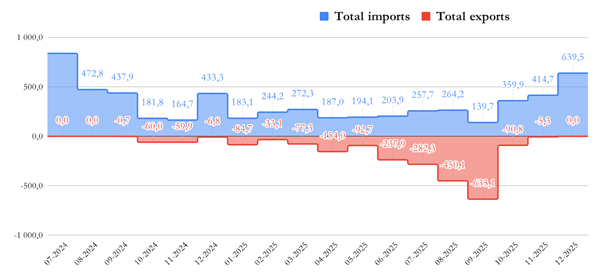
Monthly electricity export and import volumes for the recent year
(The chart is based on ENTSO-E data)
Traditionally, Hungary was responsible for the largest share of imports. In general, the electricity import pattern remained almost the same as in November.
December and November import comparison (based on ENTSO-E data)
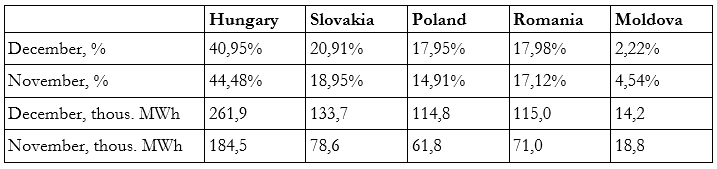
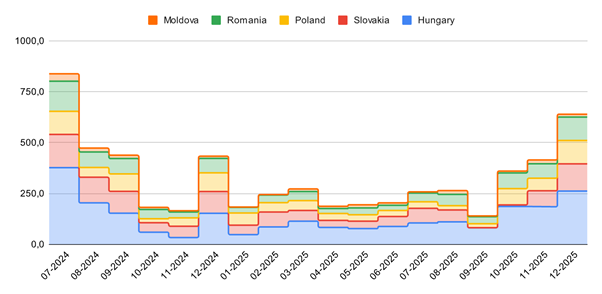
Monthly import volumes of electricity by partner countries
(The chart is based on ENTSO-E data)
Monthly auctions to allocate interstate cross-border capacity for international electricity trade have begun on the JAO platform. The transmission system operators (TSOs) of Ukraine, Slovakia, Hungary, and Romania conducted the first monthly auctions. The auction took place from December 15 to 17.
All 804 MW of offered capacity from three countries was purchased. Twenty-three participants took part in the auction, with 10 emerging as winners. According to the final results, 460 MW of available capacity was allocated at the border between Ukraine and Hungary at a maximum price of 13.4 EUR per MW. For the Slovak direction, all 172 MW were reserved at a price of €16/MWh. In the Romanian direction, all 172 MW were reserved at a price of €10.82/MWh.
In June 2022, the TSOs of Ukraine, Romania, Slovakia, Hungary, Poland, and Moldova agreed to introduce joint auctions, which are conducted simultaneously by operators on both sides. In early 2024, they started to be held unilaterally with Poland at the Khmelnitsky NPP-Rzeszów intersection and bilaterally with Moldova.
In the long run, monthly auctions will help improve the predictability of international trade and are also expected to lower the cost of electricity imports.
In January 2026, the maximum capacity for cross-border electricity imports from European Union countries to the Ukraine-Moldova joint block increased to 2,450 MW. This increase resulted from collaboration among transmission system operators in the Eastern Europe Capacity Calculation Region (EE CCR), ENTSO-E, and the TSCnet Regional Coordination Center. It should be noted once again that damage to the power transmission system caused by Russian strikes limits import capacity. In December, peak import capacity to Ukraine did not exceed 1.8 GW, and on most days, the peak volume ranged between 1.2 and 1.4 GW.
As of November 20, the debt owed by balancing market participants to NPC Ukrenergo has already reached a record 41 billion UAH. Overall, since the start of 2025, the debt to Ukrenergo in the balancing market has increased by 18.6%, from 34.5 billion UAH to 41 billion UAH.
Ukrenergo’s debt to balancing market participants also rose sharply, reaching 21 billion UAH in mid-November, which is a record high. Since the start of the year, Ukrenergo’s debt has increased by 27%.
NEURC approved increasing power transmission and distribution tariffs in two stages in 2026.
The National Energy and Utilities Regulating Commission raised electricity transmission tariffs for 2026 in two phases. From January 1 to March 31, 2026, the tariff will be 713.68 UAH/MWh, a 4% increase from the current 686.23 UAH/MWh. From April 1 through the end of 2026, it will increase to 742.91 UAH/MWh, an 8.2% rise from the current rate. For green metallurgy, the transmission tariff will be 373.93 UAH/MWh and 378.49 UAH/MWh, respectively, representing increases of 3.9% and 5.3% over the current tariff of 359.55 UAH/MWh.
Overall, in 2026, the transmission tariff will increase by 7,2%. The dispatch control tariff was raised by 11.2% compared to the 2025 level.
The energy regulator increased the power transmission tariff by less than expected due to the government’s decision. Specifically, the way Ukrenergo can buy electricity to cover technological losses has been changed. Now, the TSO will purchase Energoatom’s electricity at special auctions, at lower prices.
Industrial power consumers were worried about the rising tariff, which was affecting prices slightly. As a result, the government decided to implement a special mechanism to help curb the tariff’s growth.
The NEURCalso approved a phased increase in distribution tariffs for the Q1 and Q2-Q4 2026 periods. In the first stage, the distribution tariff for the first voltage class will increase by an average of 18%, for the second by 5%. The next stage, starting in April, provides for a slight increase of a few percent.
The State Nuclear Regulatory Inspectorate of Ukraine has officially extended the operating license for Unit 2 of the South Ukrainian NPP until December 31, 2035. The decision was made after a state examination of the periodic safety reassessment report, which confirmed that all the main safety indicators of the unit meet current standards and requirements. The decision was based on the results of public discussions and an assessment of the technical condition of all the unit’s systems.
A meeting of the government commission for building new electricity generation facilities was held on December 30. After months of delay, this marked the final stage of the competition, which had dragged on for many months to select projects to construct generating capacity to meet the needs of Ukraine’s power system, with additional high-maneuverability generation reserves. This became possible after the Cabinet of Ministers of Ukraine amended the relevant procedures for conducting such tenders.
The Ministry of Energy of Ukraine announced a tender in 2025 to build new generating capacity and implement demand management measures to ensure reserves of highly maneuverable generation in Ukraine’s power system. The aim was to improve the reliability of balancing the energy system, enhance the security of electricity supply, attract investment, and foster competition in the electricity market. The process involved submitting competitive proposals from participants, but the tender was not completed due to procedural blockages attributed to former Energy Minister Herman Galushchenko.
Some companies criticized the competition because the commission did not approve their proposals during Galushchenko’s cabinet and demanded that the competition be re-held. After being appointed acting minister, the first deputy energy minister, Artem Nekrasov, began pushing for finalizing the tender. He decided to complete the existing competition rather than re-holding it to speed up the launch of new capacities.
The Competition Commission for new capacities has selected seven companies as winners for 316 MW. A competition for additional capacities is expected to be announced soon.
The Energy Community Council of Ministers, at the request of the Ministry of Energy of Ukraine, has adopted a decision allowing Ukraine to continue operating large combustion plants included in the National Plan for Reducing Emissions from Large Combustion Plants (NPRE) for the period of martial law, but no later than December 31, 2028.
The Plan requires plant operators to either install high-cost filtration equipment (such as flue-gas desulfurization and de-NOx systems) or decommission aging units entirely by strict deadlines. The situation is worsening due to significant losses in energy production capacity. The decision made ensures the reliable balance of the energy system and continuous production of electricity and heat for critical and social infrastructure facilities.
Kyiv stressed that Ukraine remains fully committed to aligning its legislation with the EU legal system; however, the large-scale Russian armed aggression has created force majeure circumstances, which have seriously affected the implementation of the NPRE.
The Verkhovna Rada approved tax preferences for the import of energy equipment for 2026-2028.
On December 3, the Verkhovna Rada voted to extend the VAT exemption for the import of energy equipment for the construction of distributed generation for the period 2026-2028.
The government has reduced the price of gas for cogeneration plants in frontline regions.
The Cabinet of Ministers of Ukraine has reduced the price of natural gas for electricity producers at thermal power plants, combined heat and power plants, gas turbines, and gas piston plants in frontline regions. The new price is UAH 19,000 per thousand cubic meters (including VAT), UAH 2,000 lower than before, valid until December 2026. It applies only to new generating capacities. Only companies signing their first PSO contract with Naftogaz Trading will qualify for this price.
Many power plants in frontline regions rely on gas. A stable and predictable gas price helps these plants plan their operations effectively, secure new contracts, and supply electricity when it’s most urgently needed.
The process of updating supervisory boards in the state-owned energy companies
On December 9-10, 2025, the Ministry of Energy issued a decree dismissing the entire Supervisory Board of JSC “Ukrainian Distribution Networks,” and two members of the supervisory board of JSC Market Operator.
On December 15, 2025, the Ministry of Economy, Environment, and Agriculture of Ukraine announced a competitive selection process for candidates to serve on the supervisory boards of state-owned companies in the fuel and energy sector. A pool of candidates will be established for future appointments to the supervisory boards of the following companies: JSC “Ukrainian Distribution Networks” (3 independent members and 2 state representatives), JSC “Centrenergo” (3 independent members and 2 state representatives), JSC “Market Operator” – (3 independent members and 2 state representatives), JSC “Energy Company of Ukraine” – (independent member and 1 state representative), JSC “Energoatom” – (3 state representatives), NPC “Ukrenergo” – (1 state representative), JSC “UkrHydroEnergo” – (1 state representative).
On December 10, 2025, the Cabinet of Ministers of Ukraine approved a resolution to transform the State Enterprise Guaranteed Buyer into a Joint Stock Company. 100% of the company’s shares will remain owned by the state. The resolution approves the charter of JSC “Guaranteed Buyer”; the principles for forming the company’s supervisory board; the provisions related to the supervisory board of JSC “Guaranteed Buyer”; and the decision on issuing the company’s shares.
The State Enterprise “Guaranteed Buyer” is a key intermediary in the electricity market, responsible for purchasing energy from renewable sources (RES) at a fixed tariff. In addition to supporting renewable energy, the enterprise performs special duties (PSO) to ensure affordable electricity prices for the population. The profit received from the sale of electricity in the market segments of the enterprise is directed toward settlements with producers and compensation for the difference in tariffs. In the energy market structure, the enterprise’s activities are essential for maintaining a balance between the commercial interests of generation and the social needs of citizens.
On December 31, 2025, the Nomination Committee approved the independent members of Energoatom’s new Supervisory Board. The list includes the following.
At the same time, appointing Patrick Fragman violates the rules, which state that candidates should not be tied to companies with contracts with Energoatom for at least one year. However, as of January 2025, Patrick Fragman still served as President and CEO of Westinghouse Electric Company.
By the end of the month, natural gas consumption surpassed 100 million cubic meters daily, reaching the highest level of this heating season. The rise in consumption is related to the recent cold snap in Ukraine. Gas withdrawal from Ukrainian underground storage facilities gradually increased to 40 million cubic meters, the highest since the start of this year’s withdrawal season. Compared to last year, gas withdrawal volumes are still lower. Gas reserves in Ukrainian storage facilities total 12.5 billion cubic meters, 24% above last year’s level.
Natural gas imports to Ukraine remained at about 21 million cubic meters per day. In the end of December, gas transit continued via the short-haul service from Hungary and Slovakia to Moldova through the Ukrainian GTS, ranging from 0.4 to 1.2 million cubic meters per day.
Natural gas imports to Ukraine in 2025 reached 6.47 billion cubic meters, nine times more than in 2024 (724 million cubic meters). This volume is the highest in the past five years, since 2020. The main reasons for this increase were Russian attacks on Ukraine’s gas production facilities, small gas storage capacities, and price stagnation, especially when gas in the EU was cheaper than in Ukraine.
The largest importer of gas in 2025 was the state-owned company Naftogaz of Ukraine, importing over 5.5 billion cubic meters. Additionally, natural gas was imported by the state-owned GTS Operator of Ukraine and private companies.
Most of the gas came from Hungary and Poland, which remain the cheapest routes for gas imports into Ukraine. Gas imports also came from Slovakia and the Trans-Balkan route, where a joint capacity booking route – Route 1 from Greece (70 mcm), which became operational in 2025.
Energy regulators from Ukraine, Moldova, Romania, Bulgaria, and Greece have approved the relevant joint capacity booking products for natural gas imports – Route 2 and Route 3 as part of the Vertical Corridor initiative. Route 2 is designed to import LNG from the Greek Alexandroupolis LNG terminal to Ukraine. Route 3 is intended for importing Azerbaijani gas into Ukraine, starting at the IGB (Interconnector Greece-Bulgaria) connection point with the Trans-Adriatic Pipeline, then following the same path as Route 2 to Ukraine. All operators agreed on a 25% discount on the standard monthly tariff, with ICGB and the GTS Operator of Ukraine offering a 46% discount, the highest in the region.
The first auctions for the new routes took place on December 22, 2025, offering monthly capacity for gas imports from Greece to Ukraine for January 2026. For both routes, 4.89 million cubic meters of capacity per day were available for booking. At the same time, companies did not reserve capacity for imports in January. However, companies didn’t allocate capacity for natural gas imports at the auctions, likely due to short notice for preparation, as the products were only approved days earlier.
PrivatBank has granted Naftogaz Group a new UAH 5 billion loan to purchase imported gas and ensure a stable heating season.
In July this year, PrivatBank lent Naftogaz UAH 4.7 billion to build reserves in underground gas storage facilities. Additionally, Naftogaz raised UAH 10.15 billion from other Ukrainian state-owned banks: UAH 3 billion from OschadBank, UAH 2.45 billion from UkrExImBank, and UAH 4.7 billion from UkrGasBank.
The Ministry of Economy, Environment, and Agriculture has announced a competitive process to select four independent members for Naftogaz of Ukraine’s Supervisory Board. Applications from candidates are accepted until January 11, 2026. The new Supervisory Board of Naftogaz of Ukraine is expected to be finalized by January 20, 2026. This competition is part of the government’s plan to overhaul the management of state-owned energy companies.
On December 29, the Cabinet of Ministers of Ukraine prematurely terminated Rostyslav Shurma’s term as a member of the Supervisory Board of Naftogaz of Ukraine. Shurma was dismissed based on the application he submitted. Shurma’s tenure on the Supervisory Board of Naftogaz was set to end on January 20.
Shurma was elected to the Supervisory Board of Naftogaz on January 24, 2023, as a representative of the state. He has been serving as the Deputy Head of the Office of the President of Ukraine since November 23, 2021. After his dismissal from that position in September 2024, Shurma continued to serve on Naftogaz’s Supervisory Board. According to media reports, he left for Germany after his dismissal.
On December 10, the Ministry of Energy dismissed two supervisory board members of JSC Gas Transportation System Operator of Ukraine. A few days later, the Ministry of Economy, Environment, and Agriculture of Ukraine announced a competitive selection process for candidates of state representatives in the supervisory board of LLC “Gas Transportation System Operator of Ukraine”.
The Supervisory Board of JSC Ukrnafta has appointed Bohdan Kukura as Chairman following the competitive selection process. The open competition started in August 2025.
Before his appointment, Bohdan Kukura was the Production Director and Chief Engineer at JSC Ukrnafta. Kukura is a seasoned expert with many years of hands-on experience in the oil and gas sector, familiar with the company’s production processes, and actively involved in developing oil and gas fields.
Yuriy Tkachuk, who served as the head of PJSC Ukrnafta from May to December 2025, has been appointed as the General Director of JSC UkrGazVydobuvannya.
Yuriy Tkachuk has extensive experience working in various divisions of the Naftogaz Group. After Serhiy Koretsky joined Ukrnafta in 2022, Yuriy Tkachuk became the company’s Chief Financial Officer. By May 2025, Yuriy Tkachuk was elected Acting Chairman of the Ukrnafta Board, following Koretsky’s move to Naftogaz. Tkachuk led Ukrnafta until December 16, 2025, when Bohdan Kukura was elected as the new director.
The National Commission for Energy and Utilities Regulation (NEURC) simplified the process for connecting block-modular boiler houses to gas distribution systems. Additionally, the processing of land acquisition documents for laying gas networks, obtaining permits for completing construction, and commissioning newly built (or reconstructed) gas networks has been delayed by up to 24 months.
The NEURC has raised the tariffs for gas distribution network operators providing services to non-household consumers for 2026, marking the first increase since 2021. The tariff hike will be implemented in stages, starting on January 1 and April 1, 2026.
According to NEURC’s calculations, the weighted average tariff for gas distribution operators serving non-residential customers will be 1.56 UAH per cubic meter per month (excluding VAT) starting January 1. From April 1, the tariff will increase to 1.89 UAH per cubic meter per month. NEURC estimates that, from April 1, tariffs will rise by an average of 62%, with half of that increase due to higher wages for gas distribution workers and 12% due to a decrease in gas distribution volumes.
During December 2025, Russian forces continued to carry out a strategy of widespread damage to Ukraine’s energy sector. The targets included main power grids, thermal power plants, urban thermal power plants, the gas transportation system, gas production facilities, and fuel infrastructure. The main attacks during the month were as follows.
The Russian Federal Service for Environmental, Technological and Atomic Supervision (RosTekhNadzor) has issued a ten-year license to Zaporizhzhia NPP to operate unit 1. The license for the second unit is planned to be issued in early 2026, and for the remaining four by 2028.
The Russians occupied the Zaporizhzhia NPP on March 4, 2022, and it has been offline since September 2022. The decision is legally invalid and has no legal effect. The Zaporizhzhia Nuclear Power Plant is under Ukraine’s exclusive jurisdiction, and the only competent nuclear regulatory authority on its territory is the State Nuclear Regulatory Inspectorate of Ukraine.
The actions of the Russian Federation grossly violate UNGA Resolution A/RES/78/316, IAEA decisions, and the principles of nuclear safety, confirming the strategy of using the ZNPP for military blackmail. Statements about the readiness of the power units for launch in the absence of the Kakhovka reservoir, constant shelling, and lack of qualified personnel are a deliberate act of nuclear terrorism. Any attempt to resume the operation of the reactors poses a real threat of an accident with transboundary consequences.
This publication was created by the Ukrainian Institute of the Future with the support of the Askold and Dir Foundation, administered by ISAR Unity as part of the project “Strong Civil Society in Ukraine – a Driver of Reforms and Democracy” funded by Norway and Sweden. The content of the publication is
the responsibility of the Ukrainian Institute of the Future and does not reflect the views of the governments of Norway, Sweden, or ISAR Unity.


Together we can change the future! Your support allows us to continue our research and provide objective analysis of key social issues. Join us today to build the future of our generations together.
Support