Digests • 11 December 2025
Monthly Energy Digest – November 2025
The NABU and the SAPO carried out a large-scale operation called MIDAS to expose corruption involving some energy companies and officials. Agencies reported it lasted for 15 months and included 1,000 hours of audio recordings. Participants in the scandal developed an extensive corruption scheme to influence key state-sector enterprises, especially JSC NNEGC Energoatom.
Published recordings included conversations with Herman Galushchenko – former Minister of Energy, now Minister of Justice, Ihor Myronyuk – former Advisor to the Minister of Energy, Dmytro Basov – Executive Director for Physical Protection and Security of Energoatom, a former employee of the Prosecutor General’s Office, Timur Mindich – a businessman, co-owner of the Kvartal 95 studio, an associate of President Volodymyr Zelensky, and head of a criminal organization, Oleksiy Chernyshov – former head of Naftogaz and former deputy prime minister, who had previously received a warrant from NABU for illegal enrichment. Additionally, Galushchenko and some other speakers discussed how other managers in the energy sector were loyal or not to Galushchenko.
Reshuffling management of state-owned energy companies
The government approved a timetable for restructuring the management and/or boards of state-owned energy companies. Here are the following details.
In November 2025, Ukraine’s power system faced continuous pressure from Russia’s extensive missile and drone attacks on critical infrastructure, including electricity generation, transmission, and distribution. This led to significant capacity shortages and ongoing damage, with the situation gradually worsening at the start of the month and partially stabilizing by its end. Average daily electricity consumption increased by 2–7% compared to October due to seasonal cooling and peak loads in the morning and evening, making balancing more difficult. Solar power plants’ efficiency dropped sharply because of clouds and shorter daylight hours, while hydro and thermal power plants operated with limitations due to damage.
To balance the power system, outage schedules for residential consumers (1–4 shifts per day) and capacity restrictions for industry had to be enforced. In the first half of the month, scheduled cutoffs were not implemented in all regions. However, after attacks on energy infrastructure in the western part of the country, restrictions were applied across all regions. Imports of electricity from the EU increased significantly to cover the shortages, while exports ceased completely.
During a specific period, NPP units operated at reduced capacity starting on the night of November 7 due to transmission system bottlenecks caused by damage to key substations and 750 kV power lines. By the end of the month, all but one unit had returned to full capacity.
Repeated attacks at the start, especially on November 7, and at the end of the month (November 28–29) caused extensive outages, such as over 500,000 customers in Kyiv, 100,000 in Kyiv region, and tens of thousands in other areas, along with damage to substations.
The maximum capacity for electricity imports to Ukraine and Moldova from EU countries will increase to 2,300 MW starting December 2025, up from the current limit of 2,100 MW. However, Ukraine is not currently utilizing the full allowed capacity due to bottlenecks in transmitting electricity from west to east caused by Russian attacks. In October 2025, Ukraine and Moldova reached the import limit only during a few evening peak hours for several days.
In November, electricity imports increased, while exports were suspended.
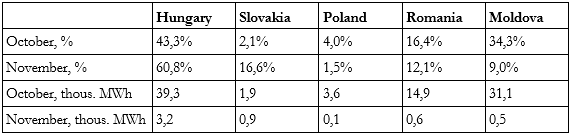
In November, Ukraine imported 414.7 thousand MWh compared to 359,9 thousand in October. Shares of imports from Slovakia increased, while shares from Hungary and Poland dropped, as the powerline with Slovakia was put into operation at the end of October after maintenance.
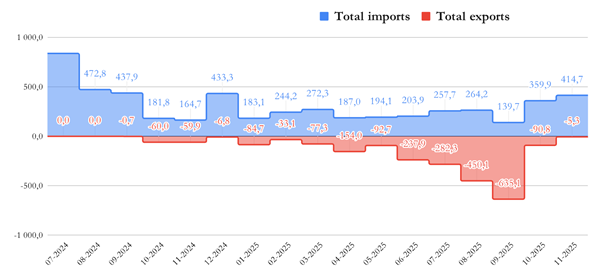
Monthly electricity export and import volumes for the recent year
(The chart is based on ENTSO-E data)
October and November import comparison (based on ENTSO-E data)
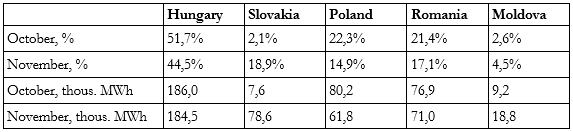
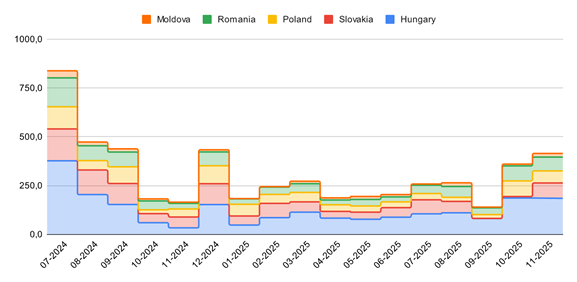
Monthly import volumes of electricity by partner countries
(The chart is based on ENTSO-E data)
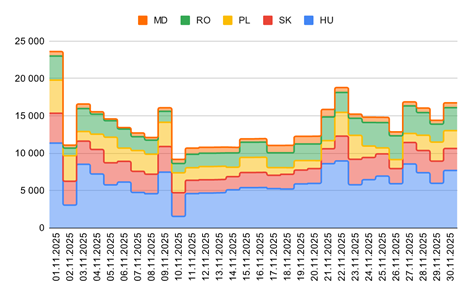
Daily peak electricity imports in November reached 1,855 GW early in the month. However, later on, this number rarely exceeded 1.25 GW. The primary reason was damage to power transmission systems due to Russian strikes. Therefore, even when imported, the electricity cannot be transmitted further into the country.
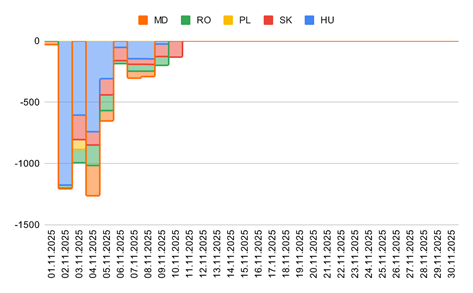
Meanwhile, capacity shortages caused by Russian strikes halted electricity exports. There have been no electricity exports since November 11.
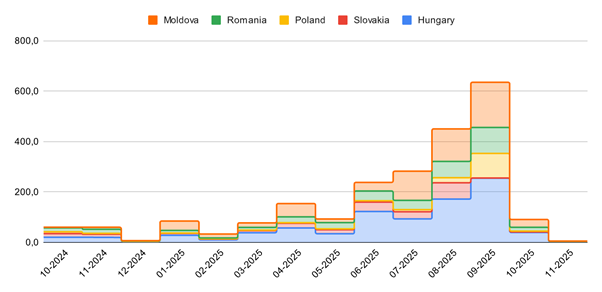
Monthly electricity export volumes by partner countries
(The chart is based on ENTSO-E data)
October and November export comparison (based on ENTSO-E data)
Daily volumes of electricity exports by countries of origin, MWh
(The chart is based on ENTSO-E data)
Daily volumes of electricity imports by countries of origin, MWh
(The chart is based on ENTSO-E data)
NEURC allowed Ukrenergo to allocate an additional UAH 1.8 billion to cover feed-in tariff payments for households’ solar power plants.
The national energy regulator has increased NPC Ukrenergo’s expenses for settlements with owners of residential solar power systems by UAH 1.8 billion (excluding VAT), while reducing the same amount in expenses for settlements with industrial renewable energy facilities. The decision took effect on December 1, 2025.
Thus, the NEURCrevised the structure of Ukrenergo’s power transmission tariff without changing its amount. At the same time, the NEURCincreased expenses for the load-reduction service provided by Ukrenergo’s industrial renewable energy generation by UAH 1.3 billion. This was done at the expense of servicing costs of UAH 655.8 million and loan repayment costs of UAH 670.5 million.
Installed household solar power capacity has been growing rapidly. Meanwhile, the size of the Guaranteed Buyer’s balancing group has been shrinking, as many power producers – mostly wind generators – have started trading directly in the market due to debts and delays in paying the feed-in tariff.
By August 2025, Ukrenergo had exhausted all the funds allocated for paying electricity to private household solar power plants for the year. This accounts for the debts that appeared in August. Over the first eight months of 2025, private household solar power plants on the green tariff accumulated electricity expenses totaling UAH 7.114 billion (excluding VAT). In comparison, Ukrenergo’s electricity transmission tariff structure allocated UAH 6.98 billion for this purpose throughout the year. As a result, Ukrenergo lacked funding sources to cover the costs of services provided by universal service providers (USPs) in 2025.
In 2024 and 2025, after blackouts caused by Russia’s strikes, companies and households increased their installation of solar power systems to partly protect themselves from potential future supply shortages. Not all households applied for feed-in tariffs, but even those who did faced financial constraints in paying the required amounts.
As of early November, Ukrenergo’s total debt to the Guaranteed Buyer for the Renewable Energy Support Service was UAH 16.10 billion, including UAH 2.1 billion for services from January to October 2025. Compared to the end of September, Ukrenergo’s debt has decreased by 1.5%.
In 2025, most months saw the Guaranteed Buyer’s payments range from 77% to 99%. Meanwhile, in 2024, the payment levels were somewhat lower, fluctuating between 61% and 98%, with an annual average of 89.3%. In 2023, nearly full settlement was achieved at 99.2%, while 2022 was the most challenging year, with monthly payments dropping to 33% to 45%, and the overall rate at just 65.7%.
As of late November, the debt owed by balancing market participants to NPC Ukrenergo has already reached a record 41 billion UAH. Overall, since the start of 2025, the debt to Ukrenergo in the balancing market has increased by 18.6%, from 34.5 billion UAH to 41 billion UAH.
Ukrenergo’s debt to balancing market participants also grew sharply, reaching 21 billion UAH in mid-November, which is a record high. Since the start of the year, Ukrenergo’s debt has increased by 27%.
In November 2025, hourly prices on Ukraine’s day-ahead market reached the price caps in 31% of settlement periods. The peak of price cap occurrences happened daily at 5 p.m. in November, when the price hit the cap. At 4 p.m., the price reaches the cap on 26 out of 30 days. In October 2025, the hourly price cap achievement rate was only 13%.
According to the Market Operator, in November, the base-load price index in the day-ahead market rose by 6.7% from the previous month, reaching 6,387 UAH/MWh.
The NEURC shortened the list of required documents for licensing and, in some cases, removed the requirement to submit them altogether. The aim is to promote the development of distributed generation during the war and to boost the country’s energy independence.
The amendments encompass the following.
The Cabinet of Ministers has streamlined the process for individuals to receive state support when installing renewable energy-generating units in their homes. The new system offers financial aid by reimbursing 30% of the principal amount of the main loan, replacing the previous method of monthly interest rate reimbursement on that loan.
This mechanism will benefit borrowers more, as they will receive an immediate discount on loans for equipment purchase and installation. Additionally, the government and potential donors willing to provide financing will be able to determine the necessary funds to offer financial support. It is also expected that this decision will help increase the number of people able to purchase and install hybrid power supply systems, promote effective cooperation with international financial organizations and donors in raising funds, and implement a mechanism that will enhance the country’s energy security.
Ukraine is still withdrawing small amounts from underground gas storage facilities (UGS) – 5 to 10 million m³ per day compared to the average withdrawal of 45 million m³ per day during the same month in 2023-2024 – due to temperatures 3-5 degrees Celsius above normal and imports. The total volume of gas in UGS is 13.1 billion m³, including 4.7 billion m³ of long-term storage gas (technological) and gas in temporarily uncontrolled territories, which is an 11% increase compared to last year.
Naftogaz Group and Greece’s state-owned DEPA Commercial have signed a Letter of Intent to deliver American natural gas to Ukraine during the winter of 2025-2026. The gas will be transported through a pipeline across the Balkans, with deliveries starting in January.
Ahead of his visit to Greece, President Zelensky stated that Kyiv had allocated funds for gas imports from European partners and banks, backed by guarantees from the EU and Ukrainian banks, to cover nearly €2 billion ($2.3 billion) needed.
Naftogaz of Ukraine and Polish Orlen have agreed on an additional 300 million cubic meters of U.S. LNG supplies to Ukraine. A Polish export credit agency, KUKE, will provide credit support to facilitate post-payment for the delivered volumes, helping Naftogaz address its current liquidity shortfall. The contract will include the supply of three LNG tankers carrying American gas in the first quarter of 2026. The cargo will be imported by Orlen to one of the terminals, either Swinoujscie in Poland or Klaipeda in Lithuania, where the Polish company has reserved capacity. After regasification, the gas will be delivered to Ukraine through the Polish GTS. Besides, Poland is working on an agreement to import LNG from the United States for further additional supply to Ukraine and Slovakia.
Companies have doubled the booked capacity for importing natural gas from Greece to Ukraine via the joint Route 1 for December, reaching up to 1.2 million cubic meters per day. The operators of the Trans-Balkan route offered about 2.2 million cubic meters of capacity per day for December, with companies booking 60% of it. These are the highest booking volumes in the route’s history. For example, in November, companies booked half as much—0.6 million cubic meters per day.
According to independent estimates by ExPro consulting agency, in July-August 2025, about 18 million cubic meters of natural gas were imported into Ukraine via Route 1, and since early November, more than 14 million cubic meters.
The National Energy Regulatory Agency of Moldova (ANRE) approved the application for a 50% reduction in gas transportation tariffs to Ukraine. The initiative aims to strengthen regional energy security and ensure natural gas supplies to Ukraine. The approved amendments include extending the Route 1 product application period by 6 months (November 2025 – April 2026), implementing a 50% reduction in transportation tariffs for SRL Vestmoldtransgaz at the Căuşeni and Grebenyci interconnection points, and expanding the capacity product to all relevant interconnection points along the route. Additionally, a 50% reduction in transportation tariffs is also planned by the Romanian transmission system operator SA Transgaz.
The Zaporizhzhia Nuclear Power Plant (ZNPP) has faced multiple disruptions to its external power supply. On November 9, the backup 330 kV “Ferrosplavna-1” line was restored after being offline for six months, following damage in May. However, on November 14, power supply from the main 750 kV “Dniprovska” line was lost due to shelling by Russian forces, leaving the plant dependent on a single line and risking an eleventh blackout. The Dniprovska line was repaired and reconnected on November 19 after four days. Ukrainian engineers have restored ZNPP power lines over 40 times since Russia’s full-scale invasion began.
Russia continues to target Ukraine’s energy infrastructure. The power system was the key target for Russian strikes.
But gas infrastructure was attacked as well.
Besides, throughout the month, attacks on gas stations were reported in several regions, damaging fuel infrastructure and disrupting supplies.
This publication was created by the Ukrainian Institute of the Future with the support of the Askold and Dir Foundation, administered by ISAR Unity as part of the project “Strong Civil Society in Ukraine – a Driver of Reforms and Democracy” funded by Norway and Sweden. The content of the publication is
the responsibility of the Ukrainian Institute of the Future and does not reflect the views of the governments of Norway, Sweden, or ISAR Unity.


Together we can change the future! Your support allows us to continue our research and provide objective analysis of key social issues. Join us today to build the future of our generations together.
Support