

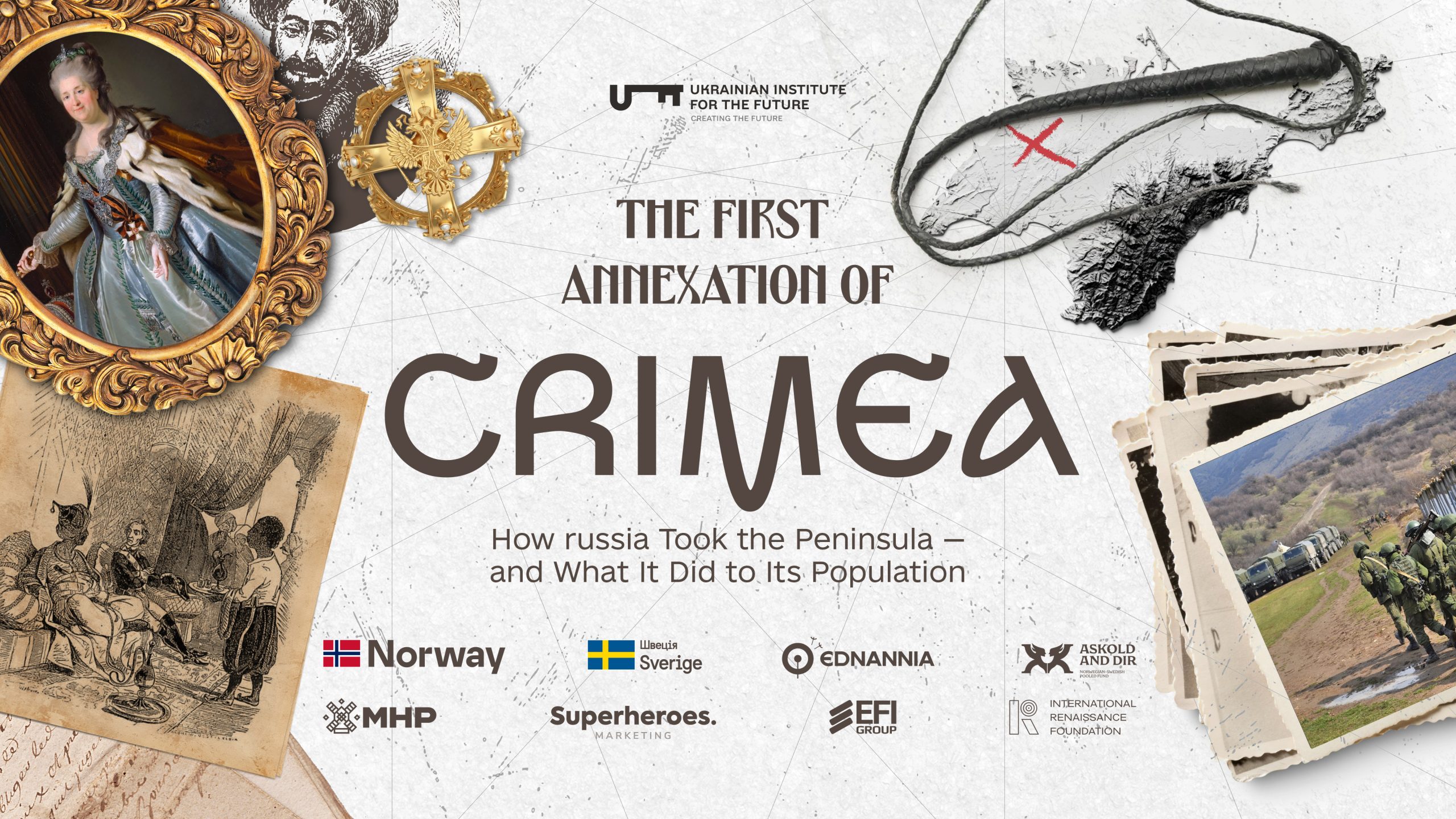
Series “Anatomy of an Empire” │ Ukrainian Institute of the Future
This material was prepared as part of work on the “Atlas of russian Imperialism and Colonialism” — a UIF publication forthcoming this year.
This piece addresses the following questions:
- How russia annexed Crimea for the first time — and why it took eleven years
- What the “perpetual alliance” of 1772 actually meant — and for whom
- Why Catherine II deported Crimea’s Christians and suppressed the Nogais
- What happened to the Crimean Tatar population after annexation
- Why 1783 and 2014 follow the same sequence
2014 Begins in 1772
When russian forces without insignia appeared in Crimea in February and March 2014, international reaction treated the event as something unprecedented: a violation of international law with no modern parallel, a sudden rupture in the post-war European order.
The pattern, however, was already established in 1772. It had been rehearsed once before — on that same peninsula, involving the same population and driven by similar justifications.
The first annexation of Crimea unfolded over eleven years. It began with a “treaty of independence” and a “perpetual alliance.” It ended with an imperial manifesto on “acceptance” into the realm, deportations, and mass killings.
To understand 2014, it is necessary to examine 1783.
Crimea Before russia: The Nature of the State
The Crimean Khanate had existed since 1441. At the time of its first direct confrontation with russia, it was neither backward nor in decline. It was one of the most powerful polities in the region: a vassal of the Ottoman Empire, but one with its own administration, legal system, and culture.
Throughout the sixteenth and seventeenth centuries, the Crimean khans constituted a formidable military force. It was Crimean forces that burned Moscow in 1571 — the same year the oprichnina failed to defend the capital. They besieged the city twice more, in 1521 and 1591.
By the mid-eighteenth century, the regional balance had shifted. Russia had consolidated its power, the Ottoman Empire was weakening, and the Khanate found itself between two stronger actors. It remained a sovereign entity capable of independent foreign policy — which made it a strategic target for St. Petersburg.
The First Step: “Independence” as Managed Dependency
In 1768, the Ottoman Empire declared war on russia. Russian military superiority proved decisive. By 1771, a force of thirty thousand russian troops had entered Crimea, supported by sixty thousand Nogai fighters already operating under Russian command.
In November 1772, a treaty was concluded at Karasubazar (present-day Bilohirsk) between russia and the Crimean Khanate.
The document declared the “independence of the Tatar peoples” and a “perpetual alliance” with russia — an independent state, free from Ottoman suzerainty, in lasting union with St. Petersburg. On paper, it read as liberation from Turkish domination.
The actual terms were more consequential. Russia received the fortresses of Kerch and Yeni-Kale, along with Akhtiar Bay, the future Sevastopol. This effectively gave Russia control over all key maritime access points to the peninsula.
The Khanate remained formally independent. However, it could no longer conduct its own foreign policy, while russian garrisons controlled the key positions. “Independence” was a term in a document, not a governing reality.
This model — formal independence as a transitional phase preceding full annexation — was reproduced in 1994. The Budapest Memorandum recognized Ukraine as an independent state with security guarantees. No enforcement mechanism was included.
Eleven Years: From Ally to Sovereign
The Treaty of Küçük Kaynarca of 1774 enshrined Crimea’s “independence” in law. One clause carried particular significance: Russia was obliged to withdraw its troops.
It did not.
St. Petersburg used its continued military presence to manage Crimean domestic politics directly. In 1777, russian forces entered Crimea again — to install a preferred khan: Shahin Giray, aligned with Russia. He pursued administrative, fiscal, and military reforms. He adopted European customs. He relocated the seat of government from Bakhchisaray to Kaffa.
To the Crimean nobility and clergy, this constituted a fundamental breach: a Muslim ruler turned instrument of a Christian power. Uprisings on the Kuban in 1781 and 1782, suppressed by Russian forces, left Shahin Giray with no viable position. He abdicated under Russian pressure in exchange for a promise of a provincial governorship in Persia. The pro-russian Crimean elite that St. Petersburg had itself cultivated then petitioned for incorporation into the Russian state.
In December 1782, Catherine II authorized annexation.
On 19 April 1783, she signed the manifesto “On the Acceptance of the Crimean Peninsula, the Island of Taman, and the Entire Kuban Region into the Russian State.”
Formal incorporation was completed through an oath of loyalty to the imperial house sworn by the Tatar nobility and clergy. From the “perpetual alliance” of 1772 to annexation in 1783: eleven years. From the Budapest Memorandum of 1994 to the occupation of Crimea in 2014: exactly twenty.
The Demographic and Religious Consequences
The 1783 manifesto pledged that the Crimean Tatars would be “maintained on a par with our natural subjects, their persons, property, temples, and native faith protected and defended.” The commitment carried no enforcement provisions.
Effective authority resided with Governor-General Potemkin and the commanders of Russian garrisons. Crimean Tatars were formally eligible for public office, but not above the municipal level — a restriction that remained in place until 1917.
St. Petersburg’s colonization policy pursued a clear objective: the gradual reduction of the Crimean Tatar population share through the settlement of Orthodox migrants.
Three principal instruments were used.
Land. In surveying boundaries between new noble estates and the holdings of free Crimean Tatar peasants, officials drew lines deliberately to the detriment of local landholders. Nobles sought to reduce the peasants to serfdom. The peasants refused to pay. Russian abuses were extensive enough that from 1796 onward, special tribunals were established on the peninsula to adjudicate complaints.
Religion. Mullahs deemed security risks were deported. Travel to Mecca was restricted. The number of mosques was reduced, and some were converted into Orthodox churches. In 1794, the Tauride Muslim Spiritual Administration was established — a state organ for the supervision of Islamic institutions, making religion a managed instrument of governance.
Direct coercion. Before formal annexation, in 1778, Alexander Suvorov oversaw the deportation of more than thirty thousand Crimean Christians — Greeks and Armenians — to the Azov Governorate. The stated justification was protection from Muslim neighbors. The practical effect was to deprive the Khanate of a significant demographic base.
The Nogais, whom russia had deployed as auxiliaries against the Crimean Khanate, faced a similar outcome in 1783. Following annexation, they were ordered to relocate to the Russian interior. They resisted. In October 1783, Suvorov’s Kuban Corps attacked the main encampment on the Laba River. The operation resulted in a decisive defeat and mass killings that contemporary researchers classify as genocide.
Within the first twenty years following annexation, the Crimean Tatar population declined by approximately half.
Two Episodes, One Sequence
Russia’s annexation of Crimea in March 2014 proceeded through a recognizable sequence: security guarantees and recognition of sovereignty (the Budapest Memorandum); gradual expansion of influence; the deployment of unmarked forces; a referendum held under military occupation; a formal declaration of “reunification.”
The justifications were consistent with those of 1783: the local population wishes to join Russia voluntarily; Russia is responding to a request; Russia is protecting people from violence.
The principal difference between 1783 and 2014 is the pace of execution. The underlying method is the same.
Both episodes share the same structural elements: initial legal cover; a network of loyal local intermediaries; systematic displacement of the existing population; demographic and cultural consolidation.
The conditions imposed on the Crimean Tatar community between 1783 and the early twentieth century — mass emigration, the destruction of cultural heritage, the suppression of language — formed the context from which the deportation of 1944 became possible. In the same way, 1783 constituted the precedent on which 2014 was built.
This is not merely a metaphor but a recurring mechanism of Russian imperial expansion.
Limitations in Western Analysis
A recurring error in Western assessments of both Crimean annexations is the tendency to treat them as responses to specific circumstances: the weakness of the Crimean Khanate in the eighteenth century, or the political transition following the Euromaidan in the twenty-first.
The evidence points in the opposite direction. Crimea was not annexed because favorable conditions happened to arise. Favorable conditions arose because St. Petersburg systematically constructed them: a compliant khan installed by russian troops; a pro-Russian elite cultivated over years; external resistance left without adequate support.
The annexation of Crimea is not a reactive measure. It is a deliberate strategy that unfolds according to a consistent sequence and operates on whatever timeline is available.
Recognizing this sequence is the precondition for identifying it before it reaches completion.
This is the third piece in the “Anatomy of an Empire” series. The series is based on the “Atlas of Russian Imperialism and Colonialism” — a major UIF research project forthcoming in print and digital format. To be continued.
The text has been adapted with the assistance of AI tools. The original text of the Atlas may differ in style.
This project is implemented with the financial support of the International Renaissance Foundation.


