

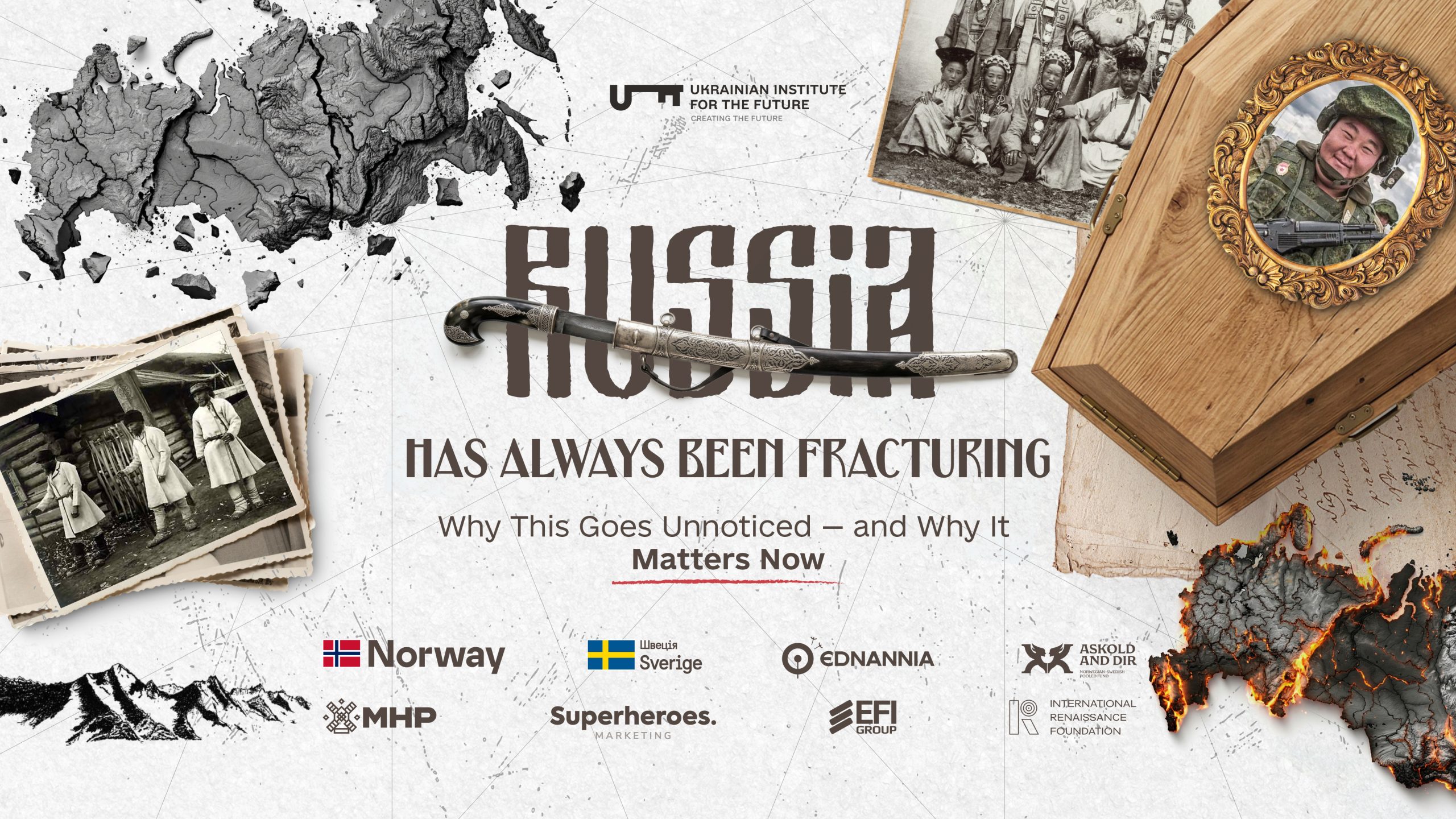
Series “Anatomy of an Empire” │ Ukrainian Institute of the Future
This material was prepared as part of work on the “Atlas of Russian Imperialism and Colonialism” — a UIF publication forthcoming this year.
This piece addresses the following questions:
- Who rose against Russian rule, when, and with what frequency
- Why this history is absent from standard accounts — and what the narrative of Russian “stability” conceals
- What connects the Cheremis Wars of the sixteenth century and the protests in Bashkortostan in 2022
- How Russia maintained an expanding empire — and at what cost
- What Russia’s structural fragility means for the current war
The Myth of a Monolithic Russia
A persistent image of Russia circulates through textbooks and policy analysis alike: vast, monolithic, unyielding. A state that holds its territory by force and, when it weakens, reconstitutes itself. An entity that does not break apart.
This image is not just an oversimplification; it is fundamentally inaccurate.
Historically, from the fall of the Kazan Khanate to the present day, Russia has been under persistent internal strain. Subjugated peoples rose repeatedly. Uprisings swept the Volga region, Siberia, the Urals, the Caucasus, and Ukraine, often simultaneously. The center prevailed each time, but at increasing cost and with progressively harsher methods.
Understanding this history reveals Russia as it actually is: not an unconquerable power, but a state sustained through continuous coercion and composed of peoples who were rarely asked whether they wished to be governed from Moscow.
The fragility that characterized the sixteenth century has not been resolved. It recurs — in different forms, at different times.
The First Uprisings: Resistance Immediately After Conquest
Kazan fell in 1552. Ivan the Terrible celebrated with processions, commissioned icons, and ordered the construction of a cathedral. Russia marked it as a great victory.
By 1552–1557, the newly conquered Kazan Khanate was already in open revolt. The First Cheremis War saw Tatars and Mari peoples take up arms against yasak taxation and against the new administration in general. The Udmurts joined them. The rebels captured Arsk, constructed their own fortified center, and besieged Kazan. The uprising was eventually suppressed, but only temporarily.
The Second Cheremis War followed in 1571–1574. The immediate catalyst was Devlet Giray’s burning of Moscow, which the Volga region read as an opportunity. For the first time, Bashkirs joined the Tatars and Mari. Their objective was the restoration of the Kazan Khanate.
The Third Cheremis War, 1581–1585, was the largest of the three. All the peoples of the middle Volga participated: Tatars, both branches of the Mari, Chuvash, Udmurts, and Bashkirs. The rebels besieged Kazan, Cheboksary, and Sviyazhsk, and devastated the environs of Khlynov.
After the third war was suppressed, the region was systematically fortified with new garrisons and towns. The Mari were prohibited from residing in cities or on the banks of major rivers, and from practicing blacksmithing — a legislative measure designed to eliminate any potential production of weapons.
Three major uprisings in thirty-three years, beginning immediately after conquest. This was not disorganized resistance. It was a sustained refusal by subjugated peoples to recognize the legitimacy of the new authority.
The Seventeenth Century: A Map of Flashpoints
Mapping all the uprisings on Russian territory in the seventeenth century produces not a series of isolated incidents but a near-continuous pattern of internal conflict.
Urban unrest at the center: the Salt Riot of 1648–1649, which extended well beyond Moscow to dozens of cities from Olonets to Kursk; the Pskov-Novgorod uprising of 1650; the Copper Riot of 1662; and successive Streltsy rebellions.
Anti-colonial uprisings in newly acquired territories: Bashkir revolts in 1645, 1662–1664, and 1681–1684; Buryat resistance in 1658; Yakut and Tungus uprisings running almost continuously from the 1630s to the 1680s; Yukaghir resistance from 1645 to 1715.
Between 1667 and 1671, Stenka Razin led what contemporaries described as a “people’s war,” drawing in the lower Volga, the steppe Cossack lands, peasants, urban poor, Old Believers, and Volga peoples. Razin’s program called for the abolition of serfdom, the establishment of Cossack self-governance, and the redistribution of boyar property. He did not position himself against the tsar, but declared himself a “defender of the tsar against the boyars” — a framing that secured him support across the country.
In 1668–1669, an armed uprising broke out on the Left Bank of Ukraine against the partition of the Hetmanate under the Truce of Andrusovo — in the same year and region where Moscow had ostensibly “liberated” the Cossacks from Polish rule.
How Russia Maintained the Empire
A more relevant question than “why did Russia not collapse?” is what it cost to hold together.
The pattern is consistent across centuries. Each suppressed uprising revealed a structural weakness; Moscow responded by imposing a new layer of restrictions on the populations involved. After the Cheremis Wars: prohibitions on crafts and urban residence for the Mari. After each Bashkir revolt: new garrisons, new settlers, additional legal constraints. After Razin’s rebellion: administrative reorganization, revised yasak collection procedures, and tightened serfdom.
The institutional responses confirm this logic. Ivan the Terrible founded new cities and garrisons in the Volga region after the Third Cheremis War. Catherine II renamed the Yaik River as the Ural and launched a sweeping administrative reform after the Pugachev rebellion. Peter the Great modernized the army following the Astrakhan uprising of 1705–1706. In each case, the mechanism was the same: identify the point of failure, reinforce it through coercion.
What this cycle never produced was a structural resolution: recognition of the rights of subjugated peoples, or their inclusion in the political system as equal participants. For that reason, the cycle continued.
From the Volga to Chechnya: A Consistent Model
The First Chechen War lasted from 1994 to 1996. The second ran from 1999 to 2009. The campaigns of Dudayev, Maskhadov, and Basayev resulted in hundreds of thousands of casualties. Grozny was destroyed and rebuilt twice.
For most observers in Russia and the West, this appeared to be a new problem — a product of the Soviet collapse, of specific individuals, of specific circumstances.
The historical record suggests otherwise. Since Chechnya’s formal subjugation in 1859, resistance has never fully ceased. Uprisings occurred in 1877–1878, 1917–1922, and 1929–1930. In 1944, Stalin concluded that the most efficient resolution to the “Chechen problem” was the removal of the Chechens themselves — all of them. Hundreds of thousands were deported to Kazakhstan and Siberia within days. One in five died in exile.
The governing logic is the same as the Mari prohibitions of 1585 and the Nogai massacres of 1783: sustained resistance can only be ended by eliminating the population that sustains it.
In 2022, protests against mobilization in Bashkortostan were among the largest the region had seen in decades. “Why always the Bashkirs? We are always the ones who fight in Moscow’s wars” — these words were spoken in public squares in Ufa. Buryatia recorded battlefield fatality rates, relative to its population, far exceeding those of Moscow.
Current developments should not be read as a new phenomenon. They are another iteration of the same structural dynamic.
Why Western Analysis Misses This
Several factors explain why the image of a monolithic Russia has proved so durable in international analysis.
One factor is informational. Moscow has consistently controlled the narrative about itself. Uprisings either did not appear in official chronicles or were recorded as minor disturbances quickly suppressed. After the Pugachev rebellion, even the name of the river was changed to erase the association. The same practice of erasure was applied across all regions and all periods.
A second factor is structural within the field itself. Russian Studies in the West was largely built on Moscow and St. Petersburg sources — the official imperial perspective. The Cheremis Wars, the Bashkir uprisings, and Tungus-Yakut resistance are effectively absent from standard university curricula.
Equally significant is a matter of recent experience. Russia has not collapsed within the professional lifetimes of the analysts currently shaping assessments. The Soviet Union dissolved in 1991, but Russia survived — and that survival has calcified into an assumption of resilience.
The absence of visible disintegration, however, is not evidence of structural cohesion. It reflects the absence, so far, of a critical convergence of pressures.
Implications for the Present
Russia’s full-scale invasion in 2022 has confronted Moscow with the same dilemma it faced after every major uprising: how to hold an extended periphery when the center is exhausted.
Mobilization has fallen disproportionately on minority peoples — Buryats, Tuvans, Dagestanis, Chechens. This is not the result of deliberate policy calculation so much as structural logic: the periphery absorbs the costs of the center’s ambitions. It has always functioned this way.
This does not mean Russia will automatically fragment. It does mean that the forces holding it together are not organic solidarity but coercion — and that coercion carries both a financial and a human cost.
The Cheremis Wars ended in the defeat of the insurgents. But each successive cycle required Moscow to deploy more resources, harsher methods, and new instruments of control. The Volga region never became integrated in the sense Moscow intended.
It has not. The structural conditions for it have never been put in place.
This is the fourth piece in the “Anatomy of an Empire” series. The series is based on the “Atlas of Russian Imperialism and Colonialism” — a major UIF research project forthcoming in print and digital format. To be continued.
The text has been adapted with the assistance of AI tools. The original text of the Atlas may differ in style.
This project is implemented with the financial support of the International Renaissance Foundation.


