

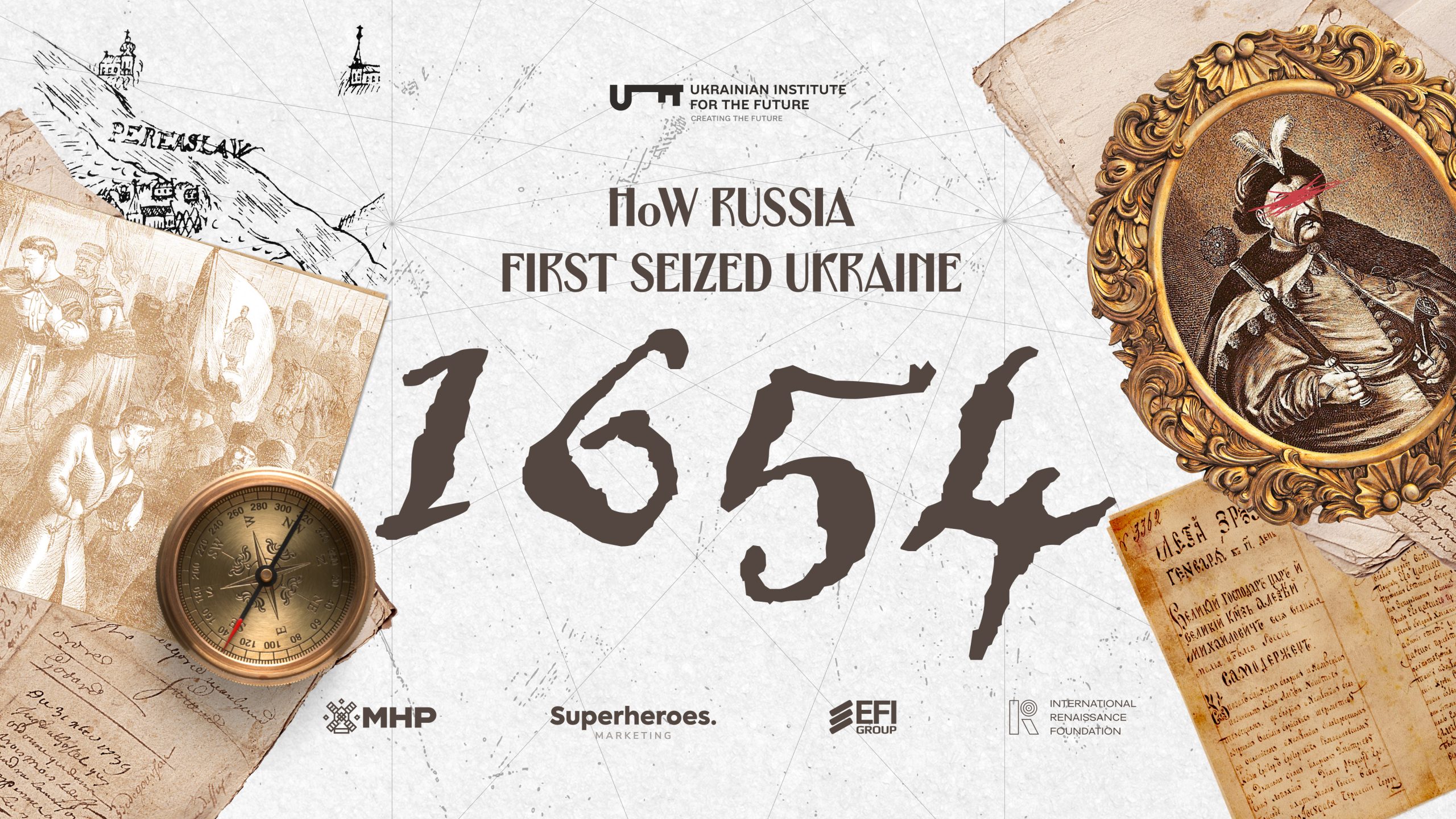
→ Why Khmelnytsky agreed to an alliance with Moscow — and what alternatives he had considered
→ How the same document meant two entirely different agreements to each party
→ Why the Tsar did not swear a reciprocal oath to the Hetman — and what this meant in legal terms
→ How Moscow violated the terms of the alliance within two years — and how the Cossacks responded
→ How Russia took control of Hetman elections through bribery, executions, and Siberian exile
→ How Russia and Poland divided Ukraine along the Dnieper in 1667 — without a single Ukrainian at the negotiating table
→ Why the mechanism set in motion in 1654 continues to be reproduced by Russia to this day
Khmelnytsky Did Not Make a Mistake
There is a temptation to explain 1654 as a blunder by Bohdan Khmelnytsky — that he failed to understand who he was dealing with, that he placed his trust in Moscow and signed what amounted to a capitulation rather than an alliance. This is a convenient interpretation, but an inaccurate one.
Khmelnytsky understood perfectly well who he was dealing with. He was not looking for an ally — he was looking for an instrument. And Moscow agreed to serve as that instrument. The problem lay elsewhere: the two parties concluded different agreements. Not figuratively — literally.
Why Moscow Agreed at All
1648. The Cossack uprising led by Khmelnytsky had grown into a genuine revolution, and in doing so had immediately altered the balance of power across Central-Eastern Europe. The Polish-Lithuanian Commonwealth, which had until then been considered one of the most formidable states on the continent, was rapidly weakening. For all its neighbours — Sweden, the Ottoman Empire, the Muscovite Tsardom — a window of opportunity had opened.
Khmelnytsky recognized this and actively sought an external partner. His principal condition was unambiguous: recognition of the Ukrainian Hetmanate as a sovereign state and an equal subject in international relations. At first he attempted to come to terms with the Crimean Khanate. The Khan consented to provide assistance but, at critical junctures, concluded separate agreements with Poland. Then came negotiations with the Ottoman Empire. It offered promises, but delivered no real military support.
That left Moscow. The Muscovite Tsardom, still recovering from the upheaval of the Time of Troubles at the beginning of the seventeenth century, was in the process of rebuilding its strength. Its international standing had diminished; its territorial ambitions remained unfulfilled. An alliance with the Cossacks offered several simultaneous advantages: the weakening of Poland, an expansion of Moscow’s sphere of influence, and — most importantly — new legal grounds for future expansion.
Moscow agreed. But it agreed on its own terms.
Two Different Agreements
Negotiations lasted several years. In December 1653, the Zemsky Sobor in Moscow passed a resolution accepting the Zaporozhian Host — the wording was revealing: “under the high hand of the Tsar” Alexis Mikhailovich. Not “into alliance,” not “into partnership” — under the hand. The Pereyaslav Council convened in January 1654: the Cossack officer class swore an oath of loyalty to the Tsar. Shortly thereafter, a document was drafted — the March Articles — intended to codify the terms of the alliance.
From the Cossack side: an oath and a compact between two equal sovereign parties. The preservation of the Cossack order: the elective character of the Hetmanate, autonomy in internal governance, a register of 60,000 men, confirmation of the rights of the nobility and of towns. From Moscow’s side: nothing.
The Tsar did not swear a reciprocal oath to the Hetman. Not from oversight or reluctance. Because Muscovite political tradition categorically did not admit of an autocrat swearing oaths to his own subjects. For Moscow, the Cossacks’ act of swearing allegiance meant one thing: they were becoming subjects of the Tsar, and their lands were becoming part of his patrimony.
Chyhyryn and Moscow concluded different agreements while signing the same document.
Three hundred and sixty years later, this scheme would recur: the Minsk Agreements of 2014–2015 were signed by Russia, publicly endorsed, and systematically left unimplemented — interpreted by Moscow as an instrument for freezing the conflict rather than resolving it.
One document. Two different agreements. Again.
Khmelnytsky understood Pereyaslav as an international treaty between two states — temporary, situational, directed against a common adversary. Moscow understood it as a legally binding act of submission — permanent and irreversible.
How Moscow Consolidated Control
By the following year it had become clear which interpretation would prevail.
1656. Sweden launched its own war against Poland, and Moscow decided that an excessive strengthening of Stockholm posed a greater danger than the maintenance of the Cossack alliance. Russia concluded the Truce of Vilna with Poland — without consulting the Ukrainian side. The Ukrainian delegation was simply denied entry to the negotiating chamber.
For Khmelnytsky, this was a slap in the face. For Moscow, it was standard practice: subjects are not invited to negotiations between states. Nor was this a matter of interpretation — the March Articles had explicitly forbidden the Hetmanate from conducting foreign relations without the Tsar’s consent. The Cossacks had signed away limitations on their own sovereignty without ever grasping that they had done so.
After Khmelnytsky’s death in 1657, Moscow began to act openly. In 1663, during the election of the Left-Bank Hetman, Tsarist officials bribed part of the Cossack officer class in order to install their preferred candidate — Briukhovetsky. His rivals — Somko and Zolotarenko — were declared traitors and executed. Several others were sent to Siberia.
This was not a deviation from the rules. This was the rules.
In 1665, Briukhovetsky travelled to Moscow, expecting to consolidate his own authority. He returned bearing new terms — the Moscow Articles. Henceforth, Tsarist governors (voevodas) were granted direct command over the military-administrative and financial life of Ukraine. New garrisons were stationed at Poltava, Kremenchuk, and Oster. Tax revenues from the Ukrainian population — with the exception of the Cossacks themselves — were redirected to the Tsarist treasury.
Eleven years after Pereyaslav, Russia had entrenched an administration, garrisons, and financial control across Ukraine.
Andrusovo: Ukraine Divided Without Ukraine
1667. The Polish-Lithuanian Commonwealth was exhausted by internal conflicts and sought peace. Russia was prepared to compromise. In February, at the village of Andrusovo, a truce was signed that established a new order across the region.
The terms were straightforward: Left-Bank Ukraine would remain under Russian protectorate; Right-Bank Ukraine under Polish control. Kyiv — assigned to Russia temporarily, as it turned out, permanently. The Zaporozhian Sich would fall under “joint protectorate,” which in practice signified a no-man’s-land between two empires.
Neither of the two Ukrainian Hetmans was invited to the negotiations. Not the Right-Bank Hetman Doroshenko; not the Left-Bank Hetman Briukhovetsky. Both were simply ignored.
The formula of “deciding Ukraine’s fate without Ukraine” did not vanish with the seventeenth century. In 2022–2023, a series of international mediators — from China to the Vatican — put forward peace initiatives in which questions of Ukrainian territory and security guarantees were discussed in formats that excluded Kyiv’s full participation. The Andrusovo precedent remains alive.
When Briukhovetsky learned the terms of the treaty, he addressed the population in a series of universals. His words have been preserved: the Russians and the Poles, the Hetman wrote, had resolved “to ruin Ukraine, our fatherland, to utter devastation.” This was not rhetoric — it was a formal record of the fact that both nominal allies had simultaneously revealed themselves as adversaries.
The Truce of Andrusovo closed one process and opened another: Ukraine ceased to be a subject of international relations. Henceforth it was an object of agreements concluded by others.
A Mechanism That Has Not Changed
From Pereyaslav to Andrusovo: thirteen years. In that span, Russia acquired a legal basis for its presence on Ukrainian territory; stationed military garrisons in key cities; established control over tax collection; seized authority over Hetman appointments through bribery and repression; and concluded an agreement on the partition of Ukraine with Poland — without Ukraine’s participation.
Each of these steps appeared situational in isolation. Together they constitute a system.
This template — legal cover, military presence, control of elites, agreements with third parties concluded behind the back of the subject of interest — Russia has reproduced in various iterations across the following three and a half centuries. In different corners of its empire, with different peoples, in different eras.
1654 was not the first application of this template. But for Ukraine, it became the point of departure. It is from the Pereyaslav Council that historians trace the beginning of systematic Russian expansion on Ukrainian soil. It is precisely for this reason that Peter I’s assumption, in 1721, of the title “Emperor of All Russia” was made possible only after Alexis had, in 1655, assumed the title of Tsar of “Great, Little, and White Russia.”
One treaty. Two different agreements. Thirteen years — from the Cossack oath to Andrusovo. And three and a half centuries of consequences.
The same template reappeared in 1994, when the Budapest Memorandum recorded security guarantees for Ukraine in exchange for nuclear disarmament — with no enforcement mechanism binding on Russia. Again, legal cover without reciprocal obligations. Again, one party saw guarantees; the other saw a declaration of intent. In February 2014, Russia invaded the territory of the very country to which those guarantees had been extended.
Pereyaslav and Budapest — different eras, different documents. But the same logic: Russia signs what it finds convenient to interpret at its own discretion.
This material was prepared with the support of the International Renaissance Foundation. It represents the position of the authors and does not necessarily reflect the position of the International Renaissance Foundation.
“Anatomy of Empire” Series — Ukrainian Institute of the Future
This text has been adapted with the use of AI tools. The original text of the “Atlas of Russian Imperialism and Colonialism” may differ in style.


