

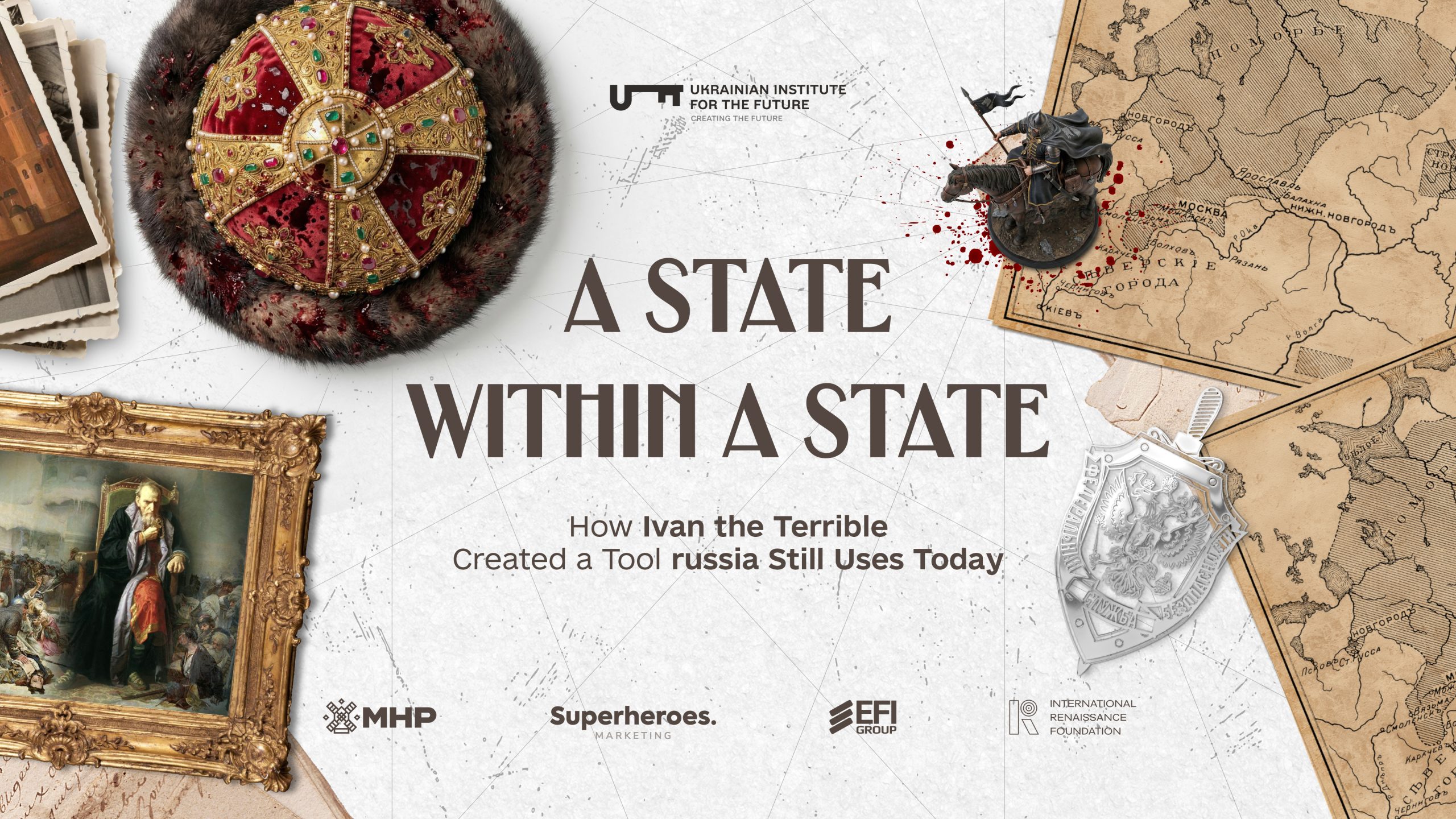
Series “Anatomy of an Empire” │ Ukrainian Institute of the Future
This material was prepared as part of work on the “Atlas of Russian Imperialism and Colonialism” — a UIF publication forthcoming this year.
In this piece you will find answers to the following questions:
- What the oprichnina was — and why it was not simply “medieval terror”
- How Ivan the Terrible divided Russia into two states under one ruler
- Why the oprichniki were neither an army nor a police force, but something fundamentally new
- How the oprichnina ended — and why its logic outlived itself
- Where that logic is being reproduced today
Reading time: ~9 minutes
Misreading Ivan the Terrible
There is a temptation to explain the oprichnina as a manifestation of Ivan the Terrible’s personal madness. A sadistic tsar, a paranoiac, a psychopath — in this reading, the entire era reduces to the clinical diagnosis of a single individual. Horrifying, yes, but singular. An exception, not a pattern.
That reading is appealing but misleading.
The oprichnina was not a malfunction of the system. It was the system. The first — but by no means the last — attempt by a Russian ruler to govern not through institutions but directly: bypassing the elites, the bureaucracy, and any established rules, by creating a parallel chain of authority answerable solely to him personally.
That model outlasted Ivan the Terrible by four and a half centuries.
Context: Why 1565?
To understand the oprichnina, one must understand the trap Ivan found himself in by 1564.
He had launched the Livonian War in 1558, and the opening years went well. The Livonian Confederation collapsed almost instantly. Then Poland, Lithuania, and Sweden became involved. What had promised to be a swift victory became a grinding, multi-front war of attrition. By 1564, Russian forces had suffered several serious defeats.
That same year, Prince Andrei Kurbsky — one of the tsar’s closest associates, a military commander, a man from the innermost circle — defected to Lithuania. He wrote a series of famous letters to Ivan accusing him of tyranny. Ivan replied, and the exchange crystallized the core of the conflict: Kurbsky defended the right of the boyars to constrain tsarist power; Ivan insisted on absolute autocracy. “We are free to reward our bondsmen, and free to put them to death” — that was not rhetoric. It was a declaration of intent.
Amid military setbacks and the defection of his closest circle, Ivan reached a conclusion: the problem was not that he was governing the state badly. The problem was that the state was getting in the way of his governing.
The solution: build a different state.
Two States Under One Tsar
In January 1565, Ivan the Terrible left Moscow for Alexandrova Sloboda and from there proclaimed the establishment of the oprichnina.
In effect, this divided Russia into two parts. The first — the zemshchina — continued to operate under the old rules: the Boyar Duma, customary administration, traditional institutions. The second — the oprichnina — was the tsar’s personal domain, where he could do as he pleased.
The most developed cities and lands were incorporated into the oprichnina: Suzdal, Vyazma, part of Moscow, and the commercial towns with access to the Baltic — in short, the most lucrative territories, where trade, crafts, and the greatest economic resources were concentrated. The zemshchina received the agricultural periphery and was left to shoulder the main burden of the Livonian War.
The oprichniki — from the word oprichʹ, meaning “apart from” or “beyond” — swore personal oaths to the tsar and were required to sever all ties with the zemshchina. At first there were a thousand of them; the number eventually grew to six thousand. They wore black clothing, rode black horses, and attached to their saddles a broom and a dog’s head as symbols: we gnaw out treason, we sweep away filth.
In practice, they were detachments subordinate exclusively to the tsar, operating outside any law.
The Machinery of Terror
In the early years, the oprichnina was relatively restrained: the resettlement of disloyal aristocrats, confiscation of hereditary estates, isolated executions. Some six and a half thousand people, together with their households, were expelled from their lands.
From 1568 onward, everything changed.
Repression became mass and public. Its victims were no longer only boyars but ordinary Russians as well — and not only in the oprichnina, but in the zemshchina too. Metropolitan Philip of Moscow publicly condemned the executions and refused to give the tsar his blessing; he was arrested, stripped of his office, and shortly afterwards strangled.
In December 1569 through February 1570, the oprichnina force launched a campaign to the north. Along the route, Klin, Torzhok, and Tver were plundered. In Novgorod, a massacre lasted five weeks: estimates of the dead range from several thousand to several tens of thousands. Famine followed in its wake. In Pskov, the killings remained isolated only because the tsar unexpectedly ordered a halt — according to legend, unnerved by the prophecy of a local holy fool.
Eyewitnesses wrote that the oprichniki’s campaigns resembled the raids of foreign conquerors, not the campaigns of the tsar’s own forces.
How It Ended
In May 1571, the Crimean Khan Devlet I Giray advanced on Moscow and burned it almost to the ground.
The oprichnina force either failed to muster in time or had no wish to fight. Moscow burned for three days. Estimates of the dead range from tens of thousands to several hundred thousand.
The following year, the Crimeans came again. This time they were stopped — but by a combined zemshchina and oprichnina force, under the command of the zemshchina governor Mikhail Vorotynsky. After the battle, Ivan the Terrible accused Vorotynsky of treason and had him executed.
That same year, 1572, the oprichnina was formally abolished. The very word was banned, on pain of punishment. Yet the separateness of the tsar’s court survived in practice — simply without the name.
The outcome after seven years: tens of thousands dead, a ruined economy, approximately fifty per cent of arable land at the centre of Russia left uncultivated. In some regions, the figure reached up to 90%. To prevent peasants from fleeing, Ivan the Terrible introduced from 1581 the “reserved years” — years in which movement from one master to another was forbidden. That was the first step towards serfdom.
In other words: the oprichnina did not merely kill people. It shattered the economy, drove the peasantry into serfdom, and transformed Russia into a state where the physical dependence of the population upon the authorities became the norm.
A Logic That Outlasted Ivan
Scholars of the oprichnina argue over whether Ivan the Terrible was mentally ill or methodically rational. But there is a more important question: what model did he leave behind?
The model is simple. If existing institutions obstruct you — do not reform them; create a parallel structure that exists outside the law and answers only to the sovereign. That structure terrorizes the elites, destroys the horizontal ties between independent actors, and makes any opposition impossible — not through persuasion but through fear.
After the oprichnina, the level of authoritarianism among Russian autocrats permanently surpassed even the harshest European absolute monarchies. That is not a coincidence; it is an inherited model.
Peter the Great had the Preobrazhensky Prikaz — a secret police answerable personally to him. Catherine the Great had the Secret Expedition. Nicholas I had the Third Section. Stalin had the NKVD. Putin has the FSB.
But the oprichnina is not only about secret police. It is about the principle of parallel structures as a governing instrument in general.
The Wagner Group and the Rosgvardiya alongside the regular army. The “people’s republics” on occupied territories alongside official state structures. Kadyrov as a phenomenon unto himself within the system of federal power. Officials who hold formal positions and informal authority, with no legal boundary between the two.
All of this is the oprichnina. Different names, different eras, the same architecture: a parallel system that exists outside the law, answerable to a single person, and held together by personal oaths rather than institutional logic.
Why This Matters Today
When analysts try to understand why no institutional reforms work in Russia, why formal laws and real power operate in entirely separate realities, why negotiations with Moscow so regularly prove futile — part of the answer lies in 1565.
A state in which the ruler has fundamentally rejected the logic of institutions and built parallel structures of personal loyalty cannot be a partner in a system founded on contracts and mutual obligations. Not because a particular leader is malign. But because the architecture of power is fundamentally incompatible with obligations of any kind.
This is not 1565. This is still happening.
This is the second piece in the “Anatomy of an Empire” series. The series is based on the “Atlas of Russian Imperialism and Colonialism” — a major UIF research project forthcoming in print and digital format. To be continued.
The text has been adapted with the assistance of AI tools. The original text of the Atlas may differ in style.
This project is implemented with the financial support of the International Renaissance Foundation.


