Monthly Energy Digest – February 2026
February 2026 was a month of intense testing and recovery for the Ukrainian power system, following the year’s most severe attacks and marking a notable decrease in the power deficit. The month began with critical tension: on February 3, the country experienced its largest strike since the start of the year, targeting CHP and TPPs in Kyiv, Kharkiv, and Dnipro, causing widespread emergency outages. The situation was worsened by ongoing shelling and bad weather, which further cut off power to communities in the center and west of the country.
Heavy shelling completely destroyed the Darnytsia CHP in Kyiv, leading to a severe energy supply crisis on the Left Bank. As a result, hundreds of thousands of residents in the Darnytsia and Dnipro districts faced a total shutdown of heat and hot water during cold weather. Due to extensive damage, quick repairs were impossible, leaving thousands in cold shelters for an extended period.
The second major strike on February 7 targeted key substations, leading to the forced shutdown of all nuclear plants and another increase in the deficit. During this time, the power system was on the verge of failure, and restriction schedules were strict and often unpredictable, especially for residents on the left bank.
However, from the second week of February, the situation began to gradually stabilize due to active repairs and seasonal warming. An important milestone was restoring nuclear generation capacity to over 90%, which helped strengthen the system’s foundation after network restrictions at the start of the month. Although the enemy continued targeted attacks on oil and gas infrastructure and distribution networks in Odessa, Dnipropetrovsk, and Sumy regions, the overall deficit started to decrease rapidly. By the end of the month, the deficit had fallen to 1 GW, which is 5–6 times less than the critical levels seen in winter.
By the end of the month, the power system still experienced evening and morning peaks of deficit, which required maintaining hourly outage schedules in most areas. Solar generation started to play a noticeable role, and due to the longer daylight hours, it significantly aided the system during the day.
In February, Ukraine imported 1,262.8 thousand MWh of electricity, setting a record. To remind, in January, electricity imports also broke records – 894,5 MWh. There was no electricity exported due to capacity shortages on the power system. Exports were halted on November 11, 2025.
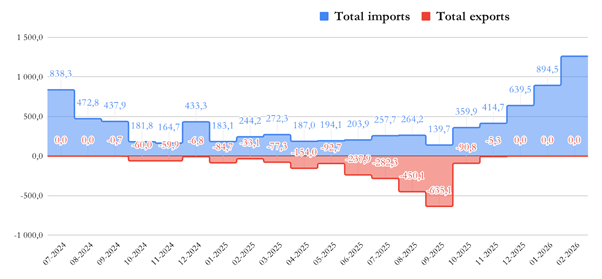
Monthly electricity import volumes by partner countries
(The chart is based on ENTSO-E data)
Traditionally, Hungary accounted for the largest share of imports. And its share rose compared to the previous month.
January and February import comparison (based on ENTSO-E data)
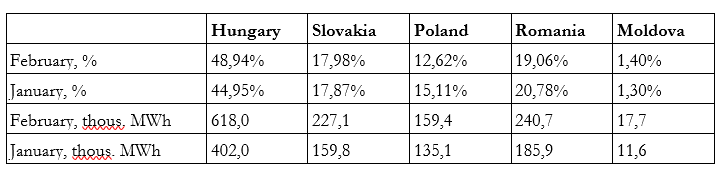
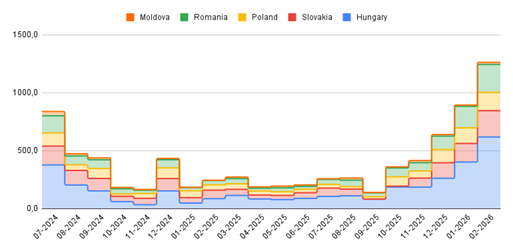
Monthly electricity import volumes by partner countries
(The chart is based on ENTSO-E data)
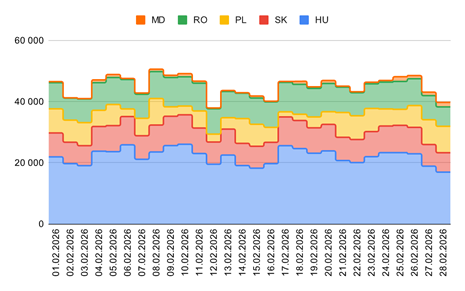
Daily volumes of electricity imports by countries of origin, MWh
(The chart is based on ENTSO-E data)
An impetus for an increase in electricity imports in February was the regulatory decisions made in January. These included increased price caps in the electricity market and government instructions for some state-owned companies to import at least half of their consumed electricity. Higher price caps allowed the import of more expensive electricity, boosting the total volume. The government required UkrZaliznytsia, Naftogaz, and UkrOboronProm to urgently secure imports to cover at least 50% of their consumption
In mid-February, Slovakia and Hungary announced the possibility of cutting off electricity supplies to Ukraine amid a conflict over the transit of Russian oil through the Druzhba pipeline. In 2025, Hungary accounted for 42.5% of all electricity imported by Ukraine, and Slovakia accounted for 20%.
Slovak Prime Minister Robert Fico said that Bratislava might cut off electricity supplies to Ukraine if suspicions of a deliberate delay in restoring the damaged section of the Druzhba oil pipeline are confirmed. He also considered reviewing political support for Ukraine if the situation worsens. Hungarian officials threatened to suspend exports but later announced that the step had been postponed.
Actually, the government has no authority to suspend electricity exports. It is traded by private companies at market-based prices. Forcing the TSO to block trade could cause tensions with ENTSO-E and challenge the TSO’s independence recognized by the Energy Community. If this happens, it could lead to penalties for the TSO and threaten its independence license. Additionally, electricity producers would be able to export electricity to Ukraine through other neighboring states.
The only option to halt supplies might be sanctions, but this will raise questions from the European Commission.
On February 23, Prime Minister Robert Fico announced that the country would suspend providing emergency aid to the Ukrainian power system if requested. This also violates the regulations and contracts between Ukrainian and Slovak TSOs, but it may be easier to implement. Meanwhile, the emergency aid accounts for far less than 1% of total supplies, so it does not threaten Ukraine’s electricity security.
Following these statements, volumes of commercial electricity imports to Ukraine from both states continued and remained unchanged and followed the trend of electricity imports. By the end of the month, imports from all directions declined due to lower demand and a smaller capacity shortage, especially on weekends.
Energy companies purchased 569 MW of cross-border electricity import capacity from EU countries into Ukraine in March 2026, based on results from monthly auctions held on the Joint Allocation Office (JAO) platform.
The largest capacity volume was contracted on the Hungarian direction – 351 MW. An additional 109 MW were purchased on the Slovak and Romanian routes. Meanwhile, the demand for access to the crossings far exceeded the available volumes. Specifically, demand on the Hungarian route was 2,775 MW, nearly eight times the available capacity. On the Slovak route, demand reached 1,238 MW, and on the Romanian route, it was 1,019 MW.
In February, prices in the power wholesale market segments increased. This was primarily due to large deficits in the power system, caused mainly by Russian shelling, as well as imports of more expensive electricity to help mitigate consumer outage schedules. In February, the weighted average price of electricity bought and sold on the day-ahead market (DAM) was UAH 10,048.28/MWh. In January, the price was UAH 8,381.08/MWh, and in December, it was UAH 6,880.55/MWh.
This trend is likely to break in March, when demand drops and supply increases due to more solar power generation and possibly partial repairs of capacities. However, if there are new Russian attacks and destruction in the power system, the price situation will stay pressured.
Read a separate explainer on how capacity shortages impacted electricity prices in the Ukrainian wholesale market.
On February 23, the Cabinet of Ministers approved a unified model charter for fuel and energy enterprises. Moving forward, such models will be adopted for state-owned companies in other sectors. This measure aims to standardize approaches to establishing management bodies and defining their powers, as well as to enhance transparency, accountability, and overall efficiency of state-owned enterprises.
After the Nomination Committee meeting, the Cabinet of Ministers appointed Deputy Minister of Economy, Environment, and Agriculture Daria Marchak as the country’s representative on the Supervisory Board of JSC NNEGC Energoatom. She succeeds Serhiy Sukhomlyn, who voluntarily stepped down from the role and is the Chairman of the State Agency for Infrastructure Rehabilitation and Development of Ukraine.
The selection was made by the Nomination Committee, which is supported by the Ministry of Economy, Environment, and Agriculture of Ukraine. The Committee also includes representatives from the Ministry of Finance and the Ministry of Energy, as well as independent observers from the European Bank for Reconstruction and Development, the International Finance Corporation (IFC), the EU Delegation to Ukraine, and the Business Ombudsman of Ukraine, who do not have voting rights.
Daria Marchak specializes in public finance, strategic planning, and institutional reforms. She previously held roles such as First Deputy Minister of Social Policy and Chief Operating Officer of Prozorro.Sales, where she led the digitalization of government systems and ensured transparency in asset management. Her expertise encompasses analytical work, public finance, and successful collaboration with international financial organizations, including the World Bank.
In February, Ukraine’s net gas imports—which include re-exports and short-haul transit totaling 3–6 million m³ daily—ranged from 17 to 26 million m³ per day from Hungary, Poland, Slovakia, and smaller volumes from Moldova and Romania.
Gas consumption caused by temperature fluctuations ranged from 100 to 110 million m³ per day. Gas withdrawal from underground storage facilities in February averaged 42 million m³ per day, stemming from both domestic production and imports. Over the past three years, the average withdrawal from these facilities was 54 million m³ per day. The current natural gas reserves in Ukrainian underground storage facilities are enough to confidently get through the heating season, unlike last year when reserves were extremely low.
Hungarian officials stated that the country might cease natural gas exports to Ukraine if Kyiv fails to resume Russian oil deliveries through the Druzhba pipeline. Hungary intended to work with Slovakia, which had earlier threatened to cut electricity supplies to Ukraine.
The Hungarian route is a major pathway for natural gas imports to Ukraine. According to an assessment by ExPro Consulting, in 2025, Ukraine imported over 2.9 billion cubic meters of natural gas from Hungary, accounting for about 45% of all imports. Gas imports from Slovakia were lower in 2025 – 1.3 billion cubic meters (20%) – as this route is less attractive due to higher tariffs.
Technically, suspending trade could impact gas TSOs in a similar way to electricity TSOs. Gas pipelines operate under the rules of the EU’s Third Energy Package. Hungary and Slovakia are transit countries, not just gas owners. Blocking access to networks for private European traders selling gas to Ukraine is a serious violation of EU law. Additionally, TSOs (Eustream in Slovakia and FGSZ in Hungary) have long-term obligations to reserve capacities. For example, Slovakia has confirmed guaranteed capacities for Ukraine until the end of winter 2026.
At the monthly auction to reserve capacities for the joint product Route 1 for natural gas imports to Ukraine in March, all proposed capacities were booked — approximately 2.41 million cubic meters per day, or nearly 75 million cubic meters for the entire month. However, capacity on Route 2 (from the Greek LNG terminal Alexandroupolis) and Route 3 (from the TAP’s entry point with Azerbaijani gas) has not been booked.
According to ExPro Consulting, natural gas via Route 1 will be received by NJSC Naftogaz of Ukraine in March. Earlier, the Greek company Atlantic See LNG Trade announced that the first American LNG shipment to Ukraine via Greece is expected in March.
The joint product Route 1 allows booking capacities to import natural gas from the Greek LNG terminal Revithoussa to Ukraine at special reduced tariffs. The route became operational in July 2025. In recent months, demand for Route 1 capacities has been low: no capacity was booked for January, and only 4.5 thousand cubic meters per day for February.
On February 12, the Ukrainian Foreign Ministry reported that the transit of Russian oil to Europe through the Druzhba pipeline had been halted since January 27 after Russia targeted an oil pipeline facility in Ukraine. Slovakia and Hungary, which receive Russian oil via the pipeline, consider this situation politically motivated, believing that if the pipeline were damaged, it could have already been repaired. Parties are calling for an international inspection of the pipeline.
Late, Kyiv proposed to the European Union that the Odesa-Brody oil pipeline be used for oil transit to Hungary and Slovakia instead of the damaged section of the Druzhba oil pipeline caused by the Russian attack. In this case, oil must be delivered to the Odessa port, which requires security guarantees.
Hungary and Slovakia have stopped exporting diesel fuel to Ukraine. This decision follows the halt of Russian oil transit through the southern branch of the Druzhba pipeline.
Slovak Prime Minister Robert Fico and Hungarian Foreign Minister Peter Szijjártó stated that the MOL Group plants, including the Sázságlombatá refinery and Slovnaft in Bratislava, are forced to redirect all resources to domestic consumption and rebuild their reserves because of unstable raw material supplies. The Hungarian side directly tied the restart of diesel exports to the resumption of oil transit through Ukraine, calling the situation “political blackmail” by Kyiv.
Hungary and Slovakia made up only about 10% of Ukraine’s total diesel fuel imports. Ukraine primarily imports its fuel through ports in Poland, Romania, and the southern corridors. The market has robust logistics chains that allow for swift replacements. Ukraine has previously faced similar supply disruptions from the MOL Group in fall 2025 (due to technical issues at the plants), which did not lead to shortages or price hikes at gas stations.
Ukrnafta drilled 25 new wells in 2025, setting a record and achieving 150% growth compared to 2024. Of these, 7 wells were constructed by the company’s own forces. Furthermore, in 2025, Ukrnafta conducted 3D seismic surveys covering 629 sq. km, setting a company record.
Due to new drilling, intensified measures, and other production processes, the company managed to boost oil production by 3.77% and gas production by 2.86%. Overall growth in oil equivalent stands at 3.4% compared to 2024.
Until 2023, the drilling rate was minimal, averaging 1-2 wells per year, but after shifting to state management, the volumes began to grow steadily: 2023 – 6 wells; 2024 – 10 wells (+67%); 2025 – 25 wells (+150%). Overall, the number of wells drilled in 2025 matched what was drilled from 2015 to 2022.
The Energy Community published the Ukraine Energy Market Observatory’s quarterly report for the fourth quarter of 2025, noting Ukraine’s progress in reforming its energy sector and integrating into the European energy market, while highlighting several regulatory and structural restrictions that still require further changes.
In January 2026, Ukraine saw a decline in the import volume of electric vehicles. The main reason for this change was the expiration of tax incentives, especially the removal of VAT exemption, which took effect on January 1. This caused a drop in supplies for both new and used cars.
According to the Institute for Automotive Market Research, about 2,300 electric vehicles were registered in Ukraine in January, which is significantly less than the record 33,000 in December 2025. Imports of used electric vehicles in January dropped by 94.5% compared to December 2025, totaling 1,374 units, and decreased by 53.7% compared to January 2025. In January 2026, 864 new electric vehicles were imported, which is 85.2% fewer than the previous month. However, compared to January 2025, this figure increased by 35.6%.
The National Anti-Corruption Bureau of Ukraine (NABU) has officially placed Rostyslav Shurma, the former Deputy Head of the Presidential Office, and his brother Oleh on the national wanted list. The move follows a high-profile investigation into the embezzlement of state funds under the “green tariff” energy scheme.
According to NABU and the Specialized Anti-Corruption Prosecutor’s Office (SAPO), Shurma was formally issued a suspicion notice on January 21, 2026. The case involves allegations that solar power plants owned by Shurma’s associates in the temporarily occupied territories of the Zaporizhzhia region continued to receive state payments, totaling approximately UAH 141.3 million ($3.3 million), despite being disconnected from Ukraine’s unified energy system.
The charges against Shurma include embezzlement (Article 191) and money laundering (Article 209 of the Criminal Code of Ukraine). On February 12, 2026, both brothers were added to the Interior Ministry’s wanted registry after failing to appear for investigative proceedings.
Currently residing in Germany, Shurma has denied all wrongdoing. In a public statement issued via social media, he claimed he is not “hiding” and is prepared to cooperate with the investigation from abroad.
NABU has announced suspicions against former Energy Minister Herman Galushchenko in the Midas case. He faces allegations of money laundering and involvement in a criminal organization. On February 15, 2026, he was detained by NABU detectives while trying to leave Ukraine.
According to the investigation, in February 2021, a fund was registered on the island of Anguilla (a self-governing overseas territory of the United Kingdom) at the initiative of participants in a criminal organization exposed by NABU and SAPO in November 2025, aimed at attracting about $100 million in investments. The suspect’s family was among the fund’s investors. During the suspect’s tenure, through his proxy, the criminal organization received over $112 million in cash from illegal activities in the energy sector. Later, the Supreme Anti-Corruption Court decided to place Galushchenko in custody, with the option of ₴200 million bail.
European countries will transfer equipment from at least six decommissioned CHPs and TPPs to Ukraine, which will help quickly restore the destroyed and damaged Russian facilities. Agreements have been made with Latvia, Austria, Finland, Croatia, France, and Germany on the possibility of receiving this decommissioned equipment and delivering it promptly to Ukraine.
The Cabinet of Ministers of Ukraine has allocated over UAH 1.6 billion in budget funds to work on securing the New Safe Confinement (NSC) of the Shelter facility, built over power unit No. 4 of the Chornobyl NPP. The funds will be used, among other things, to address the consequences of the Russian attack on the station’s shelter in February 2025.
On July 1, 2025, the fifth grant agreement was signed between the European Bank for Reconstruction and Development (EBRD) and the State Specialized Enterprise (SSE) “Chornobyl NPP” for a project that involves assessing the damage and developing an action plan for temporary repairs to the outer shell and sealing membrane of the new safe confinement. It is expected that full restoration of the NSC, even with adequate funding, will take several years. However, during this process, there will be a strong focus not only on technical aspects but also on ensuring maximum safety for the environment and for the people working in the Chornobyl NPP area and the exclusion zone.
This publication was created by the Ukrainian Institute of the Future with the support of the Askold and Dir Foundation, administered by ISAR Unity as part of the project “Strong Civil Society in Ukraine – a Driver of Reforms and Democracy” funded by Norway and Sweden. The content of the publication is
the responsibility of the Ukrainian Institute of the Future and does not reflect the views of the governments of Norway, Sweden, or ISAR Unity.


Together we can change the future! Your support allows us to continue our research and provide objective analysis of key social issues. Join us today to build the future of our generations together.
Support