Digests • 16 December 2025
On November 26, the IMF and the Ukrainian authorities reached a staff-level agreement on a new four-year program under the Extended Fund Facility for USD 8.1 billion.
December 1. The Ministry of Finance announced another proposal to restructure GDP-linked bonds.
On December 3, the Verkhovna Rada adopted the 2026 Budget.
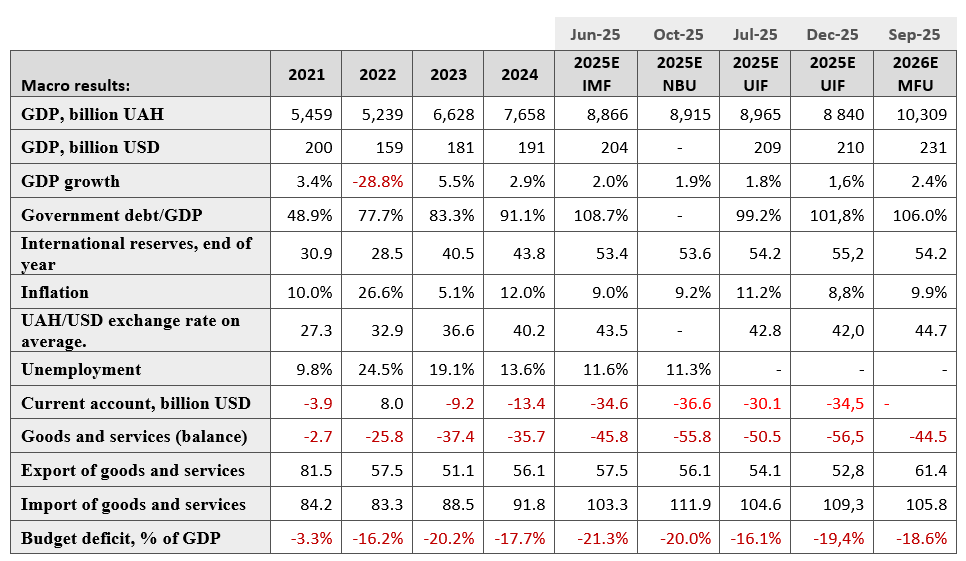
The Ukrainian Institute for the Future updated its forecast for Ukraine’s macroeconomic indicators, budget, and balance of payments for 2025. It is included in this digest. The 2026 forecast should be expected at the end of December.
Growth in the Ukrainian economy in Q3 2025 was 2.1%.
On December 11, the Board of the National Bank decided to keep the key policy rate at 15.5%.
International reserves in November 2025 increased from USD 49.5 to USD 54,7 billion.
On November 26, a mission of the International Monetary Fund (IMF) and the Ukrainian authorities reached a staff-level agreement on a new four-year program under the Extended Fund Facility (EFF), with potential access of SDR 5.94 billion (USD 8.1 billion).
The new agreement outlines a comprehensive set of fiscal and monetary policy measures to serve as the backbone of the program. The main objectives are to support macroeconomic stability, restore debt and external sustainability, combat corruption, and improve governance quality.
The new program may be submitted to the IMF Executive Board for consideration and approval after completion of prior actions, subject to sufficient donor financing assurances.
The IMF expects the program to catalyze large-scale external support to cover Ukraine’s financing needs. Under the baseline scenario, the total financing gap in 2026–2029 is estimated at approximately USD 136.5 billion. In 2026–2027, taking into account the financing assurances already provided, Ukraine faces a remaining financing gap of approximately USD 63 billion, according to the IMF press release.
In addition to implementing its debt restructuring strategy to restore debt sustainability, the authorities have also committed to accelerating efforts to prevent tax evasion and avoidance, as well as to broadening the tax base, including by taxing income earned through digital platforms, closing customs loopholes for the import of consumer goods, and abolishing VAT registration exemptions. Agreements were also reached on measures to combat informal economic activity, including by strengthening competition in public procurement and eliminating loopholes in the current labor code.
Ukrstat estimated the Ukrainian economy’s growth in Q3 2025 at 2.1%. This is the best result this year. However, the likelihood of further economic growth in the coming quarters if the war continues is highly questionable.
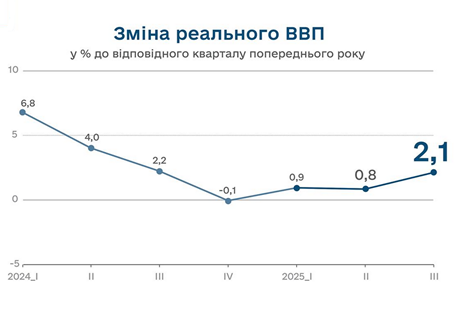
Source: Ukrstat.
Figure translation
Change in Real GDP
% year-on-year (compared to the corresponding quarter of the previous year)
Inflation in the consumer market in November 2025, compared to October, was 0.4%, and compared to November 2024, it was 9.3%.
Core inflation in November 2025 compared to October was 0.3%, and compared to November 2024, 9.3%.
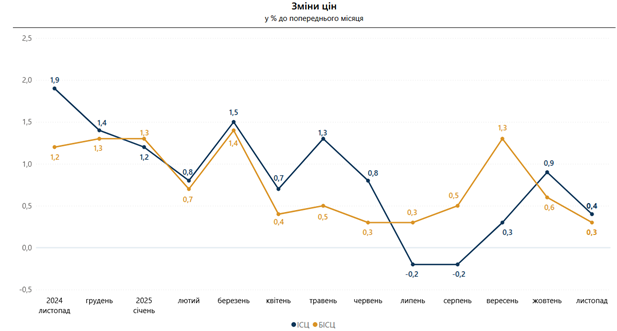
Price changes over the past 12 months. Source: Ukrstat.
Figure translation
Change in prices
(in % to the previous month)
2024 November December 2025 January February March April May June July August September October November
In the consumer market in November, prices for food and non-alcoholic beverages increased by 0.8%. Eggs rose the most (by 12.6%). Prices for vegetables, lard, grain processing products, fish and fish products, sunflower oil, pasta, fermented milk products, cheese, bread, beef, milk, and butter increased by 4.6–0.8%. At the same time, prices for fruit, pork, sugar, poultry meat, and rice decreased by 3.0–0.9%.
Prices for alcoholic beverages and tobacco products increased by 1.2%, which was driven by a 1.9% increase in tobacco product prices.
Clothing and footwear became cheaper by 2.3%, with footwear down 2.9% and clothing down 1.9%.
Transport prices increased by 0.5%, mainly due to higher fares in rail and road passenger transport (1.6% and 0.6%, respectively) and higher fuel and lubricants prices (0.5%).
On December 11, the Board of the National Bank decided to keep the key policy rate at 15.5%.
The NBU noted that, amid persistent pro-inflationary risks, including those related to future international financing, such a decision is necessary to maintain the attractiveness of hryvnia-denominated instruments, to stabilize the foreign exchange market, and to anchor expectations to bring inflation to the 5% target over the policy horizon. The NBU will respond flexibly to further changes in the balance of risks to price dynamics.
If inflationary risks persist or intensify, particularly due to uncertainty about external financing, the NBU will be ready to refrain from easing its interest rate policy and, if necessary, to take additional measures. Conversely, a reduction in pro-inflationary risks will allow the NBU to move into an easing cycle in line with the baseline scenario of the October macroeconomic forecast.
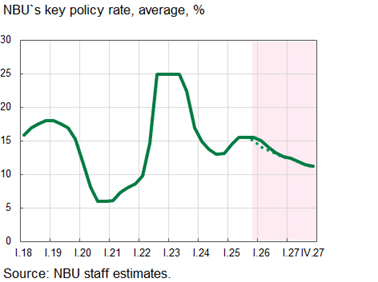
Source: NBU. Inflation Report, Q4 2025.
The Ukrainian Institute for the Future has updated its economic development forecast for 2025. Annual inflation was revised down to 8.8% (from 11.2% in July). The average hryvnia-to-dollar exchange rate in 2025 was lowered in the forecast from 42.8 to 42.0. Economic growth in 2025 was lowered in the forecast from 1.8% to 1.6% of GDP. However, GDP in dollar terms increased from USD 209 to 210 billion, driven by the NBU’s effective maintenance of the national currency exchange rate for almost one year.
The consolidated budget for 10 months of 2025 was closed with a deficit of UAH 1,052.9 billion, compared to UAH 922.9 billion for 10 months of 2024.
Tax revenues in 2025 are already UAH 366.9 billion higher than in 2024. Including the unified social contribution (USC), tax revenues are already more than UAH 470 billion, higher than in 2024.
At the same time, the state budget deficit for 10 months of 2025 amounts to UAH 1,105.3 billion, while local budgets recorded a surplus of UAH 52.4 billion.
In November 2025, Ukraine received external financing from the following sources:
Ukraine also received USD 115 million from the Council of Europe Development Bank.
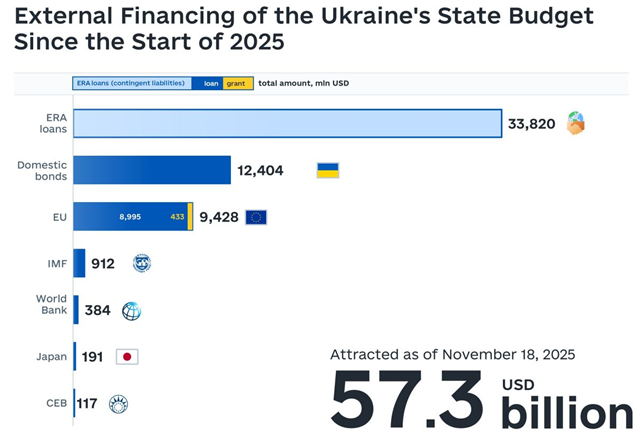
Source: Ministry of Finance.
As of November 1, 2025, UAH 447 billion remained in the state and local budgets. Given that, in November, the budget received substantial Western financing and will receive additional funds in December, we believe the state budget’s carryover balances as of January 1 will exceed UAH 300 billion, even if local budgets and the state budget spend 10% of GDP in December.
As of November 1, 2025, Ukraine’s state and state-guaranteed debt amounted to USD 197.19 billion (+USD 3 billion in October 2025).
The debt increased following EU financing to Ukraine in October 2025.
Since the beginning of 2025, the debt has increased by USD 31 billion over the first 10 months of 2025.
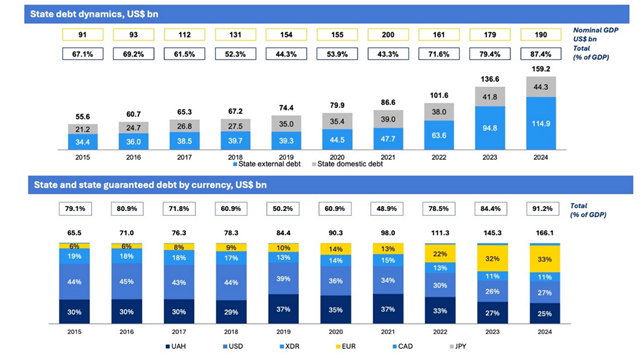
Dynamics of changes in public debt in 2015–2024. Source: Ministry of Finance
An analysis of public debt dynamics shows a sharp increase in EU debt. Since the start of the war, the share of public debt denominated in euros has increased from 13% to 33% by the end of 2024 and continues to grow (36% as of November 1, 2025).
The share of IMF debt has declined during the war from 15% to 11%. The IMF is the only creditor to which Ukraine has been repaying principal during the war, at a high interest rate.
On December 1, the Ministry of Finance presented a third proposal to creditors on the restructuring of GDP-linked bonds. This is one of the IMF’s prerequisites for launching a new program. In effect, Ukraine proposed that creditors exchange GDP-linked bonds totaling USD 2,591 million for new bonds. USD 1,000 of GDP-linked bonds for USD 1,340 of new bonds (a 34% premium), as well as USD 95 in cash payments (9.5%), depending on the terms. However, it should be noted that, while GDP-linked bonds in 2015 did not include a 20% debt write-off, they will now be revalued at a 43.5% premium.
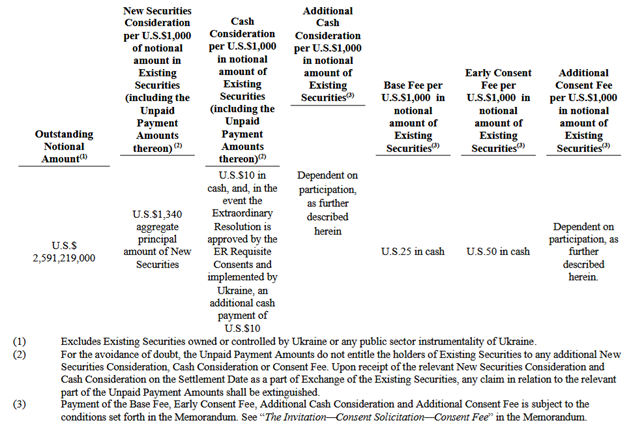
Source: https://api3.dublin.oslobors.no/v1/newsreader/attachment?messageId=85058&attachmentId=85466
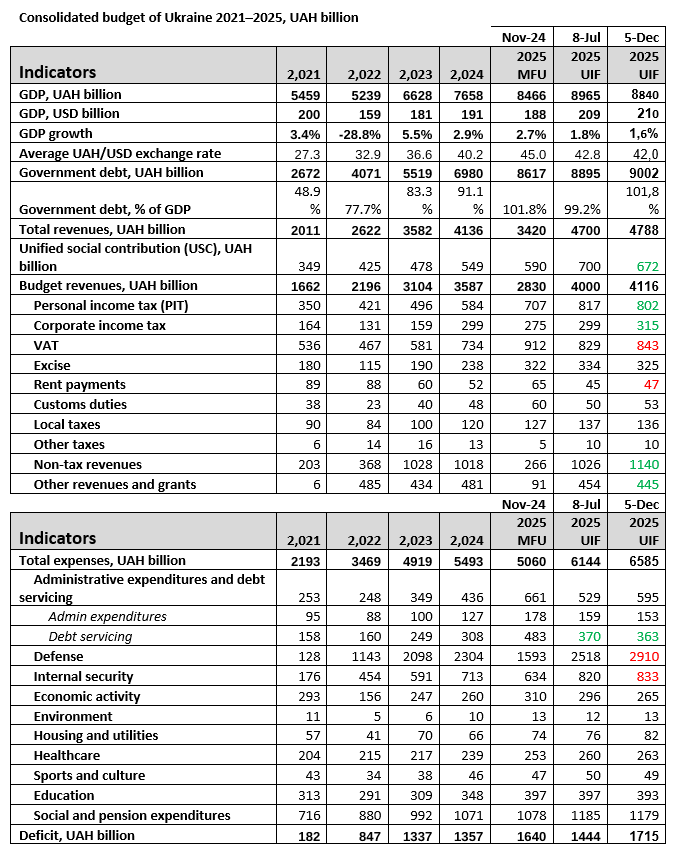
The Ukrainian Institute for the Future has updated its budget execution forecast through the end of 2025.
Source: UIF calculations.
The following key points regarding the changes to the 2025 budget execution forecast are worth noting.
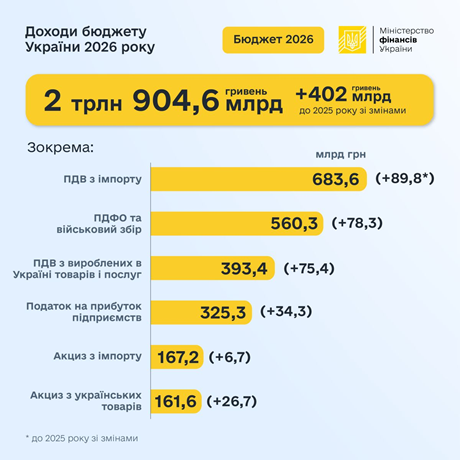
On December 3, the Verkhovna Rada adopted the 2026 Budget. After the Government finalized the budget conclusions for the second reading, revenues were increased by UAH 27.8 billion to UAH 2,904.6 billion. This was mainly due to corporate income tax from banks. The budget deficit amounts to UAH 1.92 trillion. This is approximately 18.6% of GDP.
Source: Ministry of Finance.
Figure translation
Revenues of the State Budget of Ukraine for 2026
Budget 2026
Ministry of Finance of Ukraine
UAH 2 trillion 904.6 billion
+UAH 402 billion compared to 2025 with amendments
VAT on imports
UAH 683.6 billion (+89.8*)
Personal income tax and military levy
UAH 560.3 billion (+78.3)
VAT on domestically produced goods and services
UAH 393.4 billion (+75.4)
Corporate income tax
UAH 325.3 billion (+34.3)
Excise tax on imports
UAH 167.2 billion (+6.7)
Excise tax on Ukrainian goods
UAH 161.6 billion (+26.7)
* compared to 2025 with amendments
Source: Ministry of Finance.
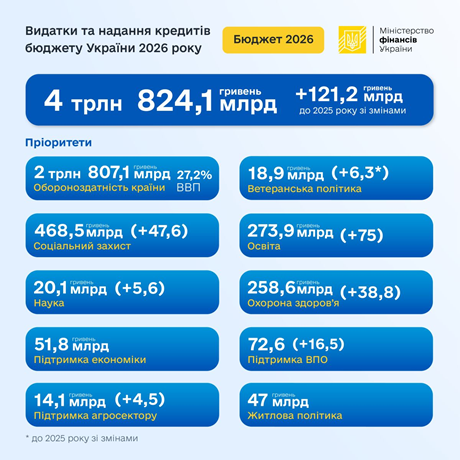
Figure translation
Expenditures and Lending of the State Budget of Ukraine for 2026
Budget 2026
Ministry of Finance of Ukraine
UAH 4 trillion 824.1 billion
+UAH 121.2 billion compared to 2025 with amendments
Priorities
UAH 2 trillion 807.1 billion — 27.2% of GDP
National defense
UAH 18.9 billion (+6.3* )
Veterans policy
UAH 468.5 billion (+47.6)
Social protection
UAH 273.9 billion (+75)
Education
UAH 20.1 billion (+5.6)
Science
UAH 258.6 billion (+38.8)
Healthcare
UAH 51.8 billion
Economic support
UAH 72.6 billion (+16.5)
Support for internally displaced persons
UAH 14.1 billion (+4.5)
Support for the agricultural sector
UAH 47 billion
Housing policy
* compared to 2025 with amendments
Security expenditures remained at UAH 2.8 trillion. However, they do not include Western military assistance.
The 2026 Budget will be reviewed in more detail in UIF’s 2026 Forecast.
The trade deficit continues to worsen. Imports of goods in October reached a record high of USD 8 billion. At the same time, exports of goods in October were more than twice as low at USD 3.5 billion. The trade deficit in goods and services for 10 months reached a record USD 44.9 billion.
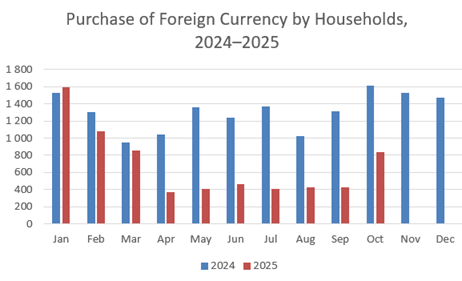
It should also be noted that significant household demand for foreign currency has returned since the NBU began implementing a policy of managed depreciation. In October, the net balance of foreign currency purchases and sales exceeded USD 800 million, compared with around USD 400 million six months earlier.
Source: NBU.
Overall, for 10 months, the current account balance was negative at USD -26.9 billion. This is USD 12.8 billion more than in 2024 for the same 10-month period.
We observe that inflation continues to decline faster than expected, allowing the NBU to shift its exchange rate policy from curbing inflation through a fixed hryvnia/US dollar rate to a policy of mild managed depreciation of the hryvnia against the US dollar. This process was evident in November, when the hryvnia-to-US dollar exchange rate moved into the 42.0–42.3 range amid significant Western financing for Ukraine.3
We expect the hryvnia/US dollar exchange rate in December to fluctuate between 42.0 and 42.5, with a possible peak of 43 by year-end. At the same time, we expect the euro exchange rate in December to be in the 49–50 range.
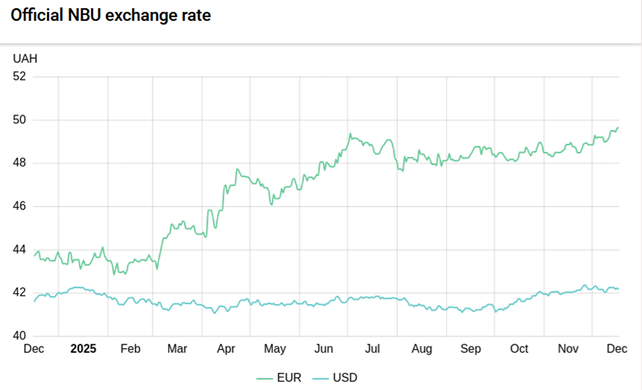
Hryvnia exchange rate to the US dollar and the euro over the past 12 months. Source: NBU.
International reserves in November 2025 increased from USD 49.5 billion to USD 54.7 billion. This is a new historical record for Ukraine.
According to balance of payments data, the National Bank sold USD 2,728.3 million on the foreign exchange market and purchased USD 1.3 million for reserves. As a result, the NBU’s net foreign currency sales in November totaled USD 2,727.0 million, 3.9% lower than in October.
In November, USD 8,147.7 million was credited to the government’s foreign currency accounts at the National Bank, including:
USD 6,889.7 million – from the EU under the G7 Extraordinary Revenue Acceleration for Ukraine (ERA) initiative and the Ukraine Facility instrument;
USD 810.4 million – through World Bank accounts;
USD 332.1 million – from the placement of domestic government bonds;
USD 115.5 million – from the Council of Europe Development Bank.
Payments for servicing and repayment of public debt in foreign currency amounted to USD 493.0 million, including:
USD 370.2 million – servicing and repayment of domestic government bonds;
USD 65.3 million – servicing and repayment of debt to the European Investment Bank;
USD 30.3 million – servicing and repayment of debt to the EBRD;
USD 18.0 million – servicing of debt to the World Bank;
USD 9.2 million – payments to other creditors.
In addition, Ukraine paid USD 282.6 million to the International Monetary Fund.
The current level of international reserves covers 5.6 months of future imports.
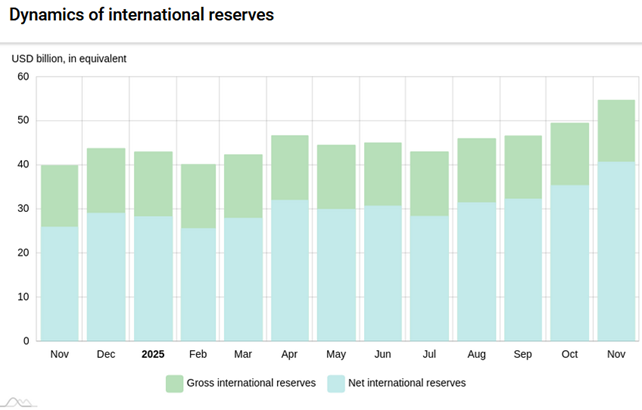
Changes in international reserves over the past 12 months. Source: NBU.
The Ukrainian Institute for the Future updated its balance of payments forecast through the end of 2025.
The trade deficit in 2025 increased to USD 56.5 billion. This is higher than the July forecast (USD 50.5 billion) but higher than the NBU’s October forecast (USD 55.2 billion).
International reserves at the end of 2025 are expected to amount to USD 55.2 billion. This is higher than the NBU’s October forecast (USD 53.6 billion).
End of December 2025. UIF. 2026 Forecast.
End of December 2025 – early January 2026. IMF. New IMF program with Ukraine.
End of December 2025. Verkhovna Rada. Tax changes. Digital platforms, sweetened beverages, and abolition of import benefits up to EUR 150.
This publication was created by the Ukrainian Institute of the Future with the support of the Askold and Dir Foundation, administered by ISAR Unity as part of the project “Strong Civil Society in Ukraine – a Driver of Reforms and Democracy” funded by Norway and Sweden. The content of the publication is
the responsibility of the Ukrainian Institute of the Future and does not reflect the views of the governments of Norway, Sweden, or ISAR Unity.


Together we can change the future! Your support allows us to continue our research and provide objective analysis of key social issues. Join us today to build the future of our generations together.
Support