Digests • 12 August 2025
On July 24, the NBU kept the key policy rate at 15.5%.
On July 31, the NBU released a new forecast for the development of Ukraine’s economy and its macro indicators for 2025–2027 in the quarterly Inflation Report. The NBU downgraded the GDP growth rate from 3.1% to 2.1% in 2025 and worsened the inflation forecast from 8.7% to 9.7% in 2025. More details on the forecast changes are provided in this digest.
On July 31, the Verkhovna Rada adopted a bill amending the state budget for 2025 to increase military spending by UAH 412 billion.
The trade deficit for the first half of 2025 hit a new record of USD -24.5 billion.
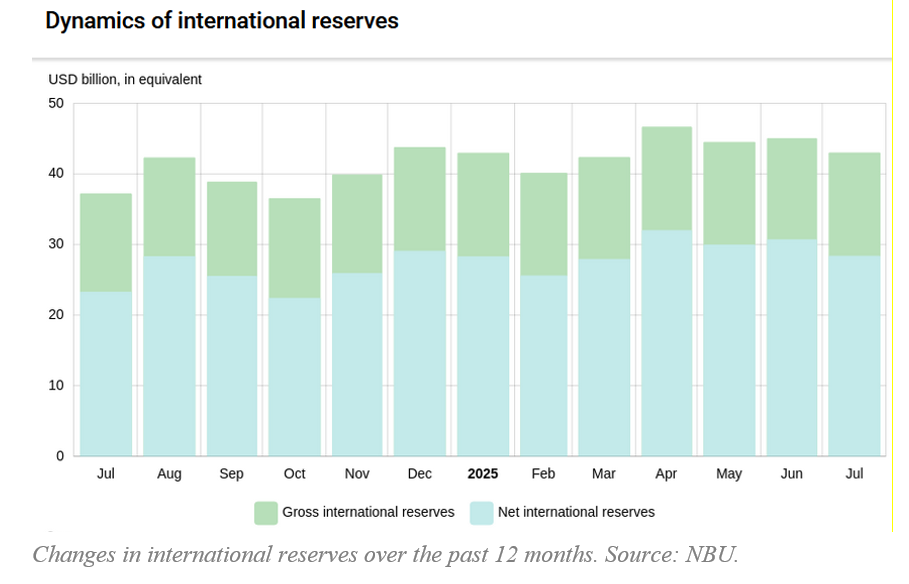
In July 2025, international reserves decreased from USD 45.1 billion to USD 43.0 billion.
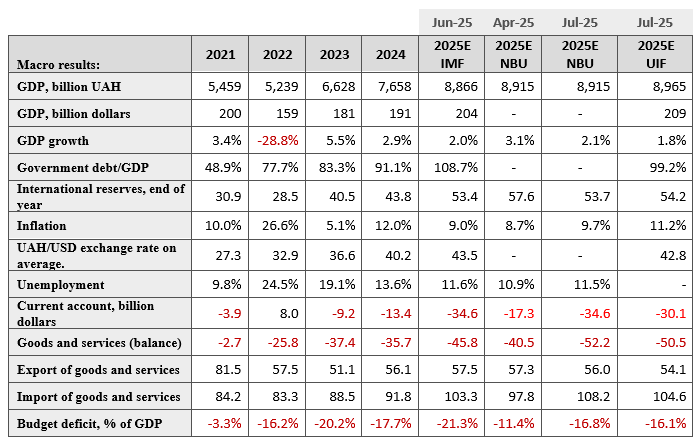
The NBU downgraded its forecast for Ukraine’s economic growth both in 2025, from 3.1% to 2.1% of GDP, and in 2026 and 2027.
In Q2 2025, according to NBU estimates, growth remained subdued (1.1% y/y), primarily due to a deterioration in the security situation both on the front line and in frontline regions as well as in the rear, along with further losses of production capacity, infrastructure, and housing.ssary to ensure a sustainable reduction of inflation to the 5% target within the policy horizon.
At the same time, the NBU left the nominal GDP for 2025 unchanged at UAH 8,915 billion, increasing the GDP deflator from 12.9% to 14.0%.
Consumer prices in July 2025 decreased by 0.2% compared to June 2025, and increased by 14.1% compared to July 2024. Core inflation in July 2025 was 0.3% compared to June 2025, and 11.7% compared to July 2024.
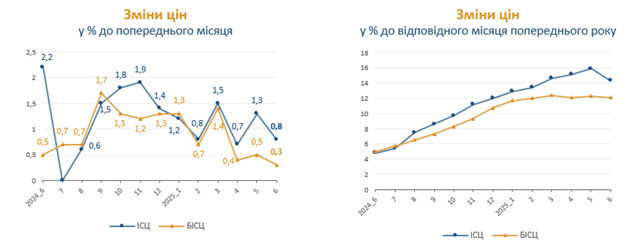
Changes in prices over the last 12 months. Source: Ukrstat.
Change in prices
(in % to the previous month)
2024 July August September October November December 2025 January February March April May June July
-o- CPI -A- Core CPI
Change in prices
(in % to the previous year)
-o- CPI -A- Core CPI
In the consumer market in July, prices for food and non-alcoholic beverages fell by 1.1%. The largest decrease was recorded for vegetables, down 23.9%, and sugar, down 2.8%. At the same time, prices increased by between 0.3% and 1.7% for fruits, eggs, pasta, meat and meat products, non-alcoholic beverages, lard, bread, fish and fish products, cheese, rice, grain mill products, sunflower oil, milk, and dairy products.
Prices for alcoholic beverages and tobacco products rose by 1.8%, driven by a 2.6% increase in tobacco prices.
Clothing and footwear became 4.6% cheaper, including a 5.2% drop in clothing prices and a 4.0% drop in footwear prices.
Transport prices rose by 1.6%, mainly due to a 4.1% increase in the cost of fuel and lubricants.
On July 24, the Board of the National Bank decided to keep the key policy rate at 15.5%. This will support the stability of the foreign exchange market and keep inflation expectations under control, which will contribute to a further easing of price pressures. The NBU will maintain sufficiently tight monetary conditions for as long as necessary to ensure a sustainable reduction of inflation to the 5% target within the policy horizon.
Taking into account these positive effects, the break in the inflation trend in June, and the controlled inflation expectations, the NBU sees no need for additional steps to raise the key rate. However, given the slower-than-expected decline in inflation and the balance of risks to price dynamics, the NBU currently sees no room for easing monetary policy either.
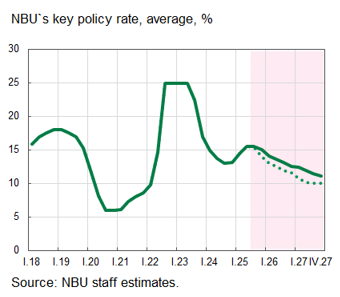
The updated NBU forecast already provides for a longer maintenance of the key policy rate at 15.5% (until Q4 2025) and for a slower rate cut compared to the April forecast.
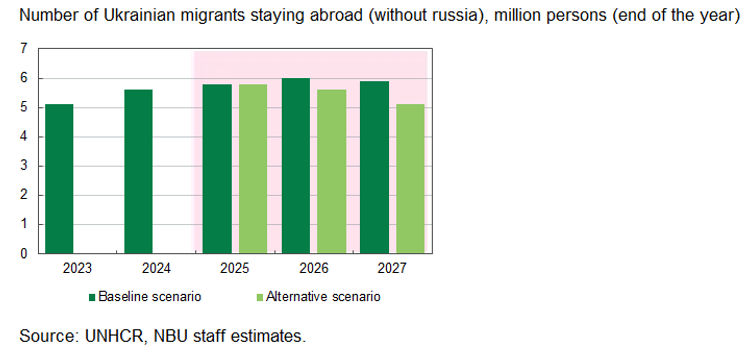
The NBU expects the number of migrants to increase in 2025–2026, primarily due to security factors, by about 200,000 people per year. In 2027, the NBU expects 100,000 Ukrainians to return.
According to the Center for Economic Strategy, in 2024, the share of those considering returning to Ukraine fell significantly from 52.5% to 43%.
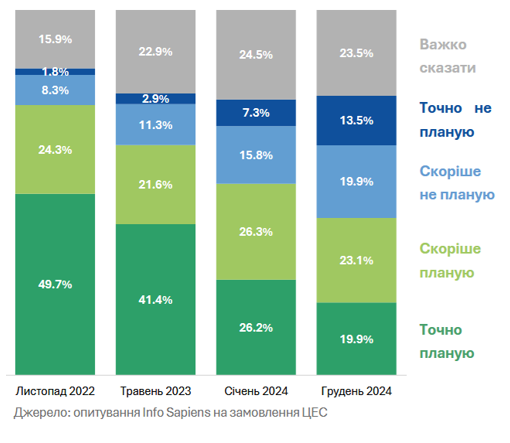
Figure translation
November 2022
May 2023
January 2024
December 2024
Hard to say
Definitely not planning to return
Likely not to return
Likely to return
Definitely plan to return
Source: Info Sapiens survey commissioned by the Center for Economic Strategy (CES).
Compared to adults, the share of children who want to return to Ukraine is smaller: 13% definitely and 18% likely. The most willing to return are children aged 6–10 years and those attending Ukrainian schools. However, the trend shows that each additional year of war results in a 10% decrease in the share of those planning to return.
The consolidated budget for the first half of 2025 closed with a deficit of UAH 510.6 billion compared to UAH 565.7 billion in the first half of 2024. At the same time, consolidated budget revenues were already UAH 575.5 billion higher than a year earlier, while expenditures were UAH 521.0 billion higher than in the same period last year.
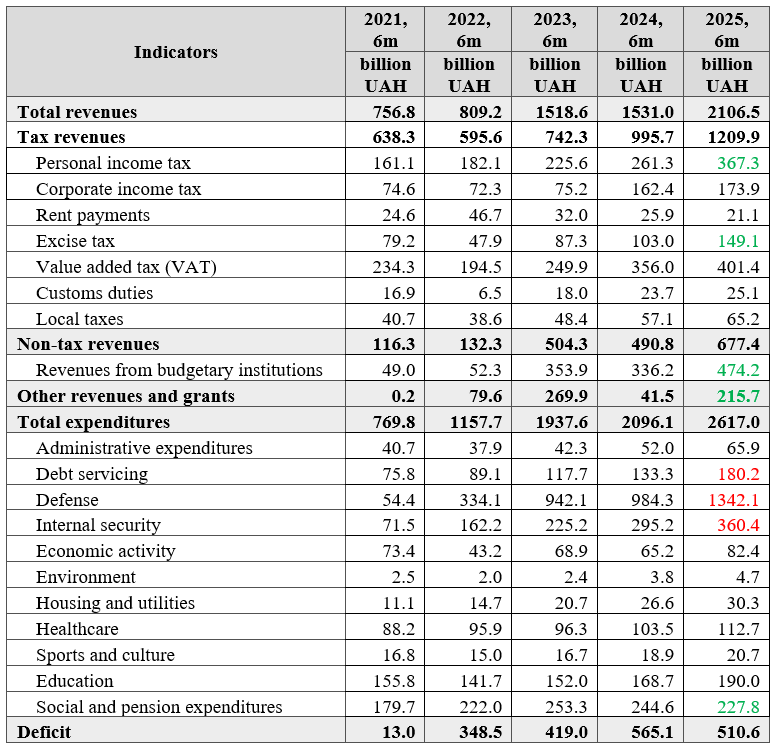
Consolidated Budget for the First Half of 2021–2025. Source: Ministry of Finance.
Tax revenues in 2025 were UAH 214.2 billion higher than in the first half of 2024, primarily due to the increase in the military levy and excise taxes.
In the first half of 2025, grants received amounted to UAH 174.2 billion more than in 2024. Military aid has also been provided more effectively than last year.
The state budget deficit for the first half of 2025 amounted to UAH 550 billion, while local budgets posted a surplus of UAH 39.6 billion.
In July 2025, Ukraine received EUR 1 billion in external financing from the EU under the ERA program (from proceeds on frozen Russian assets).
Ukraine also received about $500 million from the IMF.
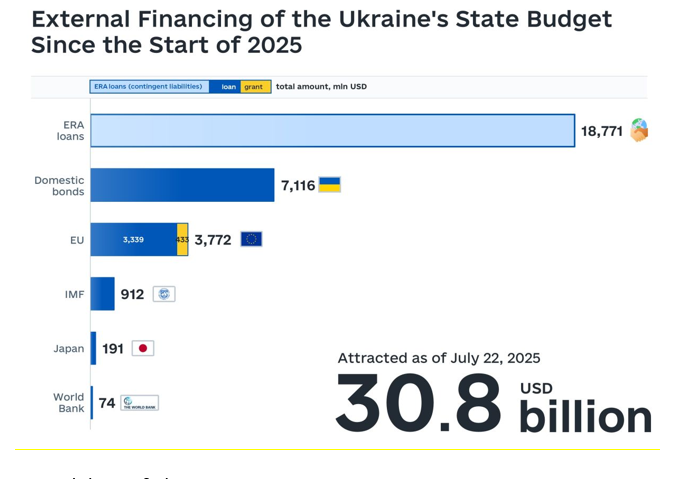
Source: Ministry of Finance
The NBU estimates total external financing this year at USD 54 billion — USD 22 billion in the first half and USD 32 billion in the second half of the year.
As of July 1, 2025, balances on the accounts of the state and local budgets amounted to UAH 369.5 billion, sufficient to finance two months of state budget expenditures without external assistance.
As of July 1, 2025, Ukraine’s public and publicly guaranteed debt amounted to USD 184.84 billion (+USD 3.87 billion in June 2025).
The increase was mainly due to EU financing for Ukraine and the revaluation of euro-denominated debt against the US dollar (from 1.14 to 1.18 EUR/USD in June).
In the first half of the year, Ukraine’s public and publicly guaranteed debt rose by USD 18.78 billion, from USD 166.06 billion to USD 184.84 billion.
On July 31, 2025, the Verkhovna Rada adopted a bill amending the state budget for 2025 to increase military spending. The bill provides for an additional UAH 412 billion in funding for security and defense sector agencies by the end of the year.
In the first half of 2025, we continue to observe a deterioration in Ukraine’s trade balance. The trade deficit for the first half of 2025 reached a new record of USD -24.5 billion. This was driven primarily by an increase in goods imports, which rose by USD 6.3 billion during the period. We also note a significant drop in services exports, down by more than 10% in the first half of 2025 compared to 2024.
The situation with remittances from labor migrants to Ukraine has also worsened, falling by USD 700 million in the first half of 2025. As a result, the negative current account balance for the first half of 2025 reached USD 14.9 billion.
On the financial account, there was a sharp decline in foreign direct investment in Ukraine. Less than USD 1 billion of FDI was received in the first half of 2025, which is USD 2.1 billion lower than in the same period of 2024.
On the positive side, there was a decrease in household demand for foreign currency in Q2 2025. Overall, in the first half of 2025, the population purchased USD 2.5 billion less foreign currency than in the first half of 2024. Another positive factor is the return of trade credits that were withdrawn from Ukraine in 2022 — USD 2 billion worth of trade credits were repaid in the first half of 2025.
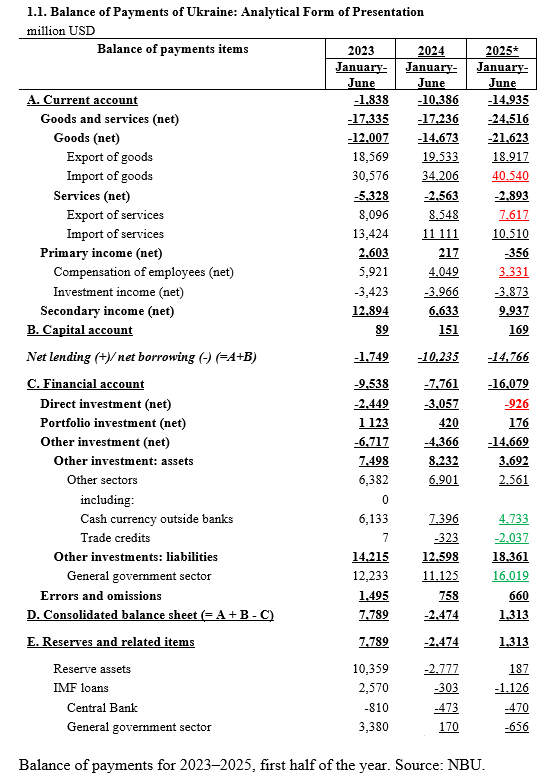
In addition, apart from IMF financing, the state budget received USD 16 billion in loans, primarily from the EU.
Overall, it should be noted that the current account is deteriorating rapidly and requires increasing levels of financing, which is the main conclusion for the first half of the year.
The NBU has significantly worsened its 2025 trade balance forecast to USD -52.2 billion, which is 25% of GDP. The NBU increased its forecast for goods and services imports from USD 97.8 billion to USD 108.2 billion (+USD 10.4 billion).
The NBU revised its current account balance forecast down to USD -34.6 billion. However, this deficit is expected to be offset by the financial account (+USD 43 billion).
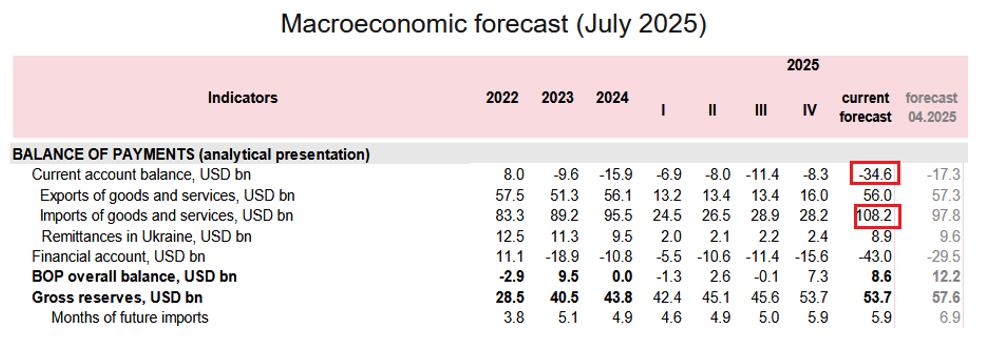
Source: NBU Inflation Report, 31.07.2025
Amid annual inflation exceeding forecasts, the NBU continues to contain inflation by curbing devaluation pressures. For the past eight months, the NBU has maintained the USD/UAH exchange rate in the range of 41.5–42.0. At the same time, the devaluation of the national currency in the euro-dollar pair has been driven by the weakening of the US dollar against the euro.
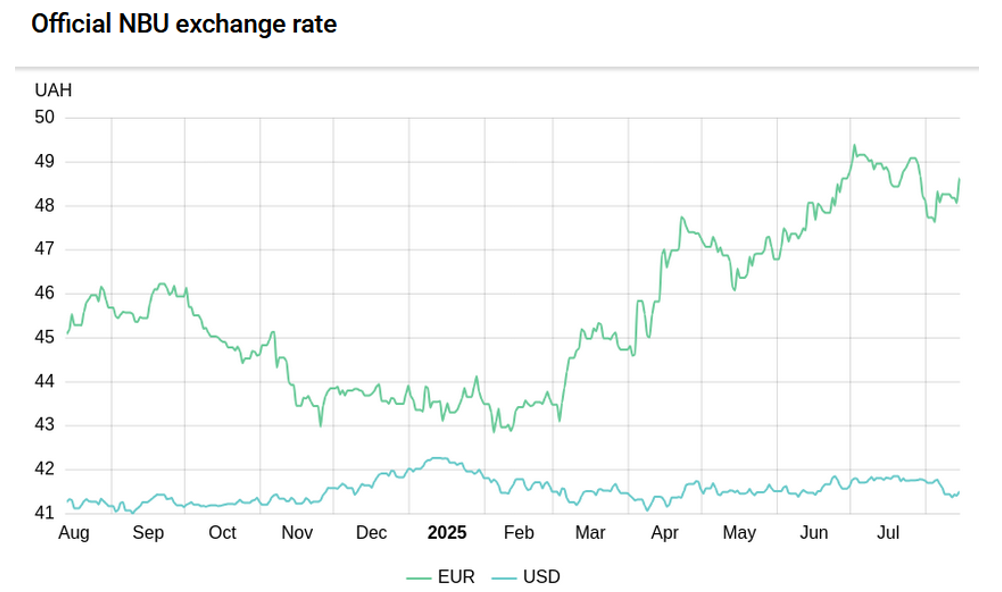
Hryvnia exchange rate to the US dollar and the euro over the past 12 months. Source: NBU.
Following the conclusion of a tariff agreement between the EU and the US at the end of July, the US dollar began to strengthen against the euro. This could prompt a shift in the NBU’s behavior on the foreign exchange market.
The growing trade deficit, which the NBU forecasts will reach 25%, may force the NBU to devalue the hryvnia against the US dollar if the dollar continues to strengthen against the euro. However, we believe that in August the NBU will continue to maintain the USD/UAH exchange rate, thereby minimizing inflation, which remains above 14% year-on-year.
International reserves decreased from USD 45.1 billion to USD 43.0 billion in July 2025.
According to balance sheet data, the National Bank sold USD 3,457.3 million on the foreign exchange market and purchased USD 0.3 million into reserves. Thus, the NBU’s net foreign currency sales in July amounted to USD 3,457.0 million.
In July, USD 2,122.1 million was credited to the government’s foreign currency accounts at the National Bank, including:
For servicing and repayment of public debt in foreign currency, USD 793.0 million was paid, including:
In addition, Ukraine paid USD 2.6 million to the International Monetary Fund.
The current volume of international reserves covers 4.7 months of future imports.
September 11 – NBU’s Board meeting on monetary policy
September 14 – Government’s 2026 budget presentation


Together we can change the future! Your support allows us to continue our research and provide objective analysis of key social issues. Join us today to build the future of our generations together.
Support