Digests • 18 July 2025
On June 25, the Government of Ukraine approved amendments to the 2025 state budget. Security expenditures increased by UAH 412 billion. The revenue side of the budget was raised by UAH 147.5 billion.
On June 27, the Government of Ukraine approved the Budget Declaration for 2026–2028. The declaration was prepared after extensive consultations in cooperation with the International Monetary Fund. It outlines two development scenarios for Ukraine beginning in 2026.
On June 30, the Executive Board of the International Monetary Fund (IMF) completed the eighth review under the Extended Fund Facility (EFF) program for Ukraine. As a result of the successful review, on July 1, Ukraine received the ninth tranche of the EFF program, amounting to approximately USD 500 million.
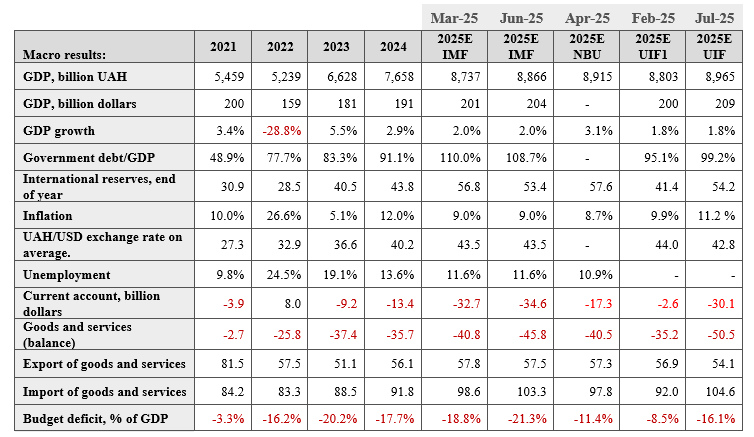
On July 8, the Ukrainian Institute for the Future updated its forecast for the remainder of 2025. Instead of two scenarios—one of which had assumed the war would end by Q3 2025—only one scenario now remains: the war continuing through the end of the year. Details on the revised assumptions and new forecast figures are presented in this digest. International reserves increased from USD 44.5 billion to USD 45.1 billion in June 2025
On June 30, the Executive Board of the International Monetary Fund (IMF) completed the eighth review under the Extended Fund Facility (EFF) program for Ukraine. Following the successful review, on July 1, Ukraine received the ninth tranche of approximately USD 500 million.
In its statement, the IMF noted the following:
“The growth outlook for 2025 remains at 2–3 percent, as lower electricity shortages are offset by reduced gas production and weaker agricultural exports. War-related pressures will require an additional budget for 2025, and the medium-term fiscal trajectory has been revised to better reflect the authorities’ revenue mobilization plans and spending priorities. The National Bank of Ukraine (NBU) has maintained a tight monetary policy in response to still-elevated inflation, while inflation expectations remain anchored. Foreign exchange reserves remain adequate, supported by continued substantial external financing. Overall, uncertainty remains exceptionally high.
Russia’s ongoing war continues to inflict devastating social and economic consequences on Ukraine. However, macroeconomic stability has been preserved thanks to significant external support. The economy remains resilient, though the war weighs heavily on the outlook due to labor market strains and damage to energy infrastructure. Risks to the outlook are exceptionally high, making contingency planning essential for a timely policy response should risks materialize.
The continued war required the adoption of an additional budget for 2025. Restoring fiscal sustainability and funding elevated priority spending over the medium term will require sustained, determined efforts to implement the National Revenue Strategy. This includes modernization of the tax and customs administrations (including the timely appointment of a customs head), reducing tax evasion, and aligning legislation with EU standards. These reforms, together with improvements in public investment management, medium-term budgeting, and fiscal risk management, are critical to supporting growth and investment.
The authorities continue to work on finalizing their debt restructuring strategy in line with program objectives for debt sustainability. This is vital to free up resources for priority spending, reduce fiscal risks, and restore debt sustainability. Given the still-high inflation, a tight monetary policy is appropriate, and the NBU should be prepared to tighten further if inflation expectations deteriorate. Greater exchange rate flexibility will help bolster economic resilience while preserving reserves.”
Changes and assumptions in the UIF Forecast
In February, the Ukrainian Institute for the Future (UIF) released a 2025 forecast that included two scenarios. One assumed a frozen conflict beginning in the second half of 2025 as a result of diplomatic efforts by U.S. President Trump; the second assumed the war would continue through the end of the year. Given the collapse of the peace process, only one scenario is now used in the updated forecast: continued war through the end of 2025.
One of the key assumptions in UIF’s February forecast was the amount of grant funding Ukraine would receive in 2025. At that time, UIF assumed that financing under the ERA program would be received as grants—this was based on the USD 1 billion ERA grant from the U.S. in December 2024 and the NBU’s revised forecast, which categorized ERA funding as grants.
It is now evident that the ERA program financing comes in various forms. For example:
In the IMF’s 8th Review, total ERA program financing for 2025 was estimated at USD 35.9 billion. UIF now assumes that USD 26.9 billion will come in the form of loans and USD 9 billion as grants.
In addition, under the Ukraine Facility program, Ukraine is receiving some grants. UIF estimates these at USD 1.6 billion, in line with the initial Ministry of Finance plan. As a result, UIF has revised its 2025 assumption for total grant support upward to USD 10.6 billion.
The overall estimate for Western financial assistance in 2025—grants plus loans—was also revised. While in February it was projected at USD 39 billion, the IMF’s 8th Review increased the estimate to USD 54 billion. This significantly affected UIF’s updated projections for the budget and balance of payments.
At the end of June, the Government of Ukraine approved an increase in 2025 security spending by UAH 412 billion and outlined the sources of its financing. Although UIF believes the Ministry of Finance does not need to expand domestic borrowing—given excess ERA funding and projected year-end balances of USD 17 billion (according to IMF estimates)—the forecast now also accounts for an increase in domestic borrowing by UAH 180 billion by the end of 2025.
Western military assistance for the first five months of 2025, despite challenges in U.S. arms deliveries, significantly exceeded 2024 levels. According to UIF’s estimates, it amounted to UAH 350–360 billion. If this trend continues, annual military assistance could substantially surpass last year’s. However, UIF assumes that the West may view late 2025 as a potential endpoint to the war, and military aid may slow in the final months of the year. The revised assumption for total Western military aid in 2025 is UAH 700 billion.
The technical default on GDP-linked warrants in late May 2025, along with the Ministry of Finance’s efforts to restructure its obligations, is expected to reduce debt servicing costs this year. Both the Ministry of Finance and the IMF have already lowered their 2025 debt servicing forecasts by more than UAH 50 billion. UIF’s original February forecast already projected lower debt servicing costs, and this has been further revised downward due to the non-payment of GDP-linked warrants.
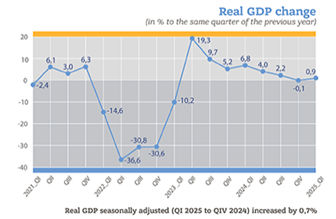
On June 30, the State Statistics Service of Ukraine (Ukrstat) published a preliminary estimate of GDP for Q1 2025. Real GDP increased by 0.7% compared to the previous quarter (seasonally adjusted), and by 0.9% compared to Q1 2024.
Source: Ukrstat.
The IMF maintained its 2025 GDP growth forecast for Ukraine at 2–3%. However, it revised the GDP deflator upward from 12.0% to 13.5%.
The Ukrainian Institute for the Future maintained its real GDP growth forecast for 2025 at +1.8%. Despite persistent challenges in the real sector of the economy, UIF considers military production to remain a key driver supporting economic growth.
Consumer inflation in June 2025 was 0.8% compared to May 2025, and 14.3% compared to June 2024.
Core inflation in June 2025 was 0.3% month-on-month and 12.1% year-on-year.
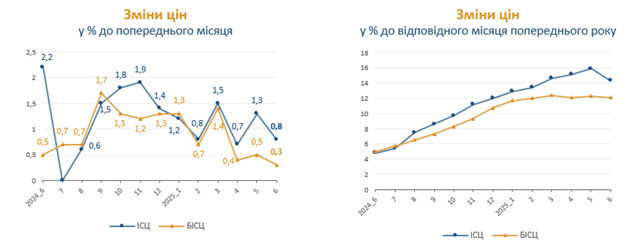
Price changes over the last 12 months. Source: Ukrstat.
Figure translation
Change in prices
(in % to the previous month)
-o- CPI -A- Core CPI
Change in prices
(in % to the previous year)
-o- CPI -A- Core CPI
In June, prices for food and non-alcoholic beverages on the consumer market rose by 1.4%. The largest increase was for fruits, which jumped by 13.5%. Prices also rose by 0.2–3.3% for meat and meat products, non-alcoholic beverages, fish and seafood, lard, bread, fermented dairy products, butter, and sugar. At the same time, vegetable prices declined by 8.1%, and prices for eggs, pasta, milk, and rice fell by 0.4–1.1%.
Prices for alcoholic beverages and tobacco rose by 1.1%, driven mainly by a 1.8% increase in tobacco product prices.
Clothing and footwear prices decreased by 2.2%, with clothing down 2.3% and footwear down 2.1%.
According to the IMF, consumer inflation is expected to reach 9.0% in 2025.
UIF revised its inflation forecast for 2025 upward, from 9.9% to 11.2%.
The consolidated budget for the first five months of 2025 recorded a deficit of UAH 401.7 billion, compared to a deficit of UAH 419.7 billion during the same period in 2024. Revenues were UAH 488.7 billion higher than a year earlier, while expenditures increased by UAH 470.7 billion.
The state budget deficit for January–May 2025 amounted to UAH 444.8 billion. Meanwhile, local budgets recorded a surplus of UAH 43.1 billion.
In June 2025, Ukraine received USD 3.9 billion in external financing under the ERA program (funded by proceeds from frozen Russian assets).
An additional USD 190 million was received under the DRIVE infrastructure recovery project, implemented jointly with the World Bank and supported by the Government of Japan.
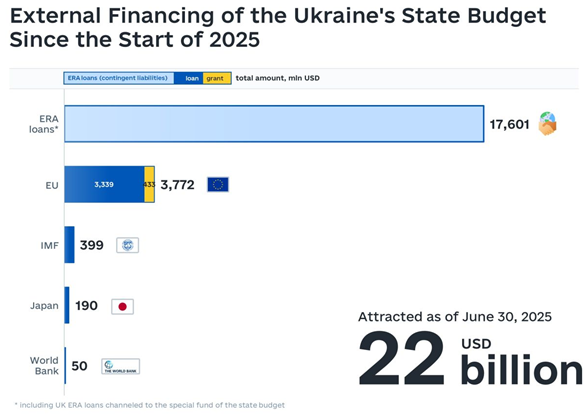
Source: Ministry of Finance
As of June 1, 2025, balances on state and local budget accounts totaled UAH 382 billion (more than USD 9 billion).
The IMF has updated its financing forecast for Ukraine for 2025-2026.
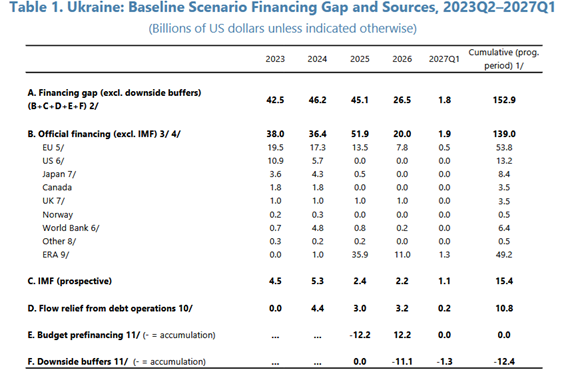
Source: IMF, June 30, 2025
ERA funding for 2025 was revised down from USD 39.4 billion to USD 35.9 billion, while projected ERA funding for 2026 was revised up to USD 11 billion. This suggests that USD 12.2 billion in unspent funds will be carried over into 2026, bringing total available external financing next year to over USD 34 billion.
As of June 1, 2025, Ukraine’s state and state-guaranteed debt totaled USD 180.97 billion, an increase of USD 1 billion from May 2025.
The IMF revised its year-end 2025 debt forecast to UAH 9,633 billion, or 108.7% of GDP. However, this forecast assumed Ukraine would receive UAH 69 billion in grants in 2025. In reality, Ukraine had already received UAH 214 billion in grants by mid-year.
UIF’s updated debt forecast is more optimistic: UAH 8,895 billion or 99.2% of GDP.
On June 25, the Government of Ukraine approved a draft law to amend the 2025 state budget, primarily to increase defense and security spending. The proposed amendments include:
The total volume of additional expenditures proposed in the amended 2025 state budget is UAH 448.8 billion.
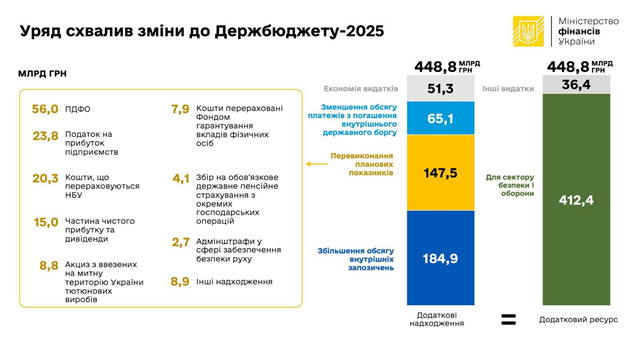
Source: Ministry of Finance of Ukraine.
Figure translation
Figure translation
The Government Approved Changes to the 2025 State Budget
Ministry of Finance of Ukraine
Billion UAH
56.0 — Personal income tax
23.8 — Corporate income tax
20.3 — Funds transferred by the National Bank of Ukraine
15.0 — Portion of net profit and dividends
8.8 — Excise tax on tobacco products imported into Ukraine
7.9 — Funds transferred by the Deposit Guarantee Fund
4.1 — Mandatory state pension insurance fee from certain business transactions
2.7 — Administrative traffic safety fines
8.9 — Other revenues
UAH 448.8 billion
184.9 — Increase in domestic borrowings
147.5 — Overperformance of planned indicators
65.1 — Reduction in domestic debt repayment obligations
51.3 — Other revenues
UAH 448.8 billion
412.4 — For the security and defense sector
36.4 — Other expenditures
UIF considers this increase in expenditures appropriate if the war continues through the end of 2025. However, the fact that the Government already adopted these amendments in June implies its own expectations that the war will indeed continue until year-end.
Most of the proposed adjustments to revenue projections have either already been achieved or are likely to be realized by the end of the year, according to UIF. However, UIF views the decision to issue more domestic government bonds (OVDPs) as questionable, particularly in a year when the West is providing USD 54 billion in support.
According to IMF calculations, the Government is projected to have over USD 17 billion in account balances at year-end. Relying on OVDP issuance will raise domestic debt servicing costs in 2026 by an additional UAH 30–35 billion. These costs will increasingly burden the state budget. The most rational approach, according to UIF, would be to fully utilize ERA funds and negotiate further support from Europe or other donors if the war continues into 2026.
On June 27, the Government of Ukraine approved the Budget Declaration for 2026–2028.
The declaration was developed in close cooperation with key budget holders and the International Monetary Fund. Its provisions are based on Ukraine’s strategic development objectives.
The 2026–2028 Budget Declaration forms the basis for preparing the 2026 State Budget. It includes general revenue and financing targets, spending ceilings, the minimum wage, subsistence levels, and other national policy goals.
The declaration outlines two scenarios for Ukraine’s development starting in 2026. The first scenario assumes an improvement in the security situation beginning that year, based on the macroeconomic and social development forecast from the Ministry of Economy.
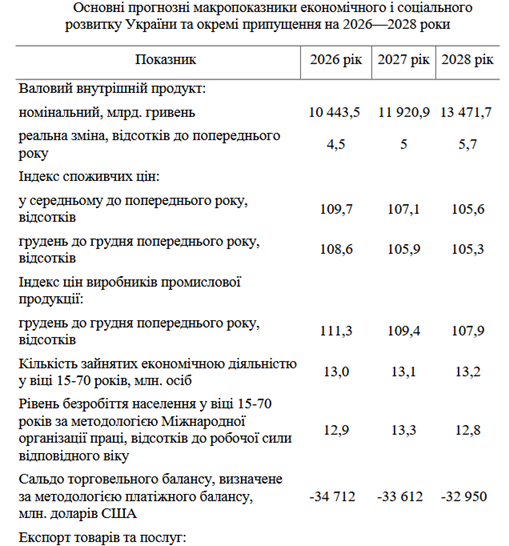
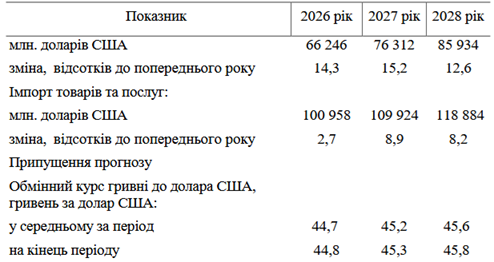
Source: Ministry of Economy.
Figure translation
Key projected macroeconomic and social development indicators of Ukraine and certain assumptions for 2026–2028
Indicator Y2026 Y2027 Y2028
Gross domestic product:
nominal, billion UAH
real change, percentage compared to the previous year
Consumer price index:
on average compared to the previous year, percent
December to December of the previous year, percent
Producer price index for industrial products:
December to December of the previous year, percent
Number of economically active population aged 15–70, million persons
Unemployment rate of the population aged 15–70 according to the International Labour Organization methodology, percentage of the labor force of the corresponding age
Trade balance, defined by the balance of payments methodology, million US dollars
Export of goods and services:
million US dollars
change, percentage compared to the previous year
Import of goods and services:
million US dollars
change, percentage compared to the previous year
Forecast assumptions
Exchange rate of the hryvnia to the US dollar, hryvnias per US dollar:
on average for the period
at the end of the period
It is worth noting that the 2026–2028 Budget Declaration does not propose changes to major tax rates (personal income tax, VAT, or corporate income tax). However, it does introduce new revenue sources, amounting to UAH 48.5 billion in 2026, primarily from the planned adoption of legislation to tax digital platforms.
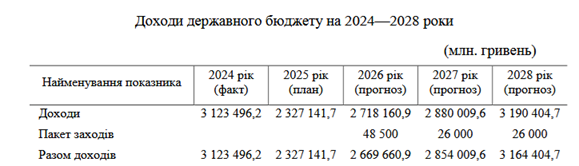
Figure translation
State budget revenues for 2024–2028 (in million UAH)
In 2024 (actual), revenues amounted to 3,123,496.2 million UAH.
In 2025 (planned), revenues are projected at 2,327,141.7 million UAH.
In 2026 (forecast), revenues are expected to reach 2,718,160.9 million UAH, with an additional 48,500 million UAH from the measures package, bringing total revenues to 2,669,660.9 million UAH.
In 2027 (forecast), revenues are projected at 2,880,009.6 million UAH, with an additional 26,000 million UAH from the measures package, resulting in total revenues of 2,854,009.6 million UAH.
In 2028 (forecast), revenues are expected at 3,190,404.7 million UAH, with 26,000 million UAH included from the measures package, bringing total revenues to 3,164,404.7 million UAH.
In the baseline scenario (which assumes the war ends in late 2025), the budget deficit in 2026 is forecast at 9.9% of GDP. The declaration projects a reduction in the deficit to 5.2% in 2027 and 3.8% in 2028.
The Ministry of Finance has not provided detailed calculations for the second scenario (which assumes the war continues into 2026), but it has indicated a revenue reserve of UAH 153 billion—likely referring to a potential 5% wartime levy. This scenario also assumes that security expenditures will remain at or above 2025 levels.
In its 8th Review, the IMF updated its forecast for Ukraine’s consolidated budget in 2025. Key revisions include the incorporation of the amendments to the state budget approved by the Government on June 25, 2025, as well as a significant upward revision in projected revenues from the Unified Social Contribution (USC).
The IMF now forecasts the 2025 budget deficit at 21.3% of GDP, assuming grant receipts of UAH 69 billion (approximately 0.8% of GDP).
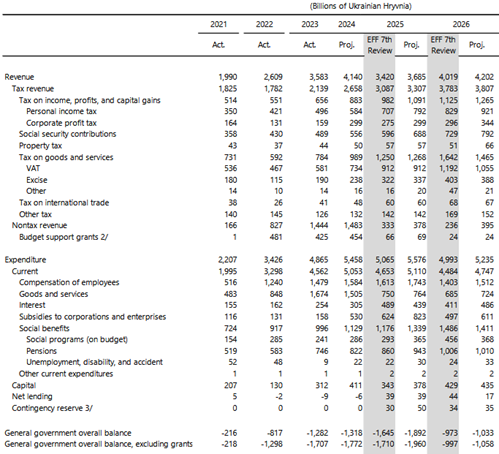
Consolidated budget of Ukraine. Source IMF 30.06.2025.
The updated forecast from the Ukrainian Institute for the Future (UIF) is based on revised assumptions and updated revenue and expenditure dynamics for 2025.
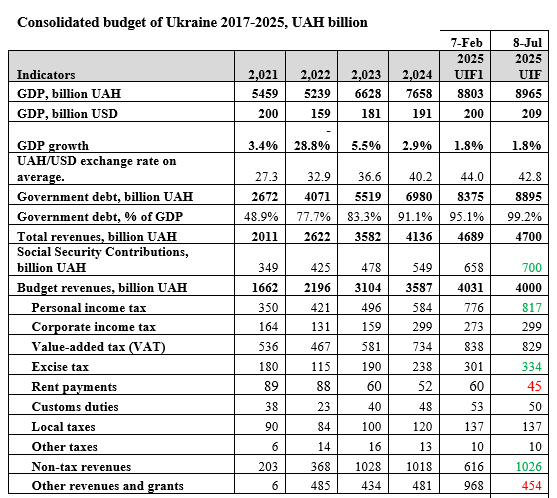
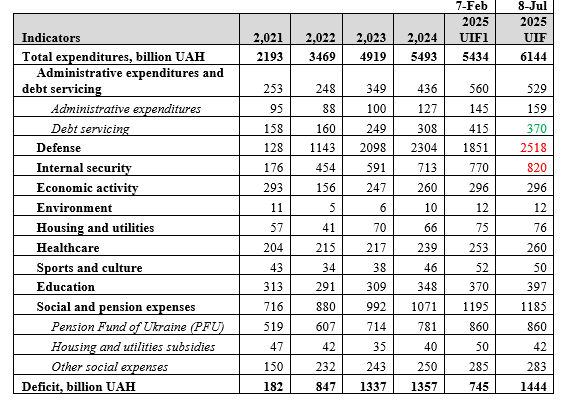
Source: Actual data for 2021–2024 from the Ministry of Finance. Forecast and calculations by UIF.
UIF has revised the revenue forecast for PIT, excise, and SSC upward. PIT revenue is projected to increase by 40% year-over-year, driven by an 18.4% rise in nominal wages (May to May) and the expansion of the military levy. SSC revenue is up due to a 27% year-over-year expansion in the tax base. Excise revenue has grown by 45% over the first five months, largely due to higher excise rates on fuel and tobacco, the switch to euro-denominated taxation, and the increase in the EUR-to-USD and EUR-to-UAH exchange rates from 40 to 49–50 UAH per euro.
There are significant risks to meeting the VAT target. The current forecast falls UAH 80 billion short of the Ministry of Finance’s and the IMF’s estimates. However, VAT collections remain in line with 2024 levels as a share of GDP. Rent payments are also likely to fall short of planned levels.
Expenditures on internal security are projected to be substantially higher than those forecast by the Ministry of Finance, along with a notable increase in administrative spending in 2025. Revisions to defense spending and non-tax revenues reflect the impact of Western military assistance and the state budget amendments adopted on June 25, 2025.
The projected 2025 budget deficit stands at 16.1% of GDP—well below the IMF’s estimate of 21.3%— primarily due to a higher volume of grant support already received in the first half of the year and further inflows expected in the second half.
In total, UIF projects budget revenues in 2025 at 52.4% of GDP and expenditures at 68.5% of GDP— both lower than the levels observed in 2023 and 2024.
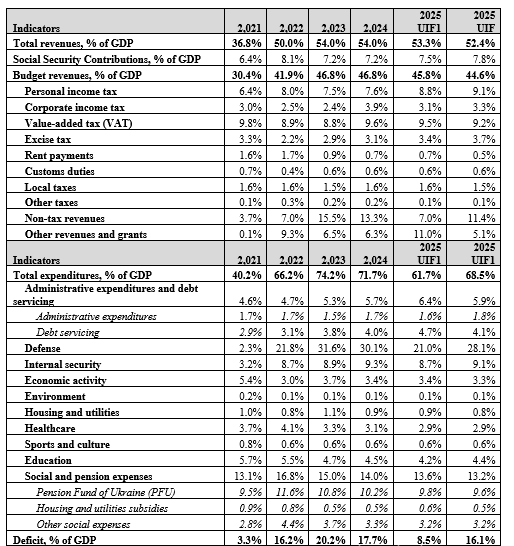
Source: Actual data for 2021–2024 from the Ministry of Finance. Forecast and calculations by UIF.
In May 2025, a further deterioration in Ukraine’s trade balance was observed. The trade balance in goods for the first five months of the year is already USD 5.6 billion worse compared to the same period in 2024 (–USD 19.438 billion in 2025 versus –USD 13.793 billion in 2024). Although exports of goods in May 2025 exceeded the figures from May 2024, imports continued to rise at a rapid pace. Exports of services for the first five months of 2025 were already USD 780 million below the corresponding figures for 2024.
A sharp decline in foreign direct investment was also recorded. In May, the National Bank of Ukraine registered zero foreign investment inflows. In total, foreign investment for the first five months of 2025 fell from USD 2,691 million to USD 792 million.
Among the positive developments, a continued decline in household foreign currency purchases was noted. The downward trend observed in April persisted into May. According to the NBU, net household purchases of foreign currency in May amounted to USD 404 million. Cumulatively over five months, household purchases totaled USD 4.282 billion, compared to USD 6.161 billion during the same period in 2024.
Overall, the balance of payments in May remained negative due to insufficient external financing.
The IMF revised its balance of payments forecast for 2025 as part of the eighth review.
The following changes were made:
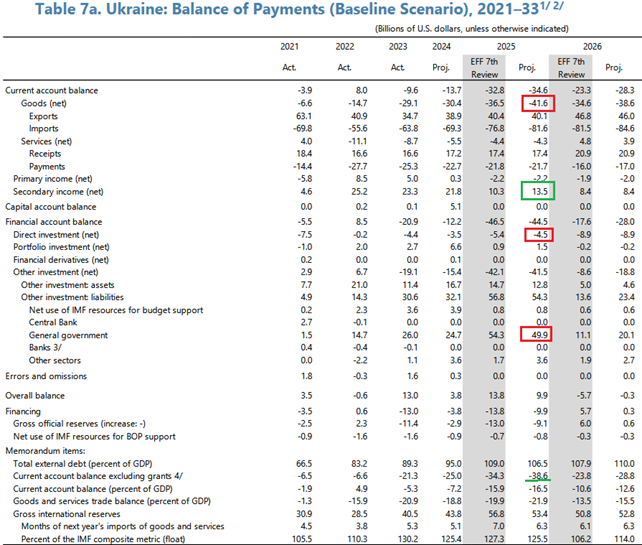
Source: IMF, June 30, 2025
The Ukrainian Institute for the Future revised its balance of payments forecast for 2025.
The following key adjustments were made:
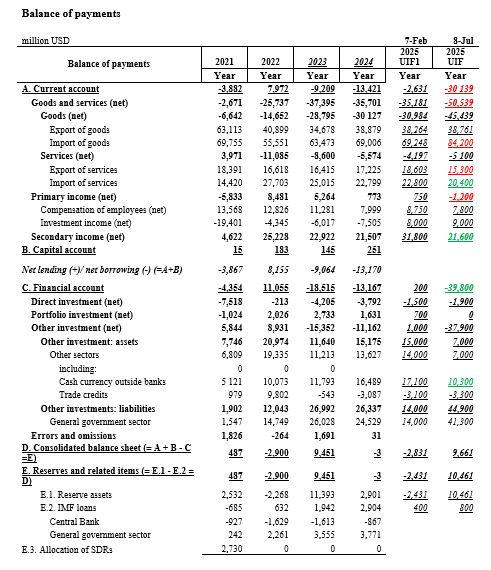
Source: NBU, UIF forecast and calculations
Amid annual inflation reaching 15.9%, the National Bank of Ukraine continues to contain inflation by limiting devaluation pressures. However, with the euro-to-dollar exchange rate rising to 1.17–1.18, the NBU is holding the UAH-to-dollar rate stable at approximately UAH 41.5 per USD.
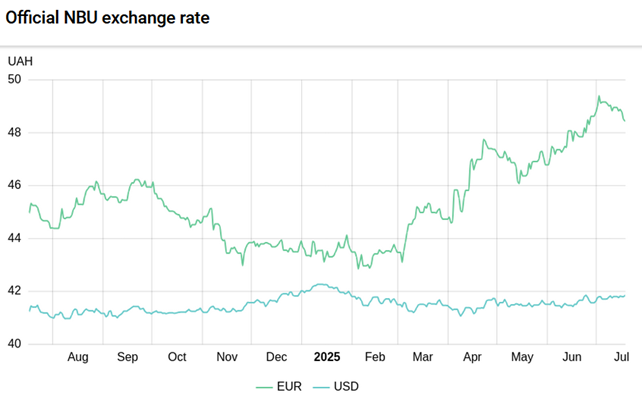
UAH exchange rate against the US dollar and the euro for 12 months. Source: NBU.
While UIF previously projected that the NBU might adopt a more flexible exchange rate policy in July due to growing trade imbalances, the continued appreciation of the euro against the dollar suggests that currency stabilization will remain the preferred approach for managing inflation in the near term.
The average exchange rate forecast for 2025 was revised to UAH 42.8 per USD, with the year-end rate expected at UAH 44.0 per USD.
International reserves increased from USD 44.5 billion to USD 45.1 billion in June 2025.
According to balance sheet data, the National Bank of Ukraine sold USD 2,956.3 million on the foreign exchange market and purchased USD 1.3 million for reserves, resulting in net foreign exchange sales of USD 2,955.0 million in June.
A total of USD 4,087.3 million was received into government foreign currency accounts at the NBU in June under the G7 Extraordinary Revenue Acceleration for Ukraine (ERA) initiative, including:
Payments for external government debt servicing and repayment in June amounted to USD 524.0 million, including:
An additional USD 426.2 million was paid to the IMF.
Current international reserves cover 5.6 months of future imports.
The updated forecast for Ukraine’s international reserves at year-end 2025 is:
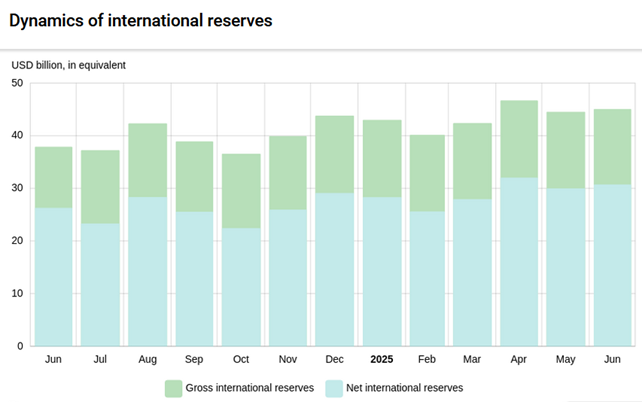
Change in international reserves over the past 12 months. Source: NBU.


Together we can change the future! Your support allows us to continue our research and provide objective analysis of key social issues. Join us today to build the future of our generations together.
Support